ANS-256 AMSAT News Service Weekly Bulletins

AMSAT News Service

ANS-256
September 13, 2026

In this edition:

* Frank Hoonhaut, KJ7DZ, Sweeps AMSAT Award Ladder
* AMSAT Youth Initiative Adds “Satellite and Astronomy” Course
* ISAR Launches 2 Ham Band Satellites
* The Addictive World of Amateur Radio Satellites – An OARC Member Talk
* World Radio Broadcast & “Send Your Name into Space” Campaign
* Changes to AMSAT TLE Distribution for September 4, 2026
* Global ARISS Contact Window- Submit Your Proposals and Applications
* ARISS News
* AMSAT Ambassador Activities
* Satellite Shorts from All Over

The AMSAT® News Service bulletins are a free, weekly news and information service of AMSAT, The Radio Amateur Satellite Corporation. ANS publishes news related to Amateur Radio in Space including reports on the activities of a worldwide group of Amateur Radio operators who share an active interest in designing, building, launching and communicating through analog and digital Amateur Radio satellites.

The news feed on https://www.amsat.org publishes news of Amateur Radio in Space as soon as our volunteers can post it.

Please send any amateur satellite news or reports to: ans-editor [at] amsat.org

You can sign up for free e-mail delivery of the AMSAT News Service Bulletins via the ANS List; to join this list see: https://mailman.amsat.org/postorius/lists/ans.amsat.org/


Frank Hoonhout, KJ7DZ, Sweeps the AMSAT Awards Ladder

Some operators apply for an award. Frank Hoonhout, KJ7DZ, applied for the whole shelf. Bruce Paige, KK5DO, AMSAT Director of Contests and Awards, has announced that Frank, having decided to apply for “a few” AMSAT awards, has been awarded five of them at once: the Satellite Communicators’ Club Award, Oscar Satellite Communication Achievement Award #660, Oscar Satellite Sexagesimal Award #205, Oscar Satellite Century Award #64, and South Africa AMSAT Satellite Communication Achievement Award #US262.

Taken together, that is the complete AMSAT operating awards ladder in a single submission. The Satellite Communicators Club recognizes an operator’s first satellite QSO. From there, the Communication Achievement, Sexagesimal, and Century Awards recognize confirmed satellite contacts with stations in 20, 60, and 100 different U.S. states, Canadian call areas, or DXCC entities, respectively; the awards aggregate, so each rung’s contacts count toward the next, and all contacts must be made from locations within 25 miles (40 kilometers) of one another. The South Africa Satellite Communication Achievement Award, meanwhile, recognizes contacts with 25 unique stations via satellite. The serial numbers tell the story of just how steep the ladder gets near the top: 660 operators have claimed the 20-entity award, but Frank is only the 64th ever to reach 100.

Frank is no stranger to the awards desk. He earned GridMaster Award #66 in 2024 for confirming satellite contacts with all 488 grid squares in the contiguous United States, and satellite rovers know him for the “grids needed by the top grid chasers” map he compiled to help activators target the squares that matter most.

Operators looking to start climbing the ladder themselves will find complete rules for all of AMSAT’s operating awards at https://www.amsat.org/awards/.

Congratulations, Frank!

[ANS thanks Bruce Paige, KK5DO, AMSAT Director of Contests and Awards, for the above information.]


AMSAT Youth Initiative Adds “Satellites and Astronomy” Course

The AMSAT Youth Initiative has added its fifth online course, Satellites and Astronomy, to the Satellites in Space Help Us Live a Better Life on Earth series. The new course is now available at www.BuzzSat.com.
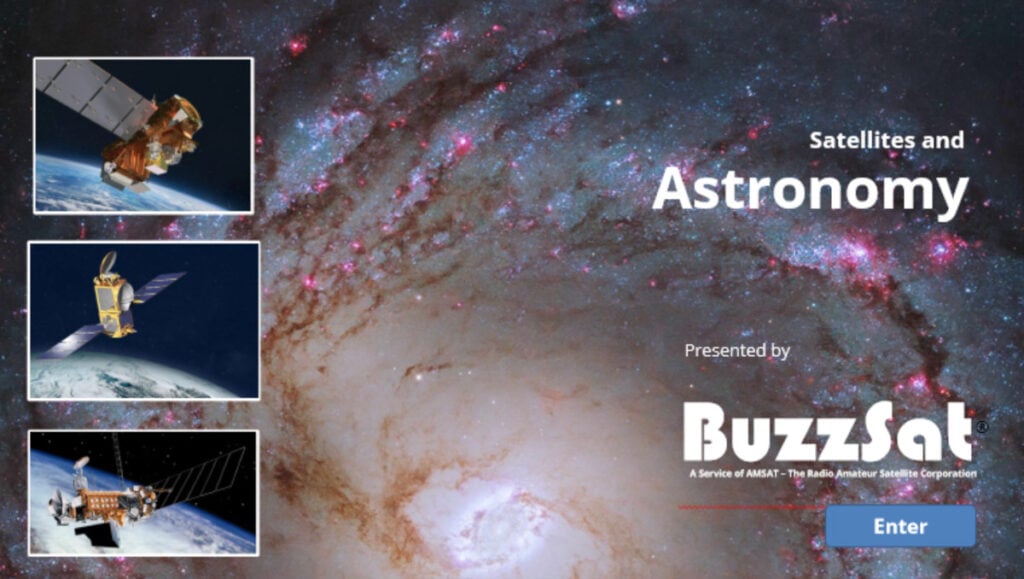
Satellites and Astronomy [Credit: NASA]

The course curriculum is broken down into three main sections:

  • Part One: An introduction to the formation of the universe and the properties of its heavenly bodies, providing a necessary starting point for understanding what satellites measure.

  • Part Two: A review of Earth-orbiting satellites used to investigate planets in our solar system and objects in interstellar space.

  • Part Three: An exploration of space-faring satellites that look beyond our solar system and galaxy to the edges of the universe.

Two additional chapters are also under consideration to familiarize learners with satellites that study the Moon and Mars.

Course Authors and Team Expansion

This new curriculum was written by AMSAT member Eric Sonnenwald, N2XS, a Montclair State University M.S. graduate in Geosciences and former Science Curriculum Coordinator for Hardyston Middle School. Eric has authored the complete existing library of courses, which includes:

  • Satellite Meteorology

  • Satellites and Climate Change

  • Satellites and Pollution Control

  • Satellites and Natural Resources

Eric is currently finishing a course on Satellites and Fighting Wildfires and has begun work on two additional courses: Satellites and Communications and Satellites and Navigation.

At the same time, Vidya Gopalakrishnan, K4VGK, has joined the Youth Initiative as a fellow course writer and editor. Vidya helped edit the newly added course and is beginning work on her first courses, Introduction to Satellites and Amateur Radio SatellitesCommunications and Telemetry.

Inspiring Future STEM Careers

Designed for junior high and high school students, these survey courses aim to interest youth in STEM subjects and careers in aerospace and engineering. ANS readers are encouraged to try out any of the courses at www.BuzzSat.com.

[ANS thanks Frank Karnauskas, N1UW, AMSAT VP of Development, for the above information.]


ISAR Launches 2 Ham Band Satellites

Isar Aerospace became the first commercial space company from Europe to successfully deliver satellites into orbit on its second flight. Mission ‘Onward and Upward’ lifted off from Isar Aerospace’s dedicated launch complex at Andøya Space in Norway at 20:12 UTC on Saturday, Sept. 5, deploying payloads in orbit. The payload included  two CubeSats coordinated by the International Amateur Radio Union (IARU).

The mission Onward and Upward proved Isar Aerospace’s orbital launch capability. In parallel, the company has advanced its global network of available launch sites and is nearing completion of Europe’s largest integrated production facility for launch vehicles. In addition to the above developments, Isar Aerospace is constructing a launch complex in Nova Scotia, Canada, covering mid- to high-inclination orbits critical for Earth observation and communications.

The launch vehicles used to transport these satellites are developed, manufactured, and tested almost entirely in-house. Headquartered near Munich, Germany, Isar Aerospace was founded in 2018 and has grown to over 400 employees, working across five international locations. Spectrum launch vehicles 3-7 are already in production.

The mission’s payloads were selected through the Microlauncher Competition of the German Space Agency at DLR, which provides educational institutions and start-ups with low-cost access to space. The Microlauncher Competition is funded through the European Space Agency (ESA) Boost! program. The two amateur radio projects chosen were SpaceTeamSat1 and FramSat-1.

SpaceTeamSat1:  SpaceTeam is a project of the Technical University of Wien, Austria, (TU Wien) that aims to get undergraduate students interested in space technologies, RF and amateur radio.  This satellite is a 1U CubeSat equipped with a range of sensors connected to a Raspberry Pi. The processor  runs code written by participating students. Young amateurs and students accompanied by an amateur operator will be able to – in coordination with TU Wien – upload and schedule their code themselves. There are also plans to open timeslots where the CubeSat acts as a data relay for amateur operators. A downlink on 437.395 MHz has multiple modes available from CW to up to 115200 baud using 2GFSK.

FramSat-1: Orbit NTNU is a project of the Norwegian University of Science and Technology at Trondheim, Norway. It is Norway’s largest student-led technical organization, and has been successful with a number of high-altitude balloon and sub-orbital launches, as well as SelfieSat, a 2U cubesat launched in 2022. FramSat-1 is a student-built 1U CubeSat engineered to develop certain satellite subsystems in-house and a functioning satellite bus capable of supporting a sun sensor payload. A downlink 435.141 MHz has been coordinated for 9600 bps AX.25 G3RUH FSK telemetry.

Both satellites are in sun-synchronous orbits of approximately 500 km altitude.

[ANS thanks Isar, IARU, SpaceTeam, and Orbit NTNU for the above information.]


Give Your Next Rove a Payload — Put Your Lunch into Orbit!

Pack the rover dogs and hit the grid line with an all-new
AMSAT Round Logo Metal Lunchbox.
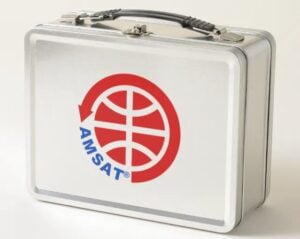
Keep Amateur Radio in Space — and your lunch in the box!

https://www.zazzle.com/amsat_round_logo_metal_lunchbox-256761530568368967


The Addictive World of Amateur Radio Satellites – An OARC Member Talk

The Online Amateur Radio Community (OARC) has published the video recording of a recent member talk exploring amateur satellite operations. Titled Chasing Birds: The Addictive World of Amateur Radio Satellites and presented by John Stringer, M5JFS, the presentation is now available to watch on YouTube.

Drawing on six years of operating experience, Stringer’s presentation provides a comprehensive entry point for operators interested in working amateur satellites. The talk traces his progression from using modest, readily available equipment to developing a more advanced station, offering a practical roadmap for newcomers.

Key topics covered in the presentation include:

  • Getting Started: Practical advice on utilizing basic equipment without requiring high-end initial investments.

  • Satellite Landscape: An overview of the various types of amateur satellites currently in orbit.

  • Station Requirements: Guidance on the essential gear needed to successfully access space-based transponders.

  • Operating Etiquette: Best practices for maintaining discipline, clarity, and courtesy during high-demand passes.

  • Software and Networks: Useful digital tools, tracking software, and social networks designed to support satellite operators.

  • Milestones: Notable achievements and experiences from Stringer’s six years on the birds.

In tandem with the video release, OARC highlights its ongoing community infrastructure for satellite enthusiasts. The organization maintains dedicated channels on its Discord server for general satellite discussions, weather satellite discussions, and specific regional or transponder projects such as QO-100.

Operators looking to engage with the community or explore further resources can access the following links:

[ANS thanks OARC and AMSAT-UK for the above information.]


World Amateur Radio Broadcasting & “Send Your Name into Space” Campaign

Amateur Radio Broadcasting Event

From September 11 to 20, 2026, amateur radio digital broadcasts of postcards will be conducted almost worldwide from the Geoscan-2, Geoscan-4, and Geoscan-5 satellites using Geoscan’s own protocol.

These postcards feature the upcoming Ioffe-1 satellite. It is scheduled to launch in the winter of 2026–2027. Ioffe-1 is a scientific and educational nanosatellite. It is built by specialists from Geoscan and the ANO “Space Education Development.” The project operates within the Space-π framework. It is backed by the Foundation for Assistance to Small Innovative Enterprises (FASIE). The satellite’s payload includes a high-resolution camera. It also carries a scintillation gamma-ray detector developed jointly with the Ioffe Institute.

Amateur radio enthusiasts can independently receive and decode images from the CubeSats. To do this, follow the instructions here.  Postcard transmissions will continue until September 20, 2026. Stations within the SONICS open network will decode postcards automatically. These images are gathered directly in the portal’s gallery section. As a reminder, Geoscan’s QSL program for radio amateurs remains active. For more information, see https://spacepi.space/news/vsemirnaya-radiolyubitelskaya-translyacziya/.

Observers can submit a report on the spot a satellite feature at the bottom of the AMSAT Status page.

 Name Submission Deadline

The Send Your Name into Space campaign for the Ioffe-1 is active. Participants have until October 15, 2026, to register online. Submissions can include a name, photograph, or drawing. All materials will be saved on a physical digital storage device and will be loaded onto the Ioffe-1 satellite. Once in orbit the nanosatellite will join the Supernova Hunters constellation.

This campaign builds on previous successes—such as the 2025 campaign where 7,887 names and over 3,500 images from 117 countries were uploaded. Sixty-seven top entries were selected for regular transmission from the 239Alferov satellite. For the current campaign, Mission Control Center specialists will select the 100 best hand-drawn works. These will be broadcast to Earth via amateur radio after launch. For more information, see https://spacepi.space/news/stante-chastyu-kosmicheskoj-missii-akcziya-otprav-svoyo-imya-v-kosmos-prodolzhaetsya/

[ANS thanks Spacepi for the above information.]


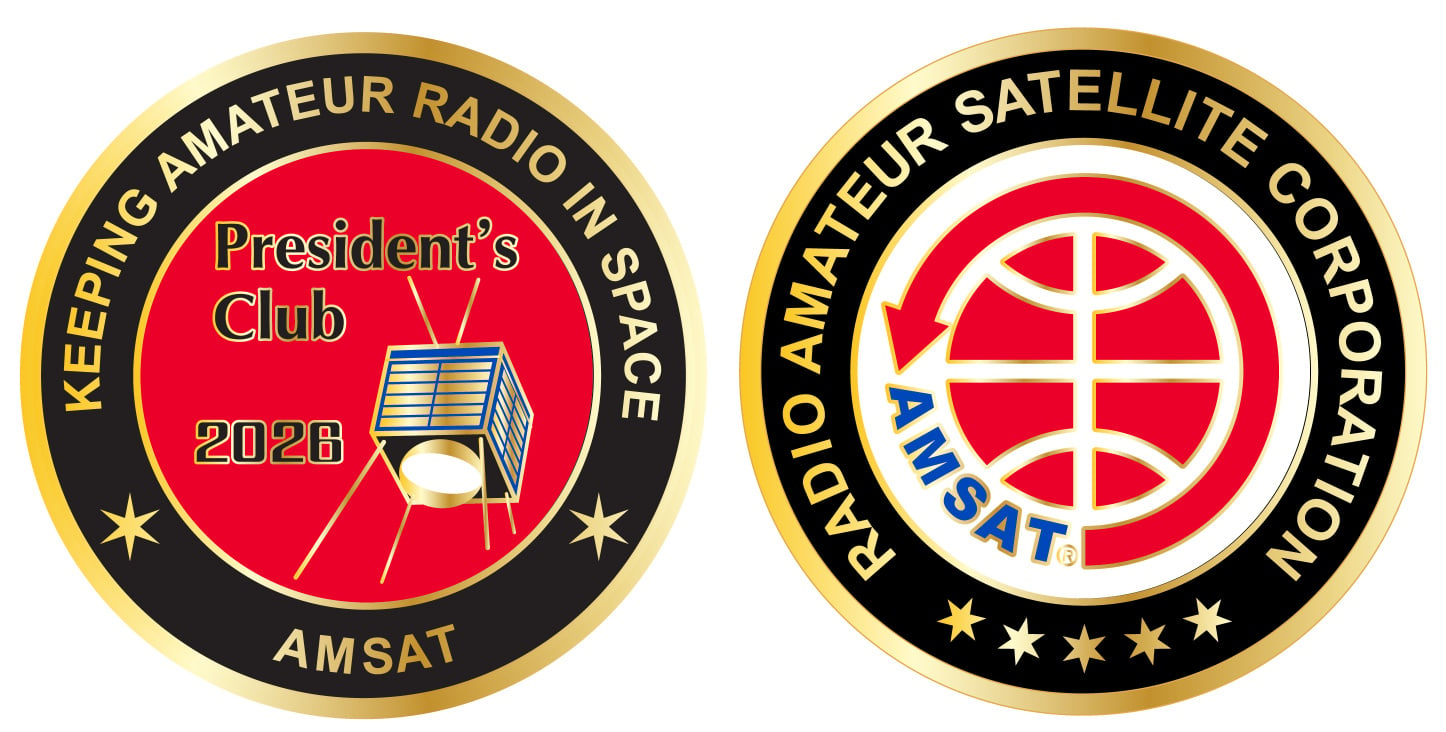
The 2026 Coins Are Here! Help Support GOLF-TEE and Fox-Plus.
Annual memberships start at only $120.
Presidents' Club 2026 Coin

Join the AMSAT President’s Club today and help Keep Amateur Radio in Space!
https://www.amsat.org/join-the-amsat-presidents-club/


Changes to AMSAT TLE Distribution for September 11, 2026

Two Line Elements or TLEs, often referred to as Keplerian elements or keps in the amateur community, are the inputs to the SGP4 standard mathematical model of spacecraft orbits used by most amateur tracking programs. Weekly updates are completely adequate for most amateur satellites. TLE bulletin files are updated daily in the first hour of the UTC day. New bulletin files will be posted immediately after reliable elements become available for new amateur satellites. More information may be found at https://www.amsat.org/keplerian-elements-resources/.

Bulletin format elements for all satellites of interest to radio amateurs.  This file is updated at least every 24 hours.

Bare elements are derived from the bulletin, but contain no header or footer.  These data are used as input to the AMSAT Pass Predictions page.

This week there are no additions or deletions to the AMSAT TLE distribution.

General Perturbations Data Support

AMSAT is pleased to announce that modern forms of what are called General Perturbations data are being disseminated via modern formats including JSON, XML and KVN at https://newark192.amsat.org/gpdata/current/. The reason this change is being made is that we are running out of 5-digit catalog numbers and the TLE format is not viable for satellites launched after July of this year. See https://celestrak.org/NORAD/documentation/gp-data-formats.php for details.

These data are presently considered in beta test for the next two months while hosted on the test server newark192.amsat.org, and we are very open to community feedback at webmaster [at] amsat.org. Testers may experience outages and errors while we make improvements. We intend to put this into production on our main web server in July as we expect that satellites launched after this summer will require one of the new formats to accommodate longer object numbers. AMSAT will continue to publish TLE bulletins for satellites launched before July 2026 indefinitely.

[ANS thanks Joe Fitzgerald, KM1P, AMSAT Orbital Elements Manager, for the above information.]


Global ARISS Contact Windows: Submit Your Proposals and Applications

ARISS Contact Proposals (U.S. only)
 The proposal window opened on July 1, 2026, and closes on September 30, 2026,  for contacts to be held from January to June 2027.To find more information and proposal instructions, visit this website: https://www.ariss.org/hosting-an-ariss-contact-in-the-us.htmlARISS Contact Applications (Europe, Africa and the Middle East)
Schools and Youth organizations in Europe, Africa and the Middle East interested in setting up an ARISS radio contact with an astronaut on board the International Space Station are invited to submit an application from September to October and from February to April.
Please refer to details and the application form at https://www.ariss-eu.org/index.php/school-contacts.ARISS Contact Applications (Canada, Central and South America, Asia and Australia and Russia)
Organizations outside the United States can apply for an ARISS contact by filling out an application.  Please direct questions to the appropriate regional representative listed below. If your country is not specifically listed, send your questions to the nearest ARISS Region listed. If you are unsure which address to use, please send your question to the ARISS-Canada representative; they will forward your question to the appropriate coordinator.For the application, click here.

  • ARISS-Japan, Asia, Pacific and Australia: Shizuo  Endo, JE1MUI,   Japan Amateur Radio League (JARL)
  • ARISS-Russia: Soyuz Radioljubitelei Rossii (SRR)

[ ANS thanks ARISS.org for the above information.]


ARISS News

Amateurs and others around the world may listen in on contacts between amateur radio operators at schools and astronauts and cosmonauts aboard the International Space Station. The downlink frequency on which to listen is 145.800 MHz worldwide.

Scheduled Contacts

+ Recently Completed

No ARISS educational contacts were completed during the last week.

+ Upcoming Contacts

MAOU School No. 200, Belogorsk, Russia — direct via TBD
The ISS callsign is presently scheduled to be RSØISS
The scheduled crewmembers are Anna Kikina and Andrey Fedyaev
The ARISS mentor is RV3DR
Contact is go for Tue 2026-09-22 08:15 UTC

Many times, a school makes a last-minute decision to do a Livestream or runs into a last-minute glitch requiring a change of the URL, but ARISS may not get the URL in time for publication. You can always check https://live.ariss.org/ to see if a school is Livestreaming.

As always, if there is an EVA, a docking, or an undocking, the ARISS radios are turned off as part of the safety protocol.

+ Schedule of ISS radio power downs and power ups
Friday 2026-09-18 15:20 UTC Columbus module radio power down
Friday 2026-09-18 15:25 UTC Service module radio power down
Saturday 2026-09-19 13:46:39 UTC Progress 96P docking

Saturday 2026-09-19 19:05 UTC Columbus module radio power up
Saturday 2026-09-19 19:10 UTC Service module radio power up
Progress Cargo Resupply: Postponed
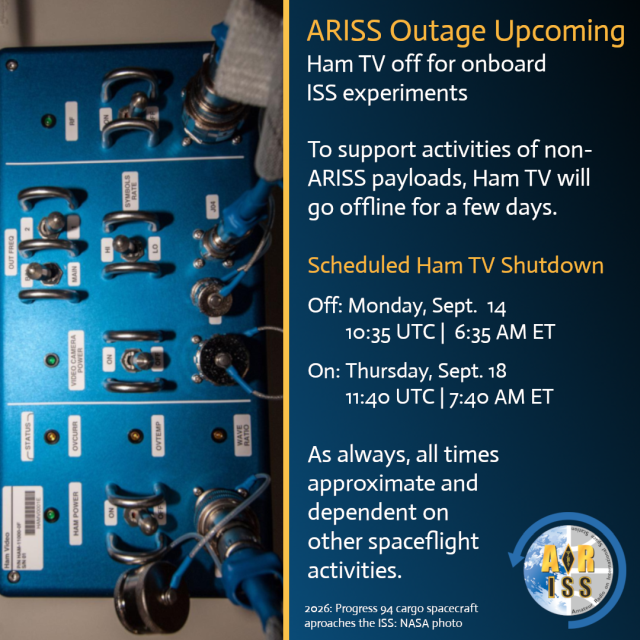
ISS HAM TV Outage [Credit: ARISS.org]

The crossband repeater remains configured in the Columbus Module (145.990 MHz up {PL 67} & 437.800 MHz down). If a crewmember decides to pick up the microphone and turn up the volume, you may hear the crew member on the air—so keep listening, as you never know when activity might occur.

Kenwood D710GA in the Zvezda Service Module – Callsign RSØISS. Please note we’re still in the process of troubleshooting and testing this radio. APRS is currently active on 437.825 MHz. Feel free to check out status reports at https://ariss-usa.org/ARISS_APRS/.

​HamTV in the Columbus Module (2395.00 MHz) is currently transmitting a test signal. For more information, visit the ARISS Ham TV Live site at https://live.ariss.org/hamtv/.

Note that all times are approximate. It is recommended that you do your own orbital prediction or start listening about 10 minutes before the listed time.

The latest information on the operation mode can be found at https://www.ariss.org/current-status-of-iss-stations.html

The latest list of frequencies in use can be found at https://www.ariss.org/contact-the-iss.html

[ANS thanks Charlie Sufana, AJ9N, one of the ARISS operation team mentors for the above information.]


AMSAT Ambassador Activities

AMSAT Ambassadors provide presentations, demonstrate communicating through amateur satellites, and host information tables at club meetings, hamfests, conventions, maker fairs, and other events.

AMSAT Ambassador Clint Bradford, K6LCS, says,

“Think a 75-minute presentation on ‘working the easy satellites’ would be appropriate for your club or event? Let me know by emailing me at k6lcsclint [at] gmail [dot] com or calling me at 909-999-SATS (7287)!”

Clint has NEVER given the exact same show twice: EACH of the 150+ presentations so far has been customized to its audiences.

Scheduled Events

Greater Louisville Hamfest – September 12, 2026
Paroquet Springs Conference Centre
395 Paroquet Springs Drive
Shepherdsville, KY 40165-6007
https://louisvillehamfest.wixsite.com/louisvillehamfest
W4FCL

Bored Net µExpo and ARRL Santa Barbara Section Convention – October 3, 2026
Cal State University Channel Islands
1 University Drive
Camarillo, CA 93010
https://www.theborednet.net/index.php/2026/06/22/2026-microexpo-is-on/
K6KH

Tucson Area Autumn Hamfest – October 3, 2026
Radio Society of Tucson
Immanuel Presbyterian Church
9252 East 22nd Street
Tucson, AZ
https://k7rst.club
N1UW

44th AMSAT Space Symposium and Annual Membership Meeting – October 8 –11, 2026
Wyndham Jacksonville Hotel and Conference Center
14670 Duval Road
Jacksonville, FL 32218
https://www.amsat.org/2026-amsat-symposium/

Southern Arizona Fall Hamfest – November 14, 2026
Oro Valley Amateur Radio Club
Marana Middle School
11285 W. Grier Rd.
Marana AZ
www.tucsonhamradio.org/hamfest
N1UW

For more information go to: https://www.amsat.org/ambassador/

[ANS thanks Bo Lowrey, W4FCL, Director – AMSAT Ambassador Program, for the above information.]


Buying from Ham Radio Outlet?
Add AMSAT’s Getting Started With Amateur Satellites to your order.
Available for $29.95 from HRO (free shipping on most orders over $100)
https://www.hamradio.com/detail.cfm?pid=H0-019238


Satellite Shorts from All Over

+ NASA’s Parker Solar Probe successfully checked in following its 29th perihelion, transmitting a normal system beacon tone on September 7, 2026. During the close approach on September 4, the spacecraft matched its record-breaking performance, sweeping within 3.8 million miles of the solar surface at a top speed of 430,000 miles per hour. Operating autonomously during the intense nine-day encounter window, the probe trained its cameras on structures near the Sun’s north pole and sampled nearly 40% of the solar circumference while diving deep into the corona. Detailed telemetry transmission begins September 11, with science data downlinks running from September 13 through September 27. Recently extended into 2029 by the Heliophysics Senior Review, the mission continues to capture vital insights into solar wind and space weather as the Sun transitions toward the declining phase of its solar cycle. [ANS thanks NASA for the above information.]

+ Astronomers at MIT and international institutions discovered a brand-new type of astrophysical object in the early universe known as a black hole star, using NASA’s James Webb Space Telescope (JWST). Designated MoM-BH*-1 and existing just a few hundred million years after the Big Bang, the object resembles a solar-system-sized star but shines 100 billion times brighter than any known star, producing an energy output typically associated with a black hole. Simulations indicate the object consists of a central black hole roughly 100,000 times the mass of the Sun enshrouded by an extremely dense, dust-free cocoon of hydrogen gas, mimicking a stellar appearance through its gaseous pseudo-photosphere rather than being powered by nuclear fusion. Published in Nature, the discovery could solve the mystery of the enigmatic “little red dots” frequently captured in deep-space JWST imagery. [ANS thanks MIT News for the above information.]

+ In a recent study analyzing a sample of about 100 fast radio bursts (FRBs), a Caltech research team led by Kritti Sharma and Professor Vikram Ravi used the data to directly measure the impact of galactic feedback on the clumpiness of intergalactic matter. Because normal matter acts as a scaffolding for dark matter, mapping this distribution enhances experiments tackling major cosmic puzzles, including the nature of dark matter, dark energy, and the mass of ghostly neutrinos. As researchers note, using FRBs as a leading cosmic probe is only just beginning. [ANS thanks Space.com for the above information.]

+ The Indian Space Research Organisation (ISRO) successfully launched the advanced Earth observation satellite EOS-05 aboard the GSLV-F17 rocket on September 4, 2026. Blasting off from the second launch pad at the Satish Dhawan Space Centre in Sriharikota at 2:55 a.m., the 19th flight of the GSLV precisely placed the 2,367-kilogram satellite into its intended sub-geosynchronous transfer orbit about 18 minutes later. Marking India’s first imaging satellite designed to monitor the Earth from a geosynchronous orbit roughly 36,000 kilometers above the surface, the milestone mission represents the 107th launch from the Sriharikota spaceport. [ANS thanks The Hindu for the above information.]

+ The Republic of Djibouti will formally sign the Artemis Accords during an in-person ceremony at NASA Headquarters on Monday, September 14, 2026, at 11:00 a.m. EDT. NASA Deputy Administrator Matt Anderson will host Djibouti’s Ambassador to the U.S., Mohamed Siad Douale, alongside U.S. State Department Assistant Secretary for African Affairs Frank Garcia at the signing, making Djibouti the 72nd nation to join the framework. Established in 2020 by the U.S. and seven founding nations, the Artemis Accords set practical principles for safe, transparent, and cooperative civil space exploration on the Moon, Mars, and beyond. Media representatives wishing to cover the event in person must RSVP to [email protected] by 8:00 a.m. EDT on September 14. Further information and details on the accords are available on the NASA Artemis Accords page[ANS thanks SciTechDaily for the above information.]

+ Adding to the vast array of new tracking programs now available, Avinstar, LLC announces the general availability of OsTrax, a satellite tracking and operating platform for Windows, macOS and Ubuntu. For more information, please view the OsTrax web site at https://www.ostrax.com or contact Jim McCullers at [email protected]. [ANS thanks Jim McCullers, WA4CWI, for the above information.]


Join AMSAT today at https://launch.amsat.org/

In addition to regular membership, AMSAT offers membership to:

  • Societies (a recognized group, clubs or organization).
  • Students enrolled in at least half-time status are eligible for free membership to age 25.
  • Memberships are available for annual and lifetime terms.

Contact info [at] amsat.org for additional membership information.

73 and remember to help Keep Amateur Radio in Space!

This week’s ANS Editor,

Vidya Gopalakrishnan, K4VGK

ANS is a service of AMSAT, the Radio Amateur Satellite Corporation, 712 H Street NE, Suite 1653, Washington, DC 20002
AMSAT is a registered trademark of the Radio Amateur Satellite Corporation.
ANS-249 AMSAT News Service Weekly Bulletins

AMSAT News Service

ANS-249
September 6, 2026

In this edition:

* AMSAT Board Election Voting Deadline Approaches
* ARISS Announces New Leadership and Operations Appointments
* July/August 2026 Issue of The AMSAT Journal Now Available
* SatNOGS Rolls Out Major Network and Database Updates
* Updated VUCC & DXCC Satellite Standings for September 2026
* Sean Borgerson, KK7OVF, Earns AMSAT Sexagesimal Award
* Eric Olson, KH6WI, Earns AMSAT Rover Award #96
* Changes to AMSAT TLE Distribution for September 4, 2026
* ARISS News
* AMSAT Ambassador Activities
* Satellite Shorts from All Over

The AMSAT® News Service bulletins are a free, weekly news and information service of AMSAT, The Radio Amateur Satellite Corporation. ANS publishes news related to Amateur Radio in Space including reports on the activities of a worldwide group of Amateur Radio operators who share an active interest in designing, building, launching and communicating through analog and digital Amateur Radio satellites.

The news feed on https://www.amsat.org publishes news of Amateur Radio in Space as soon as our volunteers can post it.

Please send any amateur satellite news or reports to: ans-editor [at] amsat.org

You can sign up for free e-mail delivery of the AMSAT News Service Bulletins via the ANS List; to join this list see: https://mailman.amsat.org/postorius/lists/ans.amsat.org/


AMSAT Board Election Voting Deadline Approaches

Voting in the 2026 AMSAT Board of Directors Election will close on September 15, and AMSAT members who have not yet cast their ballots are encouraged to do so before the deadline. As of early September, fewer than 10% of eligible AMSAT members have voted in this year’s election.

Five candidates are seeking election to the Board:

  • Rich Gopstein, KD2CQ
  • Mark Hammond, N8MH
  • Bruce Paige, KK5DO
  • Paul Stoetzer, N8HM
  • Douglas Tabor, N6UA

Three seats on the AMSAT Board of Directors are being filled this year. The three candidates receiving the highest number of votes will be elected to the Board, while the candidates receiving the next highest vote totals will be named First Alternate and Second Alternate, respectively.

Current AMSAT members may review the official candidate statements and cast their ballots through the AMSAT 2026 Board of Directors Election website. Voting closes September 15, 2026, and election results will be announced no later than September 30.

https://launch.amsat.org/2026-BoD-Election

[ANS thanks Douglas Tabor, N6UA, AMSAT Secretary, for the above information]


ARISS Announces New Leadership and Operations Appointments

Amateur Radio on the International Space Station (ARISS) has announced several leadership and operational appointments aimed at strengthening the organization’s technical, educational, and administrative activities. Daryl Young, K4RGK, has been named ARISS-USA Director of Operations, while Ryan Krenzischek, Deborah Lebair, KC3YWM, and Megan Tucker, KQ4MAM, are taking on new or expanded roles within ARISS.

Young is a longtime ARISS-USA Technical Mentor who has supported numerous direct and telebridge amateur radio contacts between astronauts aboard the International Space Station and students on Earth. As Director of Operations, he will lead the ARISS Technical Mentors and oversee other operational activities associated with the organization’s STEM contacts.

Most recently, Young led the ARISS initiative that assembled a worldwide consortium of ground stations to track Artemis II during its journey around the Moon. The AREx Artemis ground station consortium successfully tracked the spacecraft and provided Doppler data to NASA during the mission. ARISS described the effort as an important first step toward expanding its operations beyond low Earth orbit and preparing for future amateur radio activities associated with lunar exploration.

Ryan Krenzischek, who previously served as ARISS-USA Director of Operations, has moved into the newly created position of Chief Information Officer. He and his team will oversee ARISS websites and other backend systems supporting the organization’s information infrastructure. Krenzischek has served as an ARISS-USA Technical Mentor since 2013 and has additional experience with the American Radio Relay League (ARRL), Navy-Marine Corps Military Auxiliary Radio System (MARS), and Army MARS.

Deborah Lebair, KC3YWM, currently the ARISS-USA Metrics Lead, will join the ARISS International Board as its secretary while continuing her metrics responsibilities. Lebair began her professional career as an aerospace engineer at NASA’s Goddard Space Flight Center before becoming a high school mathematics teacher. Megan Tucker, KQ4MAM, has been named ARISS-USA Logistics Manager and will coordinate the organization’s growing participation in educational conferences, hamfests, and other public events.

ARISS is an international cooperative effort involving amateur radio organizations and space agencies that uses amateur radio contacts with astronauts aboard the ISS to encourage student interest in science, technology, engineering, the arts, and mathematics. AMSAT is among the U.S. sponsors of the ARISS program. Additional information about ARISS and its educational activities is available at www.ariss.org.

[ANS thanks Dave Jordan, AA4KN, and ARISS for the above information.]


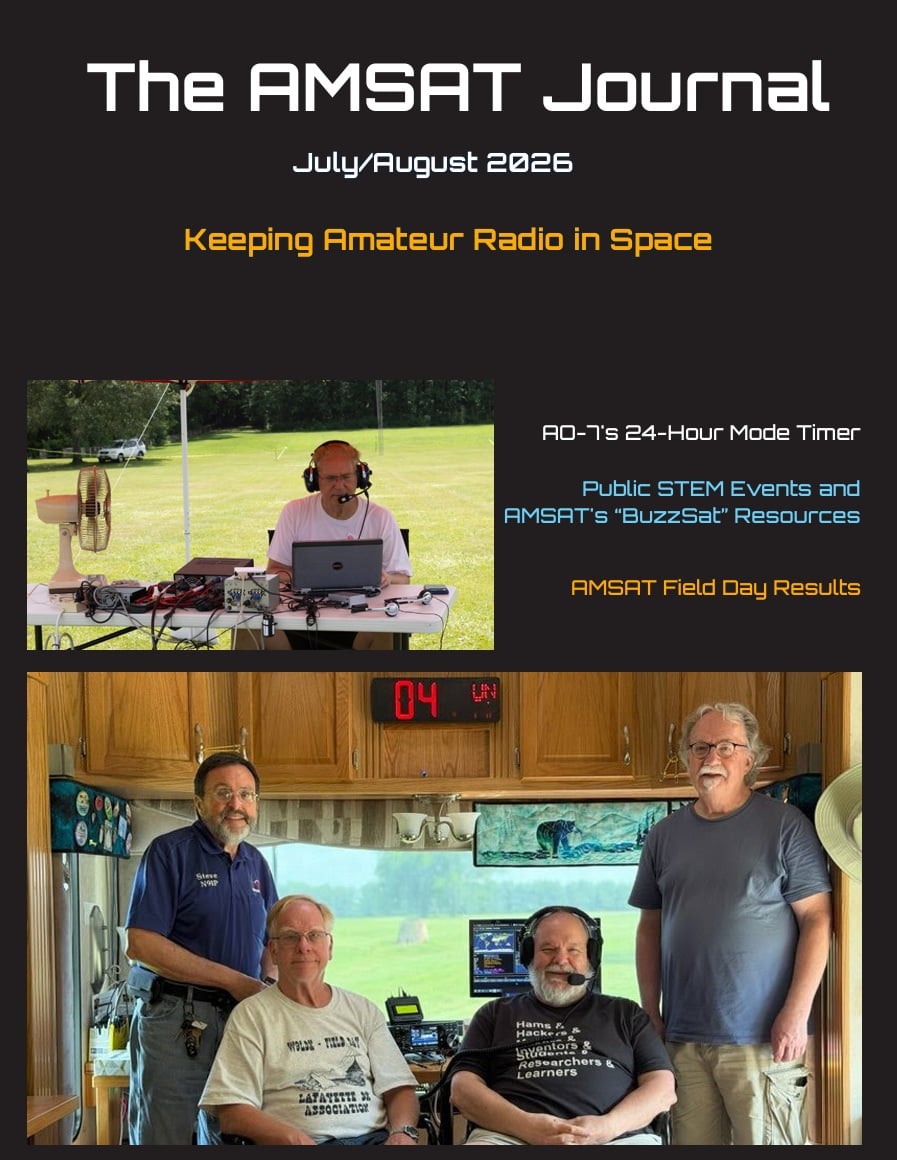
July/August 2026 Issue of The AMSAT Journal Now Available

The July/August 2026 issue of The AMSAT Journal (Volume 49, Number 4) is now available for members to download from the AMSAT member portal at https://launch.amsat.org/.

The Journal staff is always looking for articles, experiences, and photos to share with fellow members. Manuscripts, photos, and story ideas may be sent to journal [at] amsat.org.

The July/August 2026 issue includes the following features:

  • Apogee View – AMSAT President Drew Glasbrenner, KO4MA, reports from a busy week on the road, including a day at the Huntsville Hamfest and two days spreading the AMSAT message at the Small Satellite Conference in Salt Lake City, where the conversations ranged from launch providers to high schools – and included an introduction to the new president of AMSAT-Canada.
  • Educational Relations Update – Alan Johnston, KU2Y, on the CubeSatSim’s feature in the September issue of QST, a preview of the upcoming v2.3 software release, and the CubeSatSim loaner program for educators, along with a sidebar Quick Update on FoxPlus-A testing.
  • AO-7’s 24-Hour Mode Timer: What the AMSAT Status Reports Reveal During Continuous Sunlight – Paul Stoetzer, N8HM, mines nearly 1,500 AMSAT Satellite Status API reports from this summer’s illumination season to ask a simple question of a 51-year-old spacecraft: how well is its onboard mode timer really behaving?
  • Public STEM Events and AMSAT’s “BuzzSat” Resources – AMSAT Ambassador Tom Schuessler, N5HYP, shares his approach to engaging the non-ham public at Dallas’s Moon Day, from CubeSatSim demos and live SSTV to the new BuzzSat.com youth outreach materials, with ready-to-use handouts for other Ambassadors.
  • AMSAT Field Day 2026 Results – Bruce Paige, KK5DO, delivers his annual roundup of AMSAT Field Day, complete with the final standings, station stories, and the traditional visits from Murphy, followed by a 20-photo Field Day Gallery with scenes from sites across North America.

The AMSAT Journal is published bi-monthly as a benefit of AMSAT membership. Not yet a member? Join today at https://launch.amsat.org/ – students join for free.

[ANS thanks Joe Kornowski, KB6IGK, Editor-in-Chief of The AMSAT Journal, for the above information]


Give Your Next Rove a Payload — Put Your Lunch into Orbit!

Pack the rover dogs and hit the grid line with an all-new
AMSAT Round Logo Metal Lunchbox.

Keep Amateur Radio in Space — and your lunch in the box!

https://www.zazzle.com/amsat_round_logo_metal_lunchbox-256761530568368967


SatNOGS Rolls Out Major Network and Database Updates

The SatNOGS project rolled out a series of software updates in late August, including SatNOGS Network versions 1.128, 1.129 and 1.130 along with SatNOGS DB version 1.76. Network 1.128, released August 27, introduced a substantial collection of changes affecting ground station operation, observation scheduling and the project’s application programming interfaces. The release was followed in quick succession by versions 1.129 and 1.130 as developers addressed issues discovered following deployment. SatNOGS is an open-source global network of satellite ground stations developed by the Libre Space Foundation and supported by amateur radio operators and satellite enthusiasts around the world.

One of the most significant changes in Network 1.128 is the first phase of a new multi-vetting system for observations. Previously, only one vetting result could be associated with an observation artifact such as a waterfall, while the new system allows individual users to independently evaluate the same artifact. Future development is expected to extend vetting to additional observation products and could eventually allow automated systems or bots to participate in the process. The change is intended to provide more useful information about the confidence and quality of observations collected by the network. The update also removes an older observation-status field from the API as part of the transition to the new vetting system.

Ground station status handling has also been redesigned. Instead of describing a station simply as online, offline or testing, SatNOGS now separately tracks whether a station is connected, whether it is available for scheduling, and whether it is undergoing testing. Station owners can therefore leave a station connected to the network while making it unavailable for observations, providing greater control over how stations participate in the network. Another new feature separates a station’s minimum horizon from its minimum culmination elevation, allowing operators to independently specify the elevation at which tracking begins and ends and the minimum elevation a pass must reach before it can be scheduled. These limits can also be configured as hard limits when dictated by antenna patterns, local obstructions or other station constraints.

SatNOGS DB 1.76 introduces complementary changes to the way satellites and their transmitters are described. Satellite status values have changed from future, alive, dead and re-entered to future, in-orbit, launch failed and re-entered, separating the orbital status of a spacecraft from whether its transmitters remain active. The database also gains experimental support for structured transmitter parameters, intended eventually to provide SatNOGS Network, Client and Radio with enough information to create dynamic processing flowgraphs. This could improve automatic decoding and support for a wider variety of satellite modes as the feature develops.

The database update also lays groundwork for a new Launches feature intended to organize information about satellites deployed on individual launches. SatNOGS currently relies heavily on community forum threads to coordinate reports following launches, but the new system is intended to provide a central view of deployment, reception and identification status. New reception classifications include Unknown, Unverified, Partially Verified and Verified, with supporting evidence links available for received signals. This could be particularly useful following rideshare missions when observers around the world are attempting to identify numerous newly deployed spacecraft. Network 1.128 also adds support for transmitter parameters supplied by SatNOGS DB, beginning the integration of these new database capabilities with observations.

Deployment of the new Network software was not entirely trouble-free, prompting the rapid release of versions 1.129 and 1.130 following 1.128. Developers worked through database migration and performance issues and made additional corrections as the updated software entered service. Beyond the major features, the releases include numerous user-interface improvements, bug fixes, performance improvements and enhancements for developers. Together, the Network and Database updates establish groundwork for improved observation verification, more flexible ground station operation and better handling of the growing number of satellites and transmitters tracked through SatNOGS.

### For More Information

SatNOGS Network 1.128 breaking and notable changes:
https://community.libre.space/t/upcoming-satnogs-network-release-1-128-breaking-and-notable-changes/15204

SatNOGS Network releases 1.128, 1.129 and 1.130:
https://community.libre.space/t/satnogs-network-release-1-128-1-129-1-130/15231

SatNOGS DB 1.76 breaking and notable changes:
https://community.libre.space/t/upcoming-satnogs-db-release-1-76-breaking-and-notable-changes/14956

[ANS thanks Fredy Damkalis and the Libre Space Community for the above information]


Updated VUCC & DXCC Satellite Standings for September 2026

VUCC Satellite Award/Endorsement Changes for August 1, 2026 to September 1, 2026.

Callsign Previous VUCC Grids Updated VUCC Grids
DL5GAC 1745 1967
EA2AA 1235 1285
HB9AOF 1130 1158
E70A 1023 1126
JL1SAM 1008 1105
G4GIR New 1025
JG6CDH 777 941
KK4YEL 799 812
N9FN 752 753
HB9GWJ 702 741
AC9DX 730 733
LA6OP 700 711
K5TA 600 660
N5EKO 623 624
DJ7NT 510 606
JK6DXD New 602
JI5USJ 551 601
AG4W 524 587
KF2T 505 580
OH3DP 501 551
N8URE 471 488
KF0QS 400 450
W0PR 230 333
JF3MKC 280 325
G4BWP 220 303
PU5DDC 280 289
KG7CW 115 250
PY3YO 160 205
DL1TJ New 198
WB5TX 175 181
DM2RM 115 177
AD4ES New 113
IK2TPX New 101
HJ6MR New 100

Congratulations to new VUCC Satellite award holders G4GIR, JK6DXD, DL1TJ, AD4ES, IK2TPX, and HJ6MR! G4GIR is the first VUCC Satellite award holder from Maidenhead grid IO92, JK6DXD is the first from PM53, and DL1TJ is the first from JN69. HJ6MR is the first VUCC Satellite award holder from Colombia and Maidenhead grid FJ23.

DXCC Satellite Award/Endorsement Changes for August 1, 2026 to September 1, 2026.

Callsign Previous DXCC Entities Updated DXCC Entities
YO3APJ 176 178
HB9GWJ 154 160
KB1HY 143 144
I1JQJ New 123
IZ2AMW New 103
UN3G New 100

Congratulations to new DXCC Satellite award holders I1JQJ, IZ2AMW, and UN3G!

[ANS thanks Jon Goering, N7AZ, for the above information]


Sean Borgerson, KK7OVF, Earns AMSAT Sexagesimal Award

Bruce Paige, KK5DO, AMSAT Director of Contests and Awards, has announced that Sean Borgerson, KK7OVF, has earned AMSAT Sexagesimal Award #204, recognizing confirmed satellite contacts with stations in 60 different U.S. states, Canadian call areas, or DXCC entities. In announcing the award, Paige observed that this is one of the AMSAT awards that is “not easy to earn” – and the numbers back him up: in the decades since the award was introduced, only 204 operators have completed the feat.

True to its name – sexagesimal meaning “relating to the number sixty” – the award is the middle rung of AMSAT’s classic operating award ladder. Operators begin with the Satellite Communicators Club for their first satellite QSO and the Oscar Satellite Communications Achievement Award for contacts with 20 different states, provinces, or countries; those same contacts then aggregate toward the 60 required for the Sexagesimal Award and, eventually, the 100 needed for the AMSAT Century Award.

Each contact must be with a station in a different entity – work six stations in British Columbia and only one of them counts – and all contacts must be made from locations within 25 miles (40 kilometers) of one another. For most operators, collecting 60 distinct entities through satellite footprints takes years of patience, with rare DX and hard-to-find states alike surrendering only when pass geometry, timing, and luck all line up.

Sean’s callsign may ring a bell for followers of the AMSAT Satellite Distance Records: operating from grid CN85 in the Pacific Northwest, he set AO-123’s first documented distance record in November 2024, a 1,622 miles (2,610 km) contact that remained the satellite’s listed record until this summer.

Operators chasing awards of their own will find complete rules for the Sexagesimal Award and all of AMSAT’s operating awards at https://www.amsat.org/awards/. Applications require only a report of contacts – no QSL cards needed – sent to KK5DO along with a small fee.

Congratulations, Sean!

[ANS thanks Bruce Paige, KK5DO, AMSAT Director of Contests and Awards, for the above information]


Eric Olson, KH6WI, Earns AMSAT Rover Award #96

It was a busy day at the AMSAT awards desk. Alongside Sexagesimal Award #204 (see story elsewhere in this issue), Bruce Paige, KK5DO, AMSAT Director of Contests and Awards, has announced that AMSAT Rover Award #96 has been earned by Eric Olson, KH6WI – the fourth Rover Award issued in roughly a month, following recent recipients in Brazil, the United Kingdom, and Colombia.

Eric’s aloha-flavored callsign tells part of the story. A self-described adventurer and sailor, he completed Worked All States via satellite from Hawaii in 2023, crediting the IO-117 GreenCube digipeater, the rover community, and more than a few midnight passes for making it possible. His travels continue to provide plenty of opportunities for portable satellite operating and grid activations.

The Rover Award recognizes exactly that spirit. It is earned by accumulating 25 points from satellite activations in grid squares outside the rover’s home grid – one point per grid on FM transponders, two on linear transponders, and three on digital transponders – plus a bonus point for each grid activated in a state, province, or DX entity other than the rover’s own.

Publicizing an operation at least 24 hours in advance via a public social media post tagging @amsat or #amsat, the AMSAT-BB, or this bulletin adds five points, as does posting photos of the operation afterward. A grid activated maritime mobile is worth ten points and a /MM endorsement on the certificate – a bonus that would seem tailor-made for a sailor.

In announcing the award, Paige offered his congratulations along with his customary encouragement to rovers everywhere to keep on rovin’.

Complete rules and application details for the AMSAT Rover Award are available at https://www.amsat.org/amsat-rover-award/, and upcoming rover operations may be found – and publicized – at https://hams.at.

Congratulations, Eric – and mahalo for the grids!

[ANS thanks Bruce Paige, KK5DO, AMSAT Director of Contests and Awards, for the above information]


The 2026 Coins Are Here! Help Support GOLF-TEE and Fox-Plus.
Annual memberships start at only $120.

Presidents' Club 2026 Coin

Join the AMSAT President’s Club today and help Keep Amateur Radio in Space!
https://www.amsat.org/join-the-amsat-presidents-club/


Changes to AMSAT TLE Distribution for September 4, 2026

Two Line Elements or TLEs, often referred to as Keplerian elements or keps in the amateur community, are the inputs to the SGP4 standard mathematical model of spacecraft orbits used by most amateur tracking programs. Weekly updates are completely adequate for most amateur satellites. TLE bulletin files are updated daily in the first hour of the UTC day. New bulletin files will be posted immediately after reliable elements become available for new amateur satellites. More information may be found at https://www.amsat.org/keplerian-elements-resources/.

The following satellites have been removed from this week’s AMSAT TLE distribution:

HYPERVIEW-1G (RS66S) NORAD Cat ID 61772 Decayed from orbit on or about 18 August 2026
Sparrow NORAD Cat ID 43881 Decayed from orbit on or about 18 August 2026

General Perturbations Data Support

AMSAT is pleased to announce that modern forms of what are called General Perturbations data are being disseminated via modern formats including JSON, XML and KVN at https://newark192.amsat.org/gpdata/current/. The reason this change is being made is that we are running out of 5-digit catalog numbers and the TLE format is not viable for satellites launched after July of this year. See https://celestrak.org/NORAD/documentation/gp-data-formats.php for details.

These data are presently considered in beta test for the next two months while hosted on the test server newark192.amsat.org, and we are very open to community feedback at webmaster [at] amsat.org. Testers may experience outages and errors while we make improvements. We intend to put this into production on our main web server in July as we expect that satellites launched after this summer will require one of the new formats to accommodate longer object numbers. AMSAT will continue to publish TLE bulletins for satellites launched before July 2026 indefinitely.

[ANS thanks Joe Fitzgerald, KM1P, AMSAT Orbital Elements Manager, for the above information]


ARISS News

Amateurs and others around the world may listen in on contacts between amateurs operating in schools and allowing students to interact with astronauts and cosmonauts aboard the International Space Station. The downlink frequency on which to listen is 145.800 MHz worldwide.

Scheduled Contacts

+ Recently Completed

No ARISS educational contacts were completed during the last week.

+ Upcoming Contacts

No school contacts are currently scheduled for the upcoming week.

Many times, a school makes a last-minute decision to do a Livestream or runs into a last-minute glitch requiring a change of the URL, but we at ARISS may not get the URL in time for publication. You can always check https://live.ariss.org/ to see if a school is Livestreaming.

As always, if there is an EVA, a docking, or an undocking; the ARISS radios are turned off as part of the safety protocol.

+ Schedule of ISS radio power downs and power ups
Mon 2026-09-07 12:10 UTC Service module radio power down
Mon 2026-09-07 12:15 UTC Columbus module radio power down
Mon 2026-09-07 15:16 UTC Progress undocking
Mon 2026-09-07 19:05 UTC Columbus module radio power up
Mon 2026-09-07 19:10 UTC Service module radio power up

The crossband repeater remains configured in the Columbus Module (145.990 MHz up {PL 67} & 437.800 MHz down). If a crewmember decides to pick up the microphone and turn up the volume, you may hear them on the air—so keep listening, as you never know when activity might occur.

Kenwood D710GA in the Zvezda Service Module – Call sign RS0ISS. Please note we’re still in the process of troubleshooting and testing this radio. APRS is currently active on 437.825 MHz. Feel free to check out status reports at https://ariss-usa.org/ARISS_APRS/.

​HamTV in the Columbus Module (2395.00 MHz) is currently transmitting a test signal. For more information, visit the ARISS Ham TV Live site at https://live.ariss.org/hamtv/.

Note, all times are approximate. It is recommended that you do your own orbital prediction or start listening about 10 minutes before the listed time.

The latest information on the operation mode can be found at https://www.ariss.org/current-status-of-iss-stations.html

The latest list of frequencies in use can be found at https://www.ariss.org/contact-the-iss.html

[ANS thanks Charlie Sufana, AJ9N, one of the ARISS operation team mentors for the above information]


AMSAT Ambassador Activities

AMSAT Ambassadors provide presentations, demonstrate communicating through amateur satellites, and host information tables at club meetings, hamfests, conventions, maker faires, and other events.

AMSAT Ambassador Clint Bradford, K6LCS, says,

“Think a 75-minute presentation on ‘working the easy satellites’ would be appropriate for your club or event? Let me know by emailing me at k6lcsclint [at] gmail [dot] com or calling me at 909-999-SATS (7287)!”

Clint has NEVER given the exact same show twice: EACH of the 150+ presentations so far has been customized/tailored to their audiences.

Scheduled Events

Greater Louisville Hamfest – September 12, 2026
Paroquet Springs Conference Centre
395 Paroquet Springs Drive
Shepherdsville, KY 40165-6007
https://louisvillehamfest.wixsite.com/louisvillehamfest
W4FCL

Bored Net µExpo and ARRL Santa Barbara Section Convention – October 3, 2026
Cal State University Channel Islands
1 University Drive
Camarillo, CA 93010
https://www.theborednet.net/index.php/2026/06/22/2026-microexpo-is-on/
K6KH

Tucson Area Autumn Hamfest – October 3, 2026
Radio Society of Tucson
Immanuel Presbyterian Church
9252 East 22nd Street
Tucson, AZ
https://k7rst.club
N1UW

44th AMSAT Space Symposium and Annual Membership Meeting – October 8 thru 11, 2026
Wyndham Jacksonville Hotel and Conference Center
14670 Duval Road
Jacksonville, FL 32218
https://www.amsat.org/2026-amsat-symposium/

Southern Arizona Fall Hamfest – November 14, 2026
Oro Valley Amateur Radio Club
Marana Middle School
11285 W. Grier Rd.
Marana AZ
www.tucsonhamradio.org/hamfest
N1UW

For more information go to: https://www.amsat.org/ambassador/

[ANS thanks Bo Lowrey, W4FCL, Director – AMSAT Ambassador Program, for the above information]


Buying from Ham Radio Outlet?
Add AMSAT’s Getting Started With Amateur Satellites to your order.

Available for $29.95 from HRO (free shipping on most orders over $100)
https://www.hamradio.com/detail.cfm?pid=H0-019238


Satellite Shorts from All Over

+ NASA’s Nancy Grace Roman Space Telescope launched Sunday, August 30, aboard a SpaceX Falcon Heavy rocket from Kennedy Space Center in Florida. The observatory is now beginning a three-month, roughly one-million-mile journey to the Sun-Earth L2 Lagrange point, where it will conduct wide-field infrared surveys of the universe. Roman will investigate dark matter, dark energy, and exoplanets using its 300-megapixel Wide Field Instrument and a technology-demonstration coronagraph capable of directly imaging Jupiter-like planets. Controllers established contact with the spacecraft shortly after launch, and its solar arrays and lower instrument sunshade deployed successfully during the opening hours of the mission. Additional deployments, course corrections, and instrument checkouts will continue during the journey to L2, followed by several months of commissioning and calibration. NASA expects Roman’s first images in early 2027, beginning a mission designed to survey the universe up to 1,000 times faster than the Hubble Space Telescope. (ANS thanks SciTechDaily for the above information)

+ NASA’s Neil Gehrels Swift Observatory has resumed science observations after plans to boost the spacecraft into a higher orbit were abandoned. Swift’s Ultraviolet/Optical Telescope and X-ray Telescope returned to operation on August 26, while its Burst Alert Telescope is expected to resume observations in the coming weeks. Katalyst Space’s LINK spacecraft launched July 3 with plans to rendezvous with, capture, and raise Swift’s orbit, but attitude-control problems prevented the boost attempt from proceeding. LINK may still rendezvous with Swift to demonstrate proximity operations and other technologies for future satellite servicing missions. Launched in 2004 to study gamma-ray bursts and other transient astronomical events, Swift has remained operational far beyond its original two-year prime mission. With increased atmospheric drag from recent solar activity accelerating the decay of Swift’s low Earth orbit, NASA expects the observatory to reenter Earth’s atmosphere later this year. (ANS thanks NASA for the above information)

+ Europe’s second Meteosat Third Generation Imager satellite, MTG-I2, was launched aboard an Ariane 6 rocket from French Guiana on August 27. The satellite completes the first three-spacecraft family of Europe’s new Meteosat Third Generation weather satellite system. Once commissioned in geostationary orbit, MTG-I2 will provide rapid weather imagery over Europe and northern Africa, with new observations available every 2.5 minutes. Its instruments include the Flexible Combined Imager and Lightning Imager, allowing forecasters to follow rapidly developing storms and detect lightning during both day and night. Data from the satellite will also support wildfire monitoring, atmospheric pollution tracking, climate research, and improved early warnings for severe weather. MTG-I2 joins the first MTG Imager launched in 2022 and the MTG Sounder launched last year, allowing the new generation of Meteosat satellites to begin operating at full capacity. (ANS thanks ESA for the above information)

+ SpaceMD, a subsidiary of Redwire Corporation, has signed an agreement to fly a commercial pharmaceutical research mission aboard SpaceX’s new Starfall spacecraft in 2028. Starfall is an uncrewed reentry vehicle designed to provide routine access to microgravity for research, manufacturing, and testing, with experiments and other payloads returned to Earth after their time in orbit. SpaceX conducted the first demonstration flight of Starfall in June 2026, launching the spacecraft aboard a Falcon 9 rocket and testing technology intended for future return missions. SpaceMD plans to fly as many as 32 of its Pharmaceutical In-Space Laboratory, or PIL-BOX, systems on the 2028 mission, which the company says would make it the largest dedicated commercial microgravity research mission to date. The PIL-BOX systems allow researchers to crystallize pharmaceutical compounds in microgravity, where conditions can produce crystals useful in developing improved drug formulations and new therapies. Since November 2023, 54 PIL-BOX systems have flown to the International Space Station and have been used to crystallize 45 compounds, including insulin and molecules targeting cancer, cardiovascular disease, obesity, and diabetes. (ANS thanks Redwire for the above information)


Join AMSAT today at https://launch.amsat.org/

In addition to regular membership, AMSAT offers membership to:

  • Societies (a recognized group, clubs or organization).
  • Students enrolled in at least half-time status are eligible for free membership to age 25.
  • Memberships are available for annual and lifetime terms.

Contact info [at] amsat.org for additional membership information.

73 and remember to help Keep Amateur Radio in Space!

This week’s ANS Editor,

Mitch Ahrenstorff, ADØHJ
mahrenstorff [at] amsat.org

ANS is a service of AMSAT, the Radio Amateur Satellite Corporation, 712 H Street NE, Suite 1653, Washington, DC 20002
AMSAT is a registered trademark of the Radio Amateur Satellite Corporation.