

AMSAT News Service
ANS-221
August 9, 2026
In this edition:
* Registration Now Open for the 44th AMSAT Space Symposium
* Voting Still in Progress for Board of Directors
* Jackie Blumer KC9LEH Appointed as ARISS Associate Director
* AMSAT-CA Membership is Open
* AMSAT Contests and Awards
* Astronauts Complete Spacewalk for Solar Array Modifications
* SpaceX Rocket Impact: Lunar Orbiter Captures Aftermath
* VUCC Satellite Standings August 2026
* DXCC Satellite Standings August 2026
* Changes to AMSAT TLE Distribution for August 7, 2026
* ARISS News
* AMSAT Ambassador Activities
* Satellite Shorts from All Over
The AMSAT® News Service bulletins are a free, weekly news and information service of AMSAT, The Radio Amateur Satellite Corporation. ANS publishes news related to Amateur Radio in Space including reports on the activities of a worldwide group of Amateur Radio operators who share an active interest in designing, building, launching and communicating through analog and digital Amateur Radio satellites.
The news feed on https://www.amsat.org publishes news of Amateur Radio in Space as soon as our volunteers can post it.
Please send any amateur satellite news or reports to: ans-editor [at] amsat.org
You can sign up for free e-mail delivery of the AMSAT News Service Bulletins via the ANS List; to join this list see: https://mailman.amsat.org/postorius/lists/ans.amsat.org/
Registration Now Open for 44th AMSAT Space Symposium
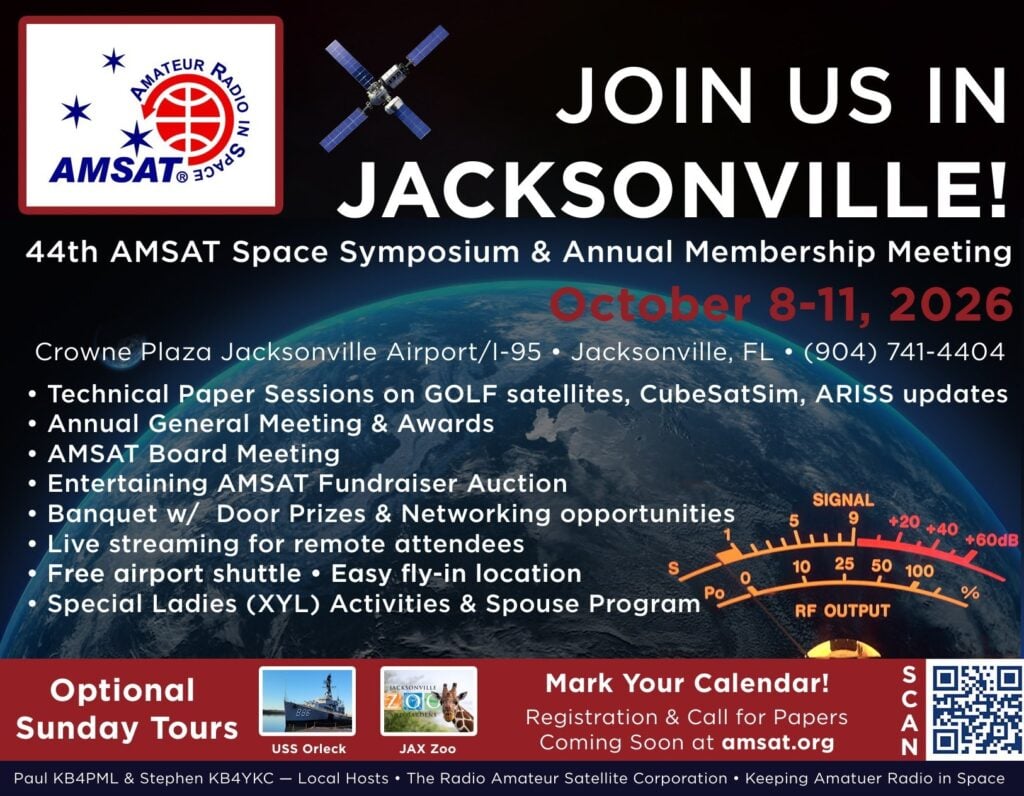
Registration is now open for the 44th AMSAT Space Symposium and Annual General Meeting, coming to Jacksonville, Florida, October 8-11, 2026. This year’s gathering will be held at the Wyndham Jacksonville Hotel & Conference Center – the same property previously known as the Crowne Plaza Jacksonville Airport/I-95, rebranded in July 2026 – an easy fly-in location with a free airport shuttle.
Symposium registration is $80 and the Saturday night banquet is $60 through September 8, after which prices rise to $90 and $70, respectively. An all-events package combining the two is also available at $140 early bird or $160 regular. Symposium registration includes admittance to all presentation sessions, the Friday night social and auction, the Sunday morning AMSAT Members Breakfast, and a digital copy of the Symposium Proceedings. Register online at https://launch.amsat.org/
The weekend kicks off with the AMSAT Board of Directors meeting on Thursday, October 8, continuing Friday morning. Symposium presentations begin Friday afternoon – with technical sessions planned on the GOLF satellites, the CubeSatSim, ARISS updates, and more – followed by the reception and auction on Friday evening. Presentations continue Saturday morning and afternoon, capped by the Annual General Meeting at 3:00 p.m. and the evening reception and banquet, complete with ham radio door prizes. Live streaming will be available for those unable to attend in person, and a spouse program is planned.
Sunday morning brings the Members Breakfast, followed by optional tours of the USS Orleck, a Gearing-class destroyer that served in the U.S. Navy from 1945 to 1982, and the 122-acre Jacksonville Zoo, home to more than 2,000 animals. Tour registration is an expression of interest only, with admission paid at the door – $35.95 for the zoo, and $20 for adults or $15 for seniors, AARP members, and veterans aboard the Orleck.
Hotel reservations at the Wyndham Jacksonville may be made through the booking link on the Symposium page at https://www.amsat.org/2026-
Make your plans now to join your fellow AMSAT members in Jacksonville!
[ANS thanks the AMSAT Symposium Team for the above information]
Voting Still in Progress for Board of Directors
AMSAT members are reminded that voting remains open in the 2026 AMSAT Board of Directors election. Three seats on the Board are being filled this year. The three candidates receiving the highest number of votes will be elected to the Board, while the candidates receiving the next highest vote totals will be named First Alternate and Second Alternate, respectively.
Voting opened on July 15, 2026, and will conclude on September 15, 2026. Election results will be announced no later than September 30, 2026.
Current AMSAT members may review the official candidate statements and cast their ballots on the AMSAT 2026 Board of Directors Election website at https://launch.amsat.org/2026-BoD-Election
Members are encouraged to take a few minutes to review the candidates’ statements and cast their ballots. Your participation helps shape the future of AMSAT and its mission to Keep Amateur Radio in Space.
[ANS thanks Douglas Tabor, N6UA, AMSAT Secretary, for the above information]
LIMITED TIME OFFER!!!
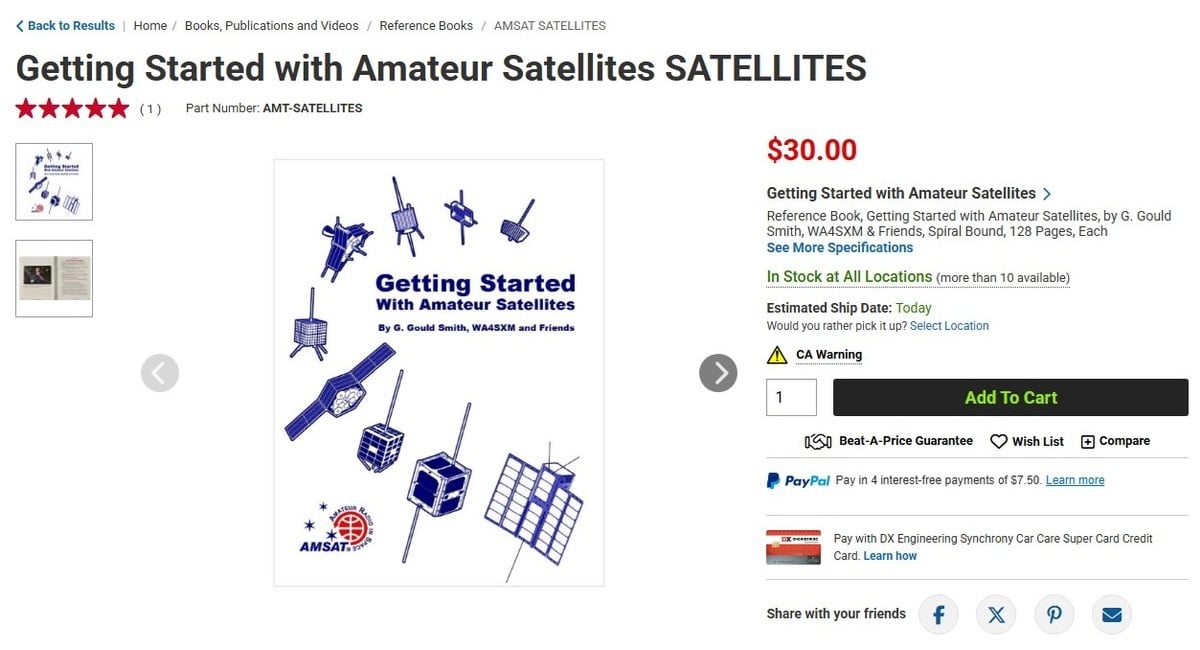
AMSAT is offering a limited-time promotion for new and renewing members that includes a free digital copy of Getting Started with Amateur Satellites. The promotion is being offered as AMSAT begins the 2026 membership year.
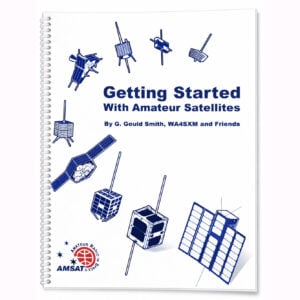
Anyone who joins or renews their AMSAT membership during the promotional period will receive a download link for the latest edition of Getting Started with Amateur Satellites in their membership confirmation email. JOIN TODAY at https://launch.amsat.org/ (Remember! Students join for FREE!)
Jackie Blumer, KC9LEH, Appointed as ARISS Associate Director

Jackie Blumer, KC9LEH, Earth/Space Educator, Associate Director, ARISS-USA
[Credit: ARISS-USA]
ARISS-USA is pleased to announce that Jackie Blumer, KC9LEH, has been appointed Associate Director of ARISS-USA (Amateur Radio on the International Space Station). Jackie is a nationally recognized science educator with an emphasis on space education.
In her work as an educator, she has often incorporated amateur radio into her curriculum as a teaching tool. In addition to her many responsibilities at ARISS-USA, Jackie has recently served as Business Development Coordinator and Logistics Manager for ARISS-USA.
In her new position as Associate Director, her focus will be on developing relations with other space-related organizations. She will also be seeking educational opportunities to collaborate on projects in conjunction with the commercial space industry.
Please join us in congratulating Jackie Blumer, KC9LEH, on her appointment and wishing her continued success in her new role with ARISS-USA.
[ANS thanks Dave Jordan, AA4KN, ARISS PR and media contact for the above information.]
AMSAT-CA Membership is Open

AMSAT-CA Logo [Credit: amsat-ca.org]
The global amateur radio community has expanded with the official formation of AMSAT CANADA (AMSAT-CA), making it the 28th affiliate of the Radio Amateur Satellite Corporation.
AMSAT Canada joins this global network to specifically serve Canadian amateur radio operators who share an interest in space communications. More information can be found at https://www.amsat-ca.org/about/.
Building on Canada’s rich history of innovation in space and radio science, AMSAT Canada stands ready to contribute to that legacy. The organization’s mandate is to promote, develop, and support amateur radio in space, reflecting a long tradition of experimentation, education, and international collaboration.
By uniting together, the organization aims to build a vibrant and enduring Canadian presence in space that:
-
Inspires new generations
-
Advances open science
-
Upholds the spirit of exploration that has always defined amateur radio
Operators and enthusiasts interested in joining the initiative, tracking upcoming projects, or learning more about membership can visit the official website at www.amsat-ca.org.
[ANS thanks Levente Buzas, VA7QF, President of AMSAT Canada for the above information.]
Buying from Ham Radio Outlet?
Add AMSAT’s Getting Started With Amateur Satellites to your order.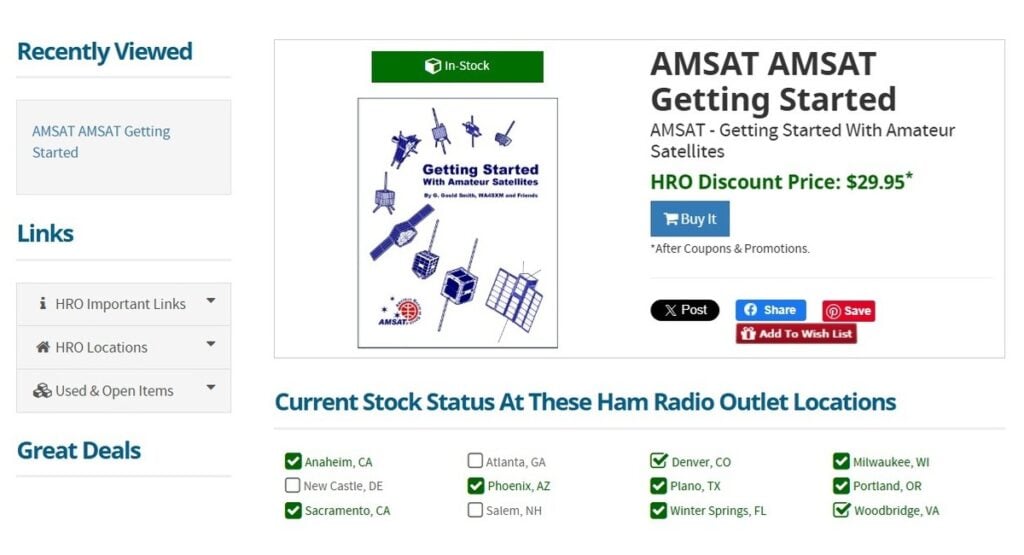
Available for $29.95 from HRO (free shipping on most orders over $100)
https://www.hamradio.com/detail.cfm?pid=H0-019238
AMSAT Contests and Awards
Kleibe, PP2KR, Earns AMSAT Rover Award #93
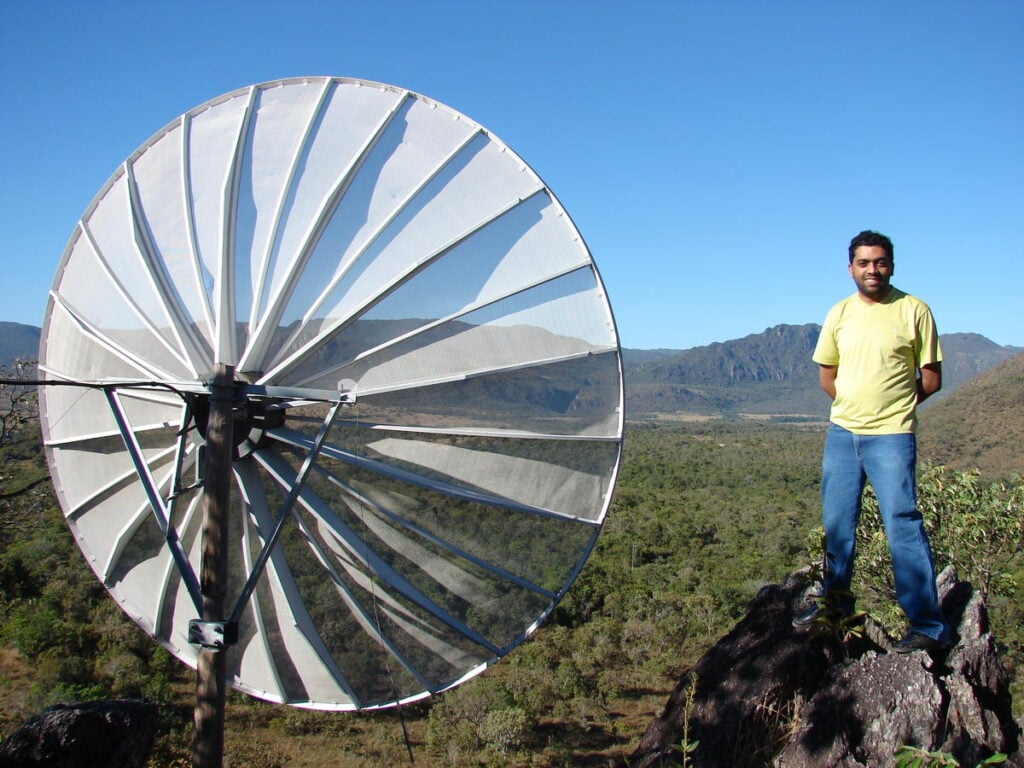
Kleibe, PP2KR [Credit: QRZ.com]
Bruce Paige, KK5DO, AMSAT Director of Contests and Awards, has announced that Kleibe, PP2KR, of Brazil has been awarded AMSAT Rover Award #93.
Introduced in 2018, the AMSAT Rover Award recognizes the operators who make grid chasing possible in the first place: the ones who pack up their stations and take them somewhere else. The award is granted to stations accumulating 25 points through roving activity, with each grid square activated outside the rover’s home grid earning one point via a single-channel FM transponder, two points via a linear SSB/CW transponder, or three points via a digital transponder such as the ISS packet system. An additional point is added for each grid activated in a state, province, or DX entity outside the rover’s own, and five-point bonuses are available both for publicizing an activation at least 24 hours in advance – via a public social media post tagging @amsat or #amsat, the AMSAT-BB, or this bulletin – and for posting photos of the operation afterward. Braver souls can earn 10 points for activating a grid while operating maritime mobile, which also adds a /MM endorsement to the certificate.
Every rare grid in a chaser’s log is there because someone made the trip, and rover activity from South America is an especially welcome treat for satellite operators throughout the Americas. In announcing the award, Paige offered his congratulations along with his customary encouragement to rovers everywhere to keep on rovin’.
Complete rules and application information for the AMSAT Rover Award are available at https://www.amsat.org/
Congratulations, Kleibe, and thanks for putting Brazil on the air!
Adrian Mol, N8AJM, Earns GridMaster Award #79
Bruce Paige, KK5DO, AMSAT Director of Contests and Awards, has announced that Adrian Mol, N8AJM, has been awarded GridMaster Award #79.
The GridMaster Award recognizes radio amateurs worldwide who achieve two-way communication via amateur satellite with operators in all 488 Maidenhead grid squares of the contiguous United States. Contacts must be confirmed in writing, in the form of QSL cards or Logbook of The World confirmations, and must be made from a single location or from locations no more than 200 kilometers apart. Originally created by the Star Comm Group in 2014 and now administered by AMSAT, the GridMaster is widely regarded as one of the most demanding achievements in amateur satellite operating. Unlike open-ended grid chasing, it has a finish line, and reaching it takes years of dedication: many of the 488 grids are sparsely populated or home to no satellite operators at all, meaning nearly every GridMaster owes a debt to the rovers who haul their stations into rare grids so others can complete the map.
That makes this award a particularly fitting one. Mol is no stranger to the other side of the microphone, having appeared on the AMSAT rover pages activating grids for fellow chasers. In announcing the award, Paige offered his congratulations along with his customary encouragement to the rover community to keep on rovin’.
Full details on the GridMaster Award, including rules and the application form, are available at https://www.amsat.org/
Congratulations, N8AJM, on a truly hard-earned achievement!
[ANS thanks Bruce Paige, KK5DO, AMSAT Director of Contests and Awards, for the above information]
The 2026 Coins Are Here! Help Support GOLF-TEE and Fox-Plus.
Annual memberships start at only $120.
Join the AMSAT President’s Club today and help Keep Amateur Radio in Space!
https://www.amsat.org/join-the-amsat-presidents-club/
Astronauts Complete Spacewalk for Solar Array Modifications
NASA astronauts Jessica Meir and Anil Menon successfully wrapped up a spacewalk outside the International Space Station on Thursday, August 6th, 3 p.m. EDT, marking Menon’s first career spacewalk and the sixth for Meir.
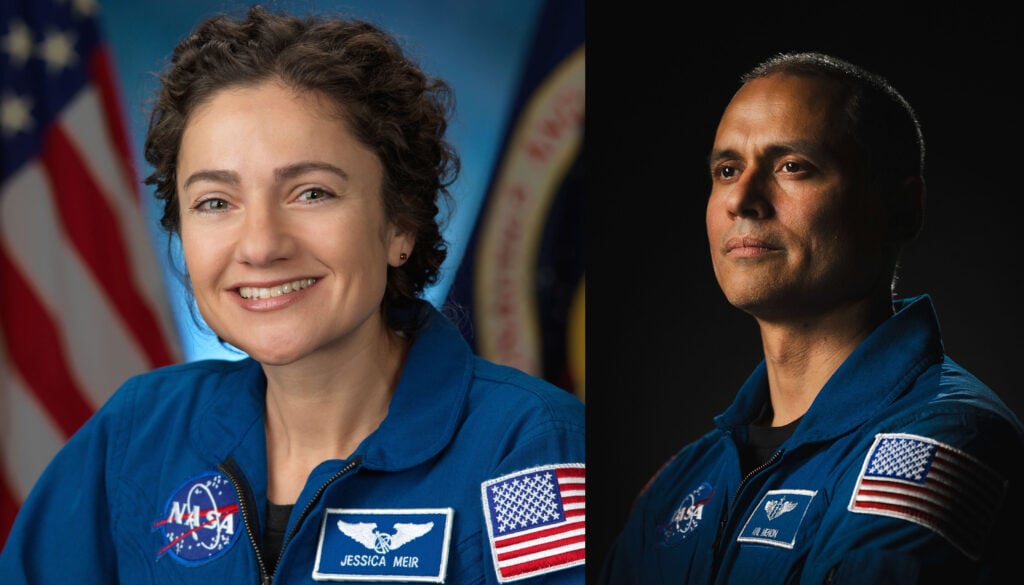
NASA astronauts Jessica Meir and Anil Menon [Credit: NASA]
Prior to stepping outside, the NASA astronauts completed hands-on preparations aboard the space station to ensure a smooth operation:
-
Tool and Gear Configuration: The duo spent time inside the Quest airlock configuring tools and staging their spacesuits.
-
Procedure Reviews: They worked closely with fellow crew members Jack Hathaway (NASA) and Sophie Adenot (ESA), who reviewed the spacewalking procedures. Hathaway and Adenot also assisted with spacesuit configurations and were assigned to monitor the extravehicular activity from inside while helping Meir and Menon into and out of their suits.
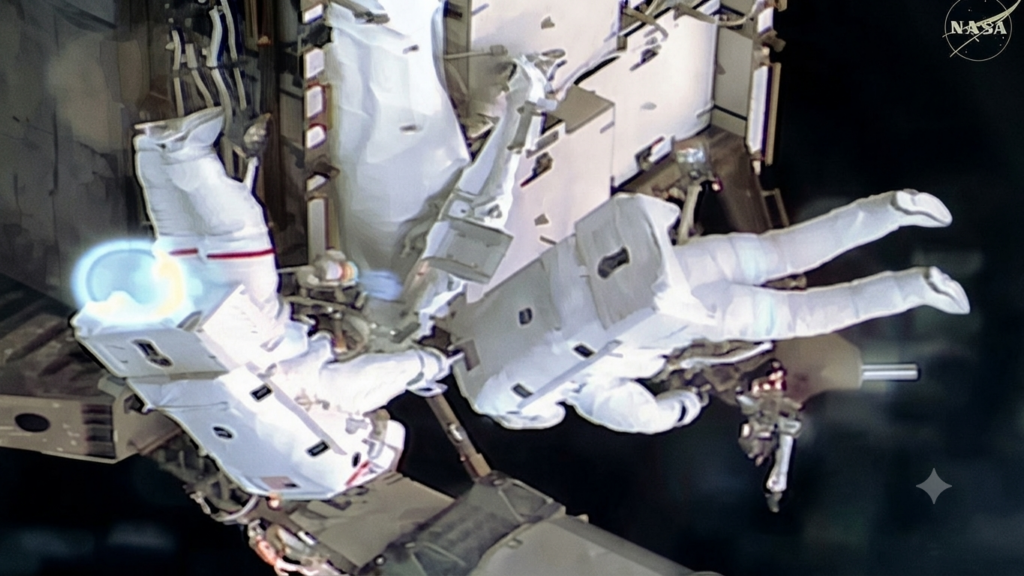
From left, NASA astronauts Jessica Meir and Anil Menon work outside the International Space Station during a spacewalk to install hardware for future power system upgrades. [Credit: NASA+]
During the 6-hour, 27-minute excursion, the duo accomplished their primary objectives by preparing the station’s 3B power channel. This critical maintenance lays the groundwork for the future installation of new roll-out solar arrays (IROSA), which will supply additional electrical power to the orbiting laboratory. The upgraded power capacity will support vital station systems as well as the future safe, controlled deorbit of the outpost.
Thursday’s extravehicular activity marked the 281st spacewalk conducted in support of International Space Station assembly, maintenance, and upgrades.
[ANS thanks NASA.gov for the above information]
SpaceX Rocket Impact: Lunar Orbiter Captures Aftermath
Impact Observations
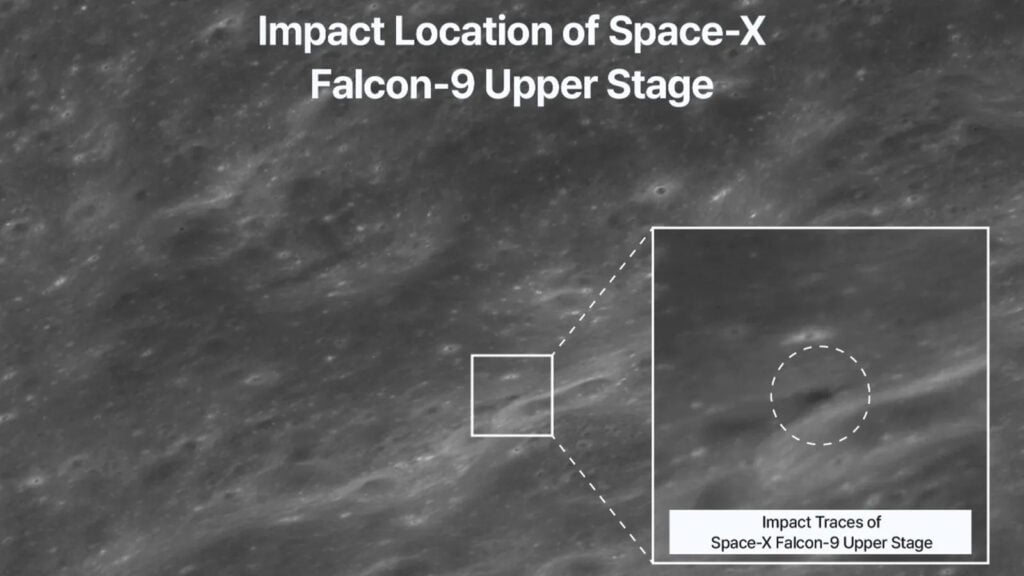
South Korea’s Danuri lunar orbiter captured this image of the crater blasted out by a SpaceX Falcon 9 upper stage when it hit the moon on Aug. 5, 2026. [Credit: KARI]
-
Plume Detection: Researchers at the Lowell Observatory in Flagstaff, Arizona, reported measuring a sodium and lithium gas plume spanning several tens of kilometers, which lasted for 5 to 10 minutes following the impact.
-
Visual Confirmation: Astronomers at the Instituto de Astrofísica de Andalucía in Spain also captured preliminary video footage of material ejected from the lunar surface at the time of the predicted impact.
Scientific Context
The Falcon 9 upper stage had been orbiting Earth since launching the private robotic landers Blue Ghost and Resilience in January 2025. Because the stage had exhausted most of its fuel to reach a high, moon-crossing orbit, it could not deorbit in Earth’s atmosphere. Over time, a combination of solar activity and gravitational forces pushed the stage onto its eventual collision course.
VUCC Satellite Standings August 2026
VUCC Satellite Award/Endorsement Change Summary for
July 01, 2026 to August 01, 2026.
------------------------------------------------------------
PY2PIM                    1310     1354
WI7P                      1104     1106
JS1LQI                     825      876
AC9DX                      725      730
N1AIA                      613      705
JA1GZK                     600      634
JO4JKL                     511      600
W9FF                       558      559
9V1EO                      133      553
HP2VX                      543      552
DL8GAM                     500      529
PY2HZ                      427      505
N6PAZ                      500      503
JI5RPT/1                   300      400
JE2UFF                     334      335
JH0BBE                     324      325
IC8TEM                     147      315
DH0GSU                     250      279
EA4DEI                     250      277
WA8ZID                     233      234
KT8O                       175      201
N9HF                       185      201
NK0S                       175      181
W4XP                       100      126
DXCC Satellite Standings August 2026
DXCC Satellite Award/Endorsement Change Summary for Jul 01, 2026 to Aug 01, 2026. ------------------------------------------------------------ YO2CMI 193 195 HB9RYZ 175 176 ON4AOI 167 176 YO2KHK 168 176 OE6MDF 169 170 IK1IYU 153 165 IK4CIE 157 164 IK0WMJ 131 159 YO2RR 150 156 G4BWP 138 150 DL6JZ 101 118 CT4NH New 116 CT1EEB 113 115 OH3DP 110 114 ON4IQ 107 108 ------------------------------ ------------------------------
Changes to AMSAT TLE Distribution for August 7, 2026
Two Line Elements or TLEs, often referred to as Keplerian elements or keps in the amateur community, are the inputs to the SGP4 standard mathematical model of spacecraft orbits used by most amateur tracking programs. Weekly updates are completely adequate for most amateur satellites. TLE bulletin files are updated daily in the first hour of the UTC day. New bulletin files will be posted immediately after reliable elements become available for new amateur satellites. More information may be found at https://www.amsat.org/keplerian-elements-resources/.
+ The following satellites have been added to this week’s AMSAT TLE distribution:
CroCube NORAD Cat ID 62394
LASARsat NORAD Cat ID 62391
MARINA NORAD Cat ID 69920
+ The following satellite has been removed from this week’s AMSAT TLE distribution:
Cute NORAD Cat ID 49263 Decayed from orbit on or about 17 July 2026.
General Perturbations Data Support
AMSAT is pleased to announce that modern forms of what are called General Perturbations data are being disseminated via modern formats including JSON, XML and KVN at https://newark192.amsat.org/gpdata/current/. The reason this change is being made is that we are running out of 5-digit catalog numbers and the TLE format is not viable for satellites launched after July of this year. See https://celestrak.org/NORAD/documentation/gp-data-formats.php for details.
These data are presently considered in beta test for the next two months while hosted on the test server newark192.amsat.org, and we are very open to community feedback at webmaster [at] amsat.org. Testers may experience outages and errors while we make improvements. We intend to put this into production on our main web server in July as we expect that satellites launched after this summer will require one of the new formats to accommodate longer object numbers. AMSAT will continue to publish TLE bulletins for satellites launched before July 2026 indefinitely.
[ANS thanks Joe Fitzgerald, KM1P, AMSAT Orbital Elements Manager, for the above information.]
ARISS News
Amateurs and others around the world may listen in on contacts between amateurs operating in schools and allowing students to interact with astronauts and cosmonauts aboard the International Space Station. The downlink frequency on which to listen is 145.800 MHz worldwide.
Scheduled Contacts
+ Recently Completed
Geneva Christian College, Latrobe, Tasmania, Australia telebridge via IK1SLD
The ISS callsign was OR4ISS
The scheduled crewmember was Sophie Adenot KJ5LTN
The ARISS mentor was VK4KHZ
Contact was successful: Mon 2026-08-03 10:00:37 UTC 55 deg
Kenya Space Agency (KSA), Nairobi, Kenya, telebridge via ON4ISS
The ISS callsign was OR4ISS
The scheduled crewmember was Sophie Adenot KJ5LTN
The ARISS mentor was IZ2GOJ
Contact was successful: Wed 2026-08-05 11:38:38 UTC 89 deg
+ Upcoming
Challenger Learning Center National Conference, Framingham, MA, telebridge via VK4ISS
The ISS callsign is presently scheduled to be NA1SS
The scheduled crewmember is Sophie Adenot, KJ5LTN
The ARISS mentor is KA3HDO
Contact is go for: Wed 2026-08-12 16:31:39 UTC 58 deg
Australian Air League (AAL), Adelaide, South Australia, Australia, telebridge via IK1SLD
The ISS callsign is presently scheduled to be OR4ISS
The scheduled crewmember is Jack Hathaway, KJ5NIV
The ARISS mentor is VK4ISS
Contact is go for: Fri 2026-08-14 10:56:13 UTC 76 deg
Many times, a school makes a last-minute decision to do a Livestream or runs into a last-minute glitch requiring a change of the URL, but we at ARISS may not get the URL in time for publication. You can always check https://live.ariss.org/ to see if a school is Livestreaming.
As always, if there is an EVA, a docking, or an undocking; the ARISS radios are turned off as part of the safety protocol.
The crossband repeater remains configured in the Columbus Module (145.990 MHz up {PL 67} & 437.800 MHz down). If a crewmember decides to pick up the microphone and turn up the volume, you may hear them on the air—so keep listening, as you never know when activity might occur.
Kenwood D710GA in the Zvezda Service Module – Call sign RSØISS. Please note we’re still in the process of troubleshooting and testing this radio. APRS is currently active on 437.825 MHz. Feel free to check out status reports at https://ariss-usa.org/ARISS_APRS/.
Ham TV is currently transmitting a test signal at 2395.00 MHz.
Note, all times are approximate. It is recommended that you do your own orbital prediction or start listening about 10 minutes before the listed time.
The latest information on the operating mode can be found at https://www.ariss.org/current-status-of-iss-stations.html
The latest list of frequencies in use can be found at https://www.ariss.org/contact-the-iss.html
[ANS thanks Charlie Sufana, AJ9N, one of the ARISS operation team mentors for the above information.]
AMSAT Ambassador Activities
AMSAT Ambassadors provide presentations, demonstrate communicating through amateur satellites, and host information tables at club meetings, hamfests, conventions, maker faires, and other events.
AMSAT Ambassador Clint Bradford, K6LCS, says,
“Think a 75-minute presentation on “working the easy satellites” would be appropriate for your club or event? Let me know by emailing me at [email protected] or calling me at 909-999-SATS (7287)!”
Clint has NEVER given the exact same show twice: EACH of the 150+ presentations so far has been customized/tailored to their audiences.
Scheduled Events
August 28-30, 2026
Best Western (Downtown)
123 W. E St.
Casper, WY 82601
http://wyohamcon.org/
K0NMR
44th AMSAT Space Symposium and Annual Membership Meeting
October 8-11, 2026
Wyndham Jacksonville Hotel & Conference Center (rebranded from Crowne Plaza Jacksonville Airport/I-95 in July 2026)
14670 Duval Road
Jacksonville, FL 32218
For more information go to: https://www.amsat.org/ambassador/
[ANS thanks Bo Lowrey, W4FCL, Director – AMSAT Ambassador Program, for the above information.]

Satellite Shorts from All Over
+ The European Space Agency (ESA) is hosting a global livestream for the upcoming total solar eclipse on August 12, 2026, which will cross Greenland, Iceland, Portugal, and Spain. Hosted by science communicator Dr. Maggie Aderin alongside ESA experts, the broadcast will air live on ESA Web TV and YouTube from 19:30 to 20:45 CEST, featuring telescope feeds from the Observatorio Astrofísico de Javalambre in Teruel, Spain, and live coverage of totality starting at 20:31 CEST. Viewers can participate by submitting questions on Bluesky or X using the hashtag #AskESA. ESA also reminds anyone viewing partial phases of the eclipse in person to use certified safety glasses to prevent eye damage. [ANS thanks the European Space Agency for the above information. Read the full article at https://www.esa.int/Science_Exploration/Space_Science/Total_solar_eclipse_how_to_watch_live_from_home]
+NASA has assigned astronaut Deniz Burnham, AI5RW, to her first mission to the International Space Station, where she will serve as an Expedition 76 flight engineer. She is scheduled to launch in March 2027 from the Baikonur Cosmodrome in Kazakhstan aboard the Roscosmos Soyuz MS-30 spacecraft alongside cosmonauts Dmitri Petelin and Konstantin Borisov. The trio will spend approximately seven months aboard the orbiting laboratory, conducting scientific investigations and technology demonstrations to support future exploration missions to the Moon and Mars. [ANS thanks NASA.gov for the above information. Read the full article at https://www.nasa.gov/news-release/nasa-assigns-astronaut-deniz-burnham-to-first-space-station-mission/]
+ Rocket Lab successfully launched a Japanese Earth-observing radar satellite early this morning (Aug. 6, 2026) from New Zealand, overcoming a five-week delay following a last-second abort on June 30. Liftoff of the Electron rocket, carrying the mission aptly named “The Grain Goddess Provides,” occurred at 5:18 a.m. EDT. The vehicle successfully deployed the QPS-SAR-13 (MIKURA-I) spacecraft into an orbit 357 miles (575 kilometers) above Earth. Operated by Tokyo-based iQPS, the satellite utilizes high-resolution synthetic aperture radar (SAR) to capture day-and-night, all-weather imagery. This mission marks the 8th of 15 dedicated launches Rocket Lab is performing to help build iQPS’s planned 36-satellite constellation. Overall, it was Rocket Lab’s 92nd flight and their 13th of 2026. [ANS thanks Space.com for the above information. Read the full article at https://www.space.com/space-exploration/launches-spacecraft/rocket-lab-launches-japanese-earth-observing-satellite-after-5-week-delay-video-photos]
+ Astronomers have tracked a rare stellar explosion, designated SN 2026gzf, from its initial X-ray shock breakout to its aftermath. First detected in March 2026 by China’s Einstein Probe 500 million light-years away, a Carnegie Mellon-led global team used a network of international telescopes to monitor the event in real time. Although the explosion closely resembled energetic supernovae typically linked to gamma-ray bursts, follow-up X-ray and radio data revealed no relativistic jets. This unexpected finding suggests the jets were “choked” by the star, proving that massive stars can die through a wider variety of pathways than previously understood. [ANS thanks Carnegie Mellon University for the above information. Read the full article at https://www.cmu.edu/news/stories/archives/2026/august/rare-stellar-explosion-gives-astronomers-a-front-row-seat-to-a-massive-stars-death]
Join AMSAT today at https://launch.amsat.org/
In addition to regular membership, AMSAT offers membership to:
- Societies (a recognized group, clubs or organization).
- Students enrolled in at least half-time status are eligible for free membership to age 25.
- Memberships are available for annual and lifetime terms.
Contact info [at] amsat.org for additional membership information.
73 and remember to help Keep Amateur Radio in Space!
This week’s ANS Editor,
Vidya Gopalakrishnan, K4VGK
ANS is a service of AMSAT, the Radio Amateur Satellite Corporation, 712 H Street NE, Suite 1653, Washington, DC 20002
AMSAT is a registered trademark of the Radio Amateur Satellite Corporation.