ANS-039 AMSAT News Service Bulletins

AMSAT News Service

ANS-039
February 8, 2026

In this edition:

* FO-29 Approaches Full Sunlight
* Gridmaster Top 100 Rovers for February 2026
* VUCC Satellite Standing February 2026
* DXCC Satellite Standing for February 2026
* SpaceX Grounds its Falcon 9 Rocket
* Declassifying JUMPSEAT: An American Pioneer in Space
* Changes to AMSAT-NA TLE Distribution
* Kenya to Represent Africa in ARISS Program 2026
* ARISS News
* AMSAT Ambassador Activities
* Satellite Shorts From All Over

The AMSAT® News Service bulletins are a free, weekly news and information service of AMSAT, The Radio Amateur Satellite Corporation. ANS publishes news related to Amateur Radio in Space including reports on the activities of a worldwide group of Amateur Radio operators who share an active interest in designing, building, launching and communicating through analog and digital Amateur Radio satellites.

The news feed on https://www.amsat.org publishes news of Amateur Radio in Space as soon as our volunteers can post it.

Please send any amateur satellite news or reports to: ans-editor [at] amsat.org

You can sign up for free e-mail delivery of the AMSAT News Service Bulletins via the ANS List; to join this list see: https://mailman.amsat.org/postorius/lists/ans.amsat.org/


FO-29 Approaches Full Sunlight

Fuji-OSCAR 29 (JAS 2) will soon enter a season of orbits in full sunlight, making it once again available for worldwide use.

JAS-2 was successfully launched on August 17, 1996. It orbits the Earth in a polar orbit at 1300 km altitude in a time of 112 minutes. The inclination is 98°. The transmission power of the beacon is 100 mW, the transponder 1 watt. The linear transponder downlink is from 435.800 MHz – 435.900 MHz (USB, CW), with uplink from 145.900 MHz – 146.00 MHz (LSB, CW). CW beacon frequency is 435.795 MHz.

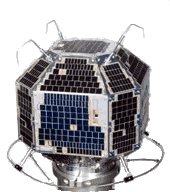
Fuji-OSCAR 29 (JAS 2) Credit: JAMSAT

Designated as Fuji-OSCAR 29 after achieving orbit, JAS 2 has long been one of the most popular and most useful linear satellites available to amateurs. However, as the satellite approaches 30 years of age, its batteries have long-since failed. It only continues to operate while the sun is illuminating its solar panels.

On March 9, FO-29 will begin orbiting in full sunlight, without periodic eclipses.

In mid-February, the duration of the shadow decreases from about 20 minutes to about 1 minute per day. Therefore, FO-29’s transmitter may suddenly come to life unexpectedly. Amateurs are encouraged to monitor the satellite and to update its activity on the AMSAT OSCAR Satellite Status page, https://www.amsat.org/status/.

Please enjoy using FO-29 while it remains available!

[ANS thanks Akira Kaneko, JA1OGZ, of JAMSAT for the above information.]


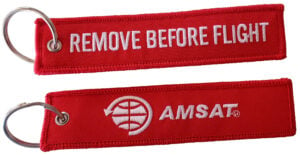
AMSAT Remove Before Flight Key Tags Now Available
Yes, These are the Real Thing!
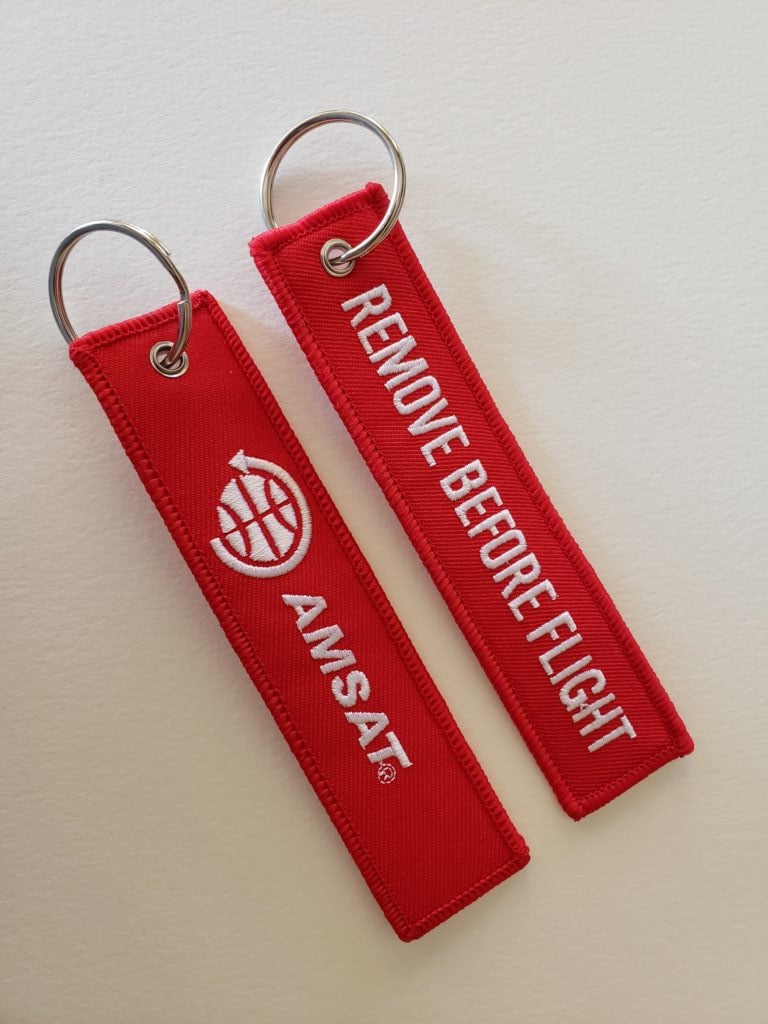
Your $20 Donation Goes to Help Fly a Fox-Plus Satellite
Includes First Class Postage (Sorry – U.S. Addresses Only)
Order Today at https://www.amsat.org/product/amsat-remove-before-flight-keychain


Gridmaster Top 100 Rovers for February 2026

The February 2026 rankings for the Top 100 Rovers (Mixed LEO/MEO/GEO) in satellite operations, as determined by @GridMasterMap on Twitter, has been released. The ranking is determined by the number of grids and DXCC entities activated, taking into account only those grids where a minimum number of QSOs logged on the gridmaster.fr website have been validated by a third party. Grid numbers do not directly reflect the exact number of activations. Satellite operators are encouraged to upload their LoTW satellite contacts to https://gridmaster.fr in order to provide more accurate data.

1 ND9M 26 BA1PK 51 KE0WPA 76 HB9GWJ
2 NJ7H 27 KX9X 52 WD5GRW 77 VA7LM
3 UT1FG 28 KG5CCI 53 KE0PBR 78 DL4EA
4 JA9KRO 29 DJ8MS 54 XE3DX 79 N8RO
5 N5UC 30 N5BO 55 BA8AFK 80 SP5XSD
6 F5VMJ 31 ON4AUC 56 LU4JVE 81 N6UTC
7 DL6AP 32 K8BL 57 W7WGC 82 N4UFO
8 DP0POL 33 KE4AL 58 PR8KW 83 VE7PTN
9 WI7P 34 KB5FHK 59 JK2XXK 84 PT2AP
10 K5ZM 35 AC0RA 60 EA4NF 85 VE1VOX
11 OE3SEU 36 PA3GAN 61 EB1AO 86 AA8CH
12 WY7AA 37 F4BKV 62 XE1ET 87 KB2YSI
13 LU5ILA 38 KI0KB 63 N6DNM 88 KI7UXT
14 N6UA 39 JO2ASQ 64 W8LR 89 AF5CC
15 HA3FOK 40 KI7UNJ 65 W1AW 90 KJ7NDY
16 OH2UDS 41 VA3VGR 66 KI7QEK 91 BI1MHK
17 W5PFG 42 VE3HLS 67 SM3NRY 92 PT9BM
18 AK8CW 43 BG7QIW 68 KE9AJ 93 FG8OJ
19 N9IP 44 LA9XGA 69 F4DXV 94 BG5CZD
20 AD0DX 45 HJ5LVR 70 VE1CWJ 95 YU0W
21 AD0HJ 46 VK5DG 71 AA5PK 96 PU4CEB
22 DL2GRC 47 N7AGF 72 AD7DB 97 W8MTB
23 N4AKV 48 DF2ET 73 KM4LAO 98 N4DCW
24 ND0C 49 K7TAB 74 PU6JBN 99 WA9JBQ
25 WD9EWK 50 JL3RNZ 75 M1DDD 100 PS8BR

[ANS thanks Gridmaster.fr  for the above information.]


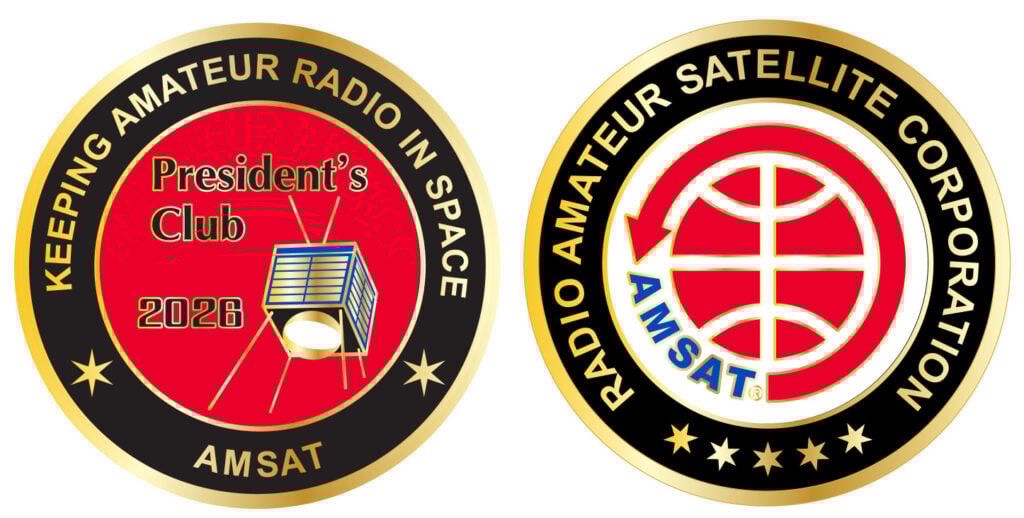
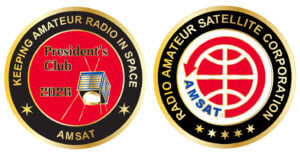
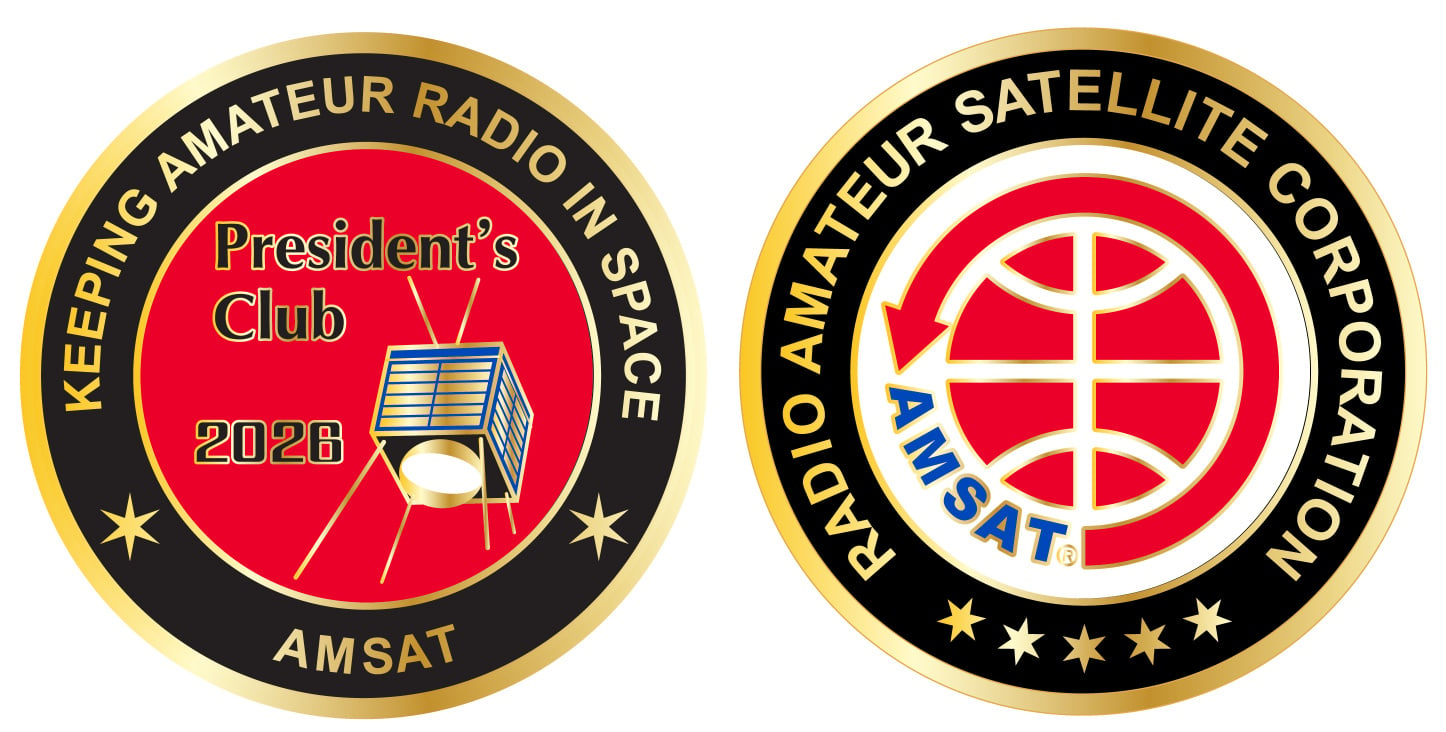
The 2026 President’s Club Coin is Now Available!
Help Support GOLF and FoxPlus.

Annual memberships start at only $120
Join the AMSAT President’s Club today and help
Keep Amateur Radio in Space!
https://www.amsat.org/join-the-amsat-presidents-club/


VUCC Satellite Standing February 2026

VUCC Satellite Award/Endorsement Change Summary for January 01, 2026 to February 01, 2026.

Call Jan Feb
DF2ET 1700 1801
DG7RO 1504 1600
PS8ET 1000 1216
EA2AA 1135 1170
JL1SAM 905 1008
JS1LQI 808 825
PA7RA 534 604
XE2YWH 595 600
HB9BIN 356 460
WO3T 437 450
OH3DP 352 401
IK8YTA 300 332
PU5DDC 254 258
EA4DEI 200 250
XE1R 105 237
G4BWP 200 220
I2OIM 155 206
WB5TX 160 165
W1AW 103 134
PU4FAR New 100
YB0OSU New 100

Congratulations to the new VUCC Satellite holders.

PU4FAR
YB0OSU

PU4FAR is first VUCC Satellite holder from GH83

[ANS thanks Jon Goering, N7AZ, for the above information.]


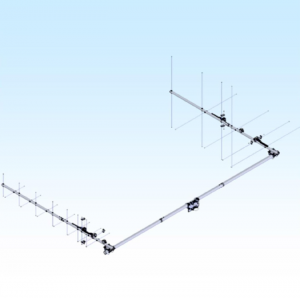
Need new satellite antennas?
Purchase M2 LEO-Packs from the AMSAT Store.

When you purchase through AMSAT, a portion of the proceeds goes towards
Keeping Amateur Radio in Space.
https://amsat.org/product-category/hardware/


DXCC Satellite Standing for February 2026

DXCC Satellite Award/Endorsement Change Summary for January 01, 2026 to February 01, 2026.

Call Jan Feb
HB9BZA 196 204
PY2RN 166 192
YO2CMI 185 186
VU2LBW 166 174
ON4AOI 156 167
HB9GWJ 150 154
EA3GP 103 153
LA7XK 118 119
IK8YTA 107 118
K6FW 102 104

[ANS thanks Jon Goering, N7AZ, for the above information.]


SDR Gen 2 Ad - 2026


SpaceX Grounds its Falcon 9 Rocket

SpaceX has temporarily grounded its workhorse Falcon 9 rocket, which is slated to launch four astronauts next week.

A Falcon 9 delivered 25 of SpaceX’s Starlink satellites into low Earth orbit (LEO) as planned on Monday (Feb. 2). But, after deploying the payloads, the rocket’s upper stage failed to perform its deorbit burn, which was designed to bring it down for controlled destruction in Earth’s atmosphere.

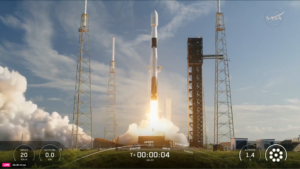
Northrop Grumman’s Cygnus XL cargo craft lifts off atop SpaceX Falcon 9 rocket from Florida’s Cape Canaveral Space Force Station
to the International Space Station in September, 2025. Credit: NASA+

The Falcon 9 is the world’s busiest rocket by far. It launched a record-breaking 165 times in 2025 and already has 14 liftoffs until its belt this year.

The rocket is incredibly reliable, too. All of last year’s missions were successful, and just a single one — a Starlink launch on March 3 — experienced a significant anomaly.

It’s unclear how long this new launch hiatus will last. But both SpaceX and NASA doubtless hope the issue is resolved soon, for a very high-profile Falcon 9 launch is coming up — that of the Crew-12 astronaut mission to the International Space Station (ISS).

Crew-12 is scheduled to include NASA astronauts Jack Hathaway, KJ5NIV, and Jessica Meir, as well as French astronaut Sophie Adenot, KJ5LTN, and Russian cosmonaut Oleg Artemyev. Their SpaceX Dragon capsule has been scheduled for launch atop a Falcon 9 rocket on February 11.

[ANS thanks Space.com for the above information. See the full article at https://www.space.com/space-exploration/launches-spacecraft/spacex-grounds-its-falcon-9-rocket-after-a-problem-with-its-upper-stage-will-the-crew-12-astronaut-mission-be-affected]


Declassifying JUMPSEAT: An American Pioneer in Space

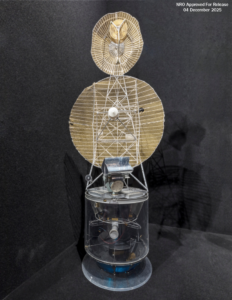
The director of the National Reconnaissance Office (NRO) recently declassified the existence of JUMPSEAT: the United States’ first-generation, highly elliptical orbit (HEO) signals-collection satellite.

Launched from 1971 to 1987 under mission numbers 7701 to 7708, JUMPSEAT was the product of the United States Air Force’s (USAF) program at the NRO. Developed under a program called “Project EARPOP,” JUMPSEAT offered the U.S. a way of collecting intelligence during unprecedented geopolitical change and Cold War tensions that lasted until the early 1990s.

JUMPSEAT Model_2_1 Credit: NRO

The NRO and USAF, collaborating as a part of NRO’s “Program A,” were tasked with developing a foundational HEO signals collection satellite to bolster the U.S. government’s space intelligence portfolio. Named JUMPSEAT, the new satellite would be capable of operating in a highly ellipical, or Molniya, orbit. [Editor’s Note: These orbits are very similar to those that were used by amateur radio satellites AO-10, AO-13, and AO-40 in the 1980s and -90s.]

Together, the NRO and the USAF launched the first JUMPSEAT mission in 1971 from Vandenberg Air Force Base (now Vandenberg Space Force Base) in California. Once in orbit, JUMPSEAT successfully collected electronic emissions and signals, communication intelligence, and foreign instrumentation intelligence: invaluable information that was downlinked to ground processing facilities within the U.S. From there, the data was provided to the Department of Defense, the National Security Agency, and other national security elements.

Over the decades, JUMPSEAT satellites continued to prove their worth to signals intelligence, finally operating in transponder mode until they were taken out of service in 2006.

[ANS thanks the National Reconnaissance Office for the above information. Read the full article at https://www.nro.gov/news-media-featured-stories/news-media-archive/News-Article/Article/4392223/declassifying-jumpseat-an-american-pioneer-in-space/]


Changes to AMSAT TLE Distribution for February 6

Two Line Elements or TLEs, often referred to as Keplerian elements or keps in the amateur community, are the inputs to the SGP4 standard mathematical model of spacecraft orbits used by most amateur tracking programs. Weekly updates are completely adequate for most amateur satellites. TLE bulletin files are updated daily in the first hour of the UTC day. New bulletin files will be posted immediately after reliable elements become available for new amateur satellites. More information may be found at https://www.amsat.org/keplerian-elements-resources/.

This week there are no additions or deletions to the AMSAT TLE distribution.

[ANS thanks Joe Fitzgerald, KM1P, AMSAT Orbital Elements Manager, for the above information.]


Kenya to Represent Africa in ARISS Program 2026

Kenya is set to make history in 2026 after being selected to host the Amateur Radio on the International Space Station (ARISS) program, a global initiative that enables the public to communicate live with astronauts aboard the International Space Station (ISS).

The Kenya Space Agency announced the selection, positioning the country at the heart of an international effort to advance space education and public engagement in science. Kenya is the only African nation chosen for the 2026 ARISS cycle, a milestone expected to spark interest in science, technology, engineering and mathematics (STEM) and inspire innovation across the country.

According to the agency, the hosting window will run between July and December 2026. During this period, Kenyan students, professionals and members of the public will take part in live radio sessions with astronauts on the ISS. Participants will have the opportunity to ask questions and receive real-time answers about daily life in orbit, scientific research conducted on board and the realities of living and working in space.

The Kenya Space Agency will oversee preparations for the event in collaboration with Pan-African Citizen Science e-Laboratory mentor and agency liaison Harold Safary. Planning efforts will include technical coordination, public outreach and the selection of participants, with an open call to be issued for interested individuals and institutions wishing to take part in the live ISS contacts.

The 2026 ARISS program will offer Kenyans a rare opportunity to speak directly with astronauts aboard the ISS, marking a significant step in the country’s engagement with global space initiatives and space education.

[ANS thanks Satellite Pro Middle East for the above information. Read the full article at https://satelliteprome.com/news/kenya-to-represent-africa-in-iss-ariss-programme-2026/]


ARISS News

Amateurs and others around the world may listen in on contacts between amateurs operating in schools and allowing students to interact with astronauts and cosmonauts aboard the International Space Station. The downlink frequency on which to listen is 145.800 MHz worldwide.

RECENTLY COMPLETED
School No. 4, Semenov, Nizhny Novgorod Region, Russia, direct via UB3TBX
The ISS callsign was scheduled to be RSØISS
The scheduled crewmember was Sergey Kud-Sverchkov
The ARISS mentor was RV3DR
Contact was successful for Thu 2026-02-05 09:14 UTC
Congratulations to the School No. 4 students, Sergey, mentor RV3DR, and ground station UB3TBX!

FBU Im. I. Kant, Kaliningrad, Russia, direct via R2FDB
The ISS callsign was scheduled to be RSØISS
The scheduled crewmember was Sergey Mikaev
The ARISS mentor was RV3DR
Contact was successful for Thu 2026-02-05 10:49 UTC
Congratulations to the FBU Im. I. Kant students, Sergey, mentor RV3DR, and ground station R2FDB!

Klimop Tongeren, Tongeren-Borgloon, Belgium, telebridge via ON4ISS
The ISS callsign was scheduled to be OR4ISS
The scheduled crewmember was Chris Williams, KJ5GEW
The ARISS mentor was ON6TI
Contact was successful for: Thu 2026-02-05 12:21:51 UTC 82 degrees maximum elevation
Congratulations to the Klimop Tongeren students, Chris, mentor ON6TI, and telebridge station ON4ISS!

UPCOMING
Hilltop Elementary, Canfield, OH, telebridge via K6DUE
The ISS callsign is presently scheduled to be NA1SS
The scheduled crewmember is Chris Williams, KJ5GEW
The ARISS mentor is KD8COJ
Contact is go for Mon 2026-02-09 18:44:58 UTC 57 deg
Watch for Livestream at https://www.youtube.com/@ARISSlive/videos and https://live.ariss.org/

Many times a school may make a last minute decision to do a Livestream or run into a last minute glitch requiring a change of the URL but we at ARISS may not get the URL in time for publication.  You can always check https://live.ariss.org/ to see if a school is Livestreaming.

As always, if there is an EVA, a docking, or an undocking; the ARISS radios are turned off as part of the safety protocol.

The crossband repeater continues to be active (145.990 MHz up {PL 67} & 437.800 MHz down),  If any crewmember is so inclined, all they have to do is pick up the microphone, raise the volume up, and talk on the crossband repeater. So give a listen, you just never know.

The packet system (145.825 MHz up & down) was scheduled for repair on February 5.

Ham TV (2395.00 MHz) is configured for scheduled digital amateur television operations.

Note, all times are approximate. It is recommended that you do your own orbital prediction or start listening about 10 minutes before the listed time.

The latest information on the operation mode can be found at https://www.ariss.org/current-status-of-iss-stations.html

The latest list of frequencies in use can be found at https://www.ariss.org/contact-the-iss.html

[ANS thanks Charlie Sufana, AJ9N, one of the ARISS operation team mentors for the above information.]


Want to fly the colors on your own grid expedition?
Get an AMSAT car flag and other neat stuff from our Zazzle store!
25% of the purchase price of each product goes towards Keeping Amateur Radio in Space


AMSAT Ambassador Activities

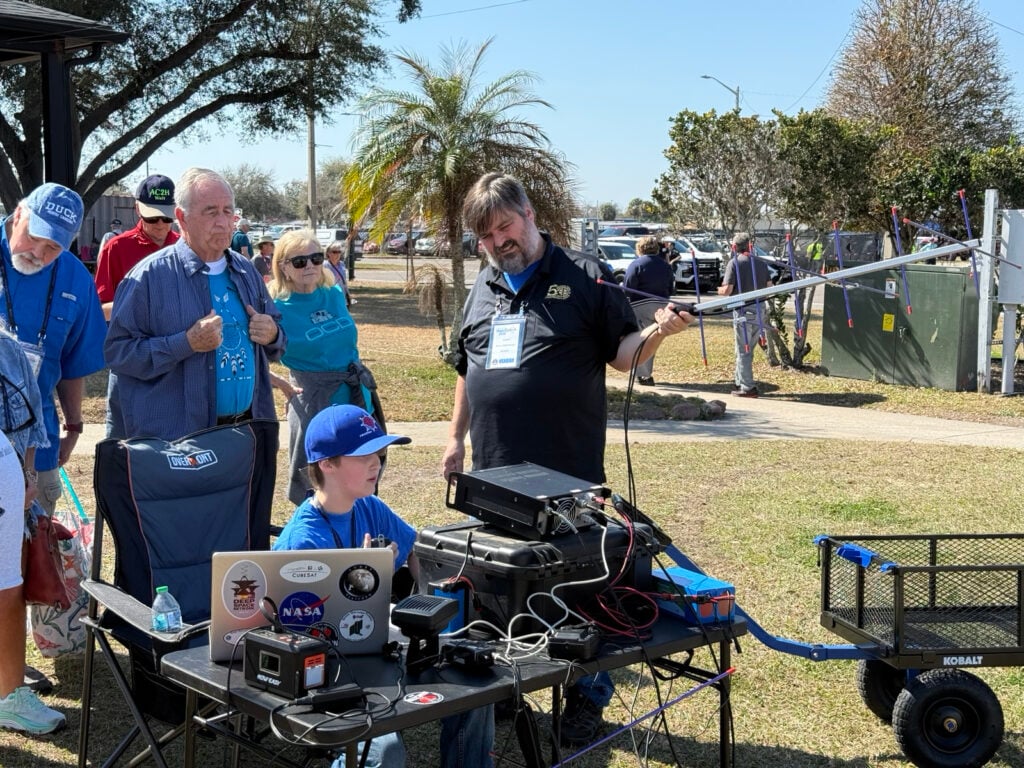
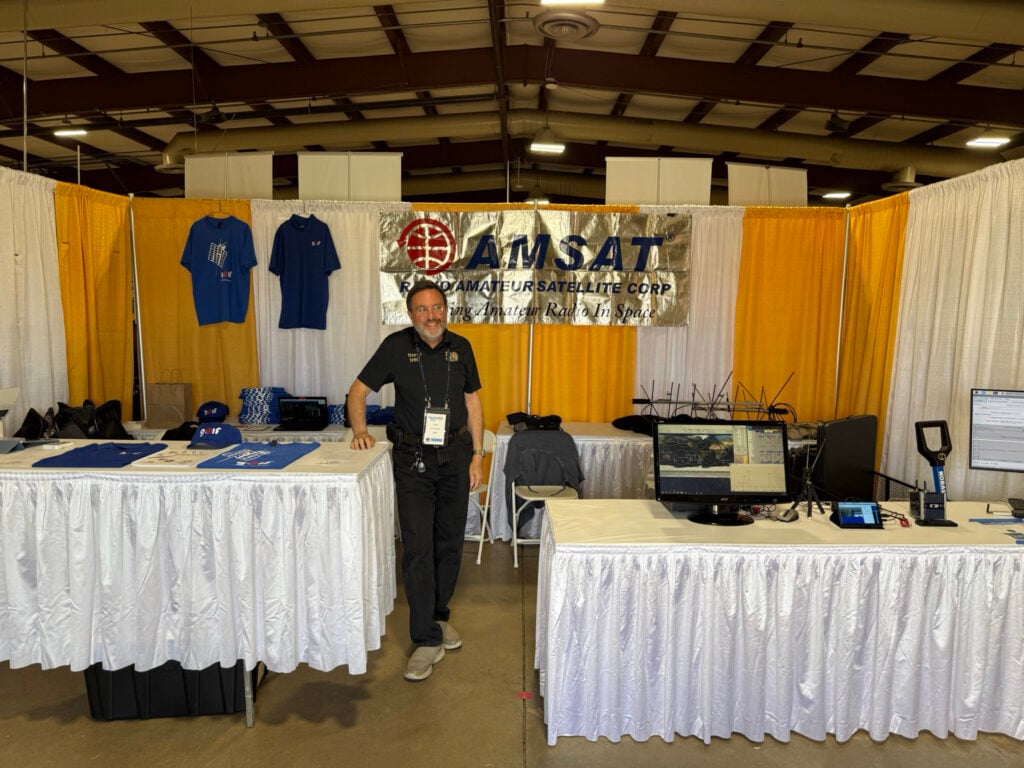
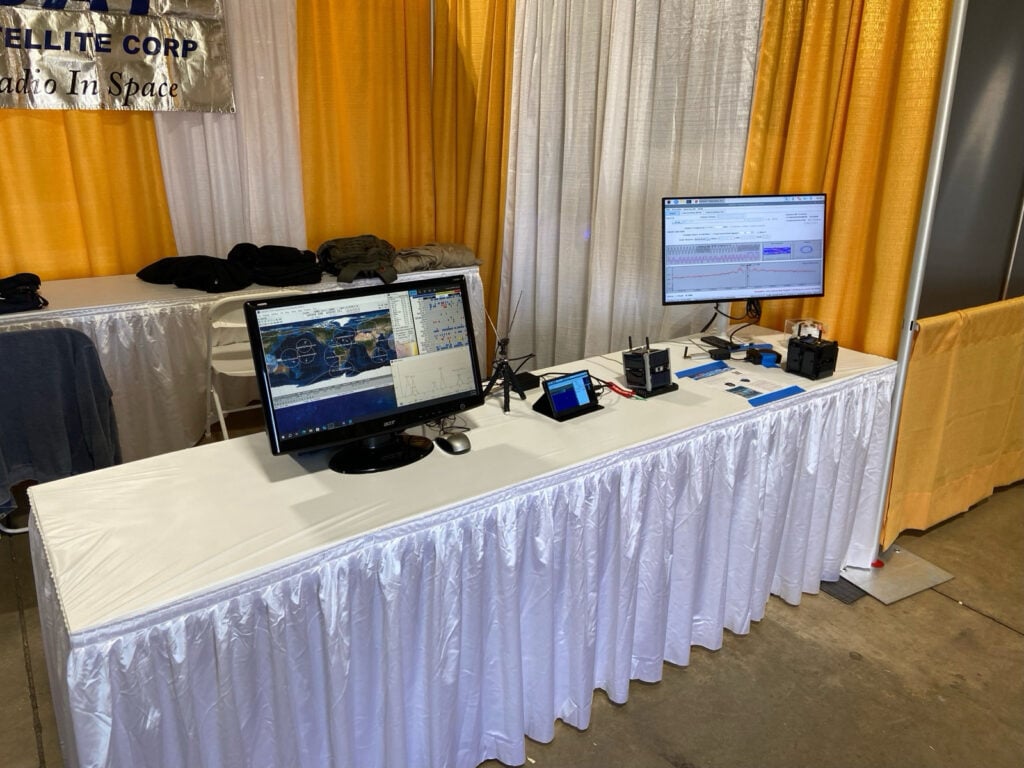
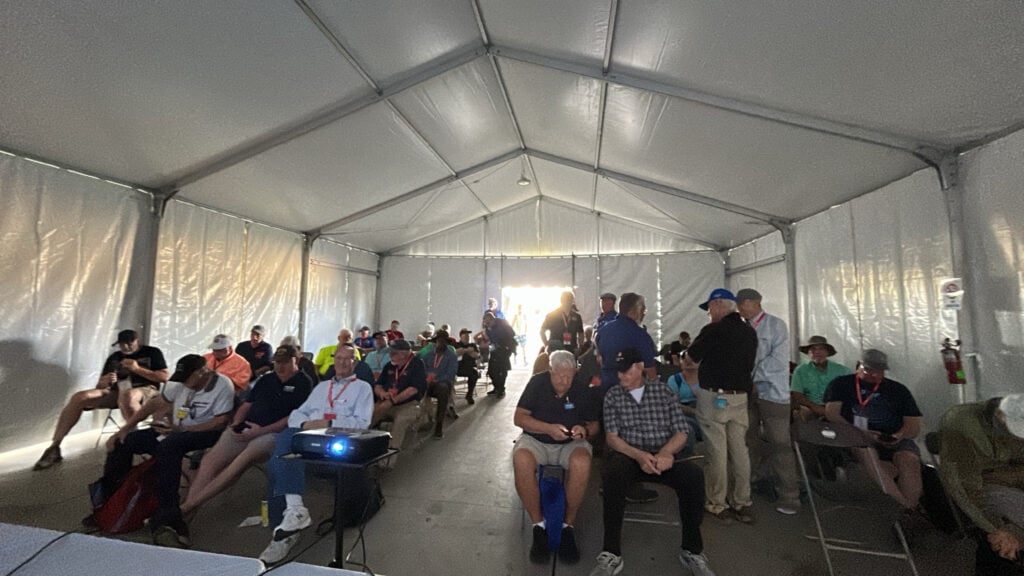
AMSAT Ambassadors provide presentations, demonstrate communicating through amateur satellites, and host information tables at club meetings, hamfests, conventions, maker faires, and other events.

February 13-15, 2026
Hamcation 2026
Central Florida Fairgrounds and Expo Park
Colonial Drive
Orlando, Florida
AMSAT will have a table and many items available for purchase
Contact Dave Jordan, AA4KN to volunteer n4csitwo [at] bellsouth.net

March 21, 2026
Midwinter Madness Hamfest 2026
Maple Grove Radio Club
Buffalo Civic Center
1306 County Rd 134
Buffalo, Minnesota 55313
https://k0ltc.org/midwinter-madness/
KØJM, ADØHJ, KEØPBR

Interested in becoming an AMSAT Ambassador? AMSAT Ambassadors provide presentations, demonstrate communicating through amateur satellites, and host information tables at club meetings, hamfests, conventions, maker faires, and other events.

For more information go to: https://www.amsat.org/ambassador/

[ANS thanks Bo Lowrey, W4FCL, Director – AMSAT Ambassador Program, for the above information.]


Satellite Shorts from All Over

+ In September 2025, AMSAT-DL and the Bochum Observatory jointly organized the “Bochum Space Days 2025” conference in the radome under the 20-metre antenna. The Radom was all about satellite and space research. A varied and informative program was offered, aimed at AMSAT members as well as all space enthusiasts and makers. The presentations are now available on the AMSAT-DL YouTube channel. The language of the presentation is mixed German/English and subtitles can also be optionally activated in the respective translation. Begin at https://www.youtube.com/watch?v=IW384KY6lBo&list=PLbIhjH2wj12GfMJGRwbYPFEjU7ECtjzzO (ANS thanks AMSAT-DL for the above information.)

+ The National Oceanic and Atmospheric Administration (NOAA) Space Weather Follow On – Lagrange 1 (SWFO-L1) satellite has reached its final destination—nearly one million miles away from Earth toward the sun and has been renamed SOLAR-1. The observatory is expected to begin space weather operations in Spring 2026. Read more at http://bit.ly/4bUIY1K. (ANS thanks NOAA for the above information.)

+ Edge of Space Sciences, a ham radio club in Englewood, Colorado, has been monitoring three amateur radio pico balloons as they continue to circumnavigate the globe. Two balloons were released at HamCon Colorado on October 25, 2025. EOSSP-3 has completed 5 circumnavigations and is currently lost somewhere “up north.” No signal has been heard for 4 days. EOSSP-4 has completed 7 circumnavigations and is currently approaching India. Meanwhile, EOSSP-2, launched September 18, completed its 10th circumnavigation at 19:05 UTC on February 4. The balloons can be tracked on aprs.fi at https://aprs.fi/#!call=a%2FEOSSP-2%2Ca%2FEOSSP-4%2Ca%2FEOSSP-3&timerange=259200&tail=86400. More information can be found on the club’s website, www.eoss.org. (ANS thanks ARRL for the above information.)

+ NASA is no longer planning a February launch of the Artemis 2 mission after encountering hydrogen leaks during a fueling test of the Space Launch System. In a statement early Feb. 3, NASA said it completed a wet dress rehearsal for Artemis 2 but determined the vehicle will not be ready to launch during the February window, which closes Feb. 11. Several other issues occurred during the test. A valve in Orion’s hatch pressurization system was accidentally vented during closeout work, requiring additional time to repressurize the system. Unseasonably cold temperatures, which had already delayed the rehearsal by two days, caused further issues, including delays in tanking operations and problems with cameras and other pad equipment. NASA also reported intermittent audio dropouts in communications among ground teams. The next launch period for Artemis 2 runs from March 6 to 11, with five two-hour windows available. Another launch opportunity extends from April 1 to 6. (ANS thanks SpaceNews for the above information. Read the full article at https://spacenews.com/artemis-2-slips-to-march/)


Join AMSAT today at https://launch.amsat.org/

In addition to regular membership, AMSAT offers membership to:

  • Societies (a recognized group, clubs or organization).
  • Students are eligible for FREE membership up to age 25.
  • Memberships are available for annual and lifetime terms.

Contact info [at] amsat.org for additional membership information.

73 and remember to help Keep Amateur Radio in Space!

This week’s ANS Editor,

Mark Johns, KØJM
mjohns [at] amsat.org

ANS is a service of AMSAT, the Radio Amateur Satellite Corporation, 712 H Street NE, Suite 1653, Washington, DC 20002
AMSAT is a registered trademark of the Radio Amateur Satellite Corporation.

ANS-032 AMSAT News Service Weekly Bulletins

AMSAT News Service

ANS-032
February 1, 2026

In this edition:

* NASA Selects Global Tracking Volunteers for Artemis II Lunar Mission
* Thailand’s KNACKSAT-2 CubeSat Preparing for Deployment from the ISS
* CubeSatSim Satellite Emulator Kits Now Available in the AMSAT Store
* Open.Space Phased Array Project Targets Low-Cost EME for Hams
* Changes to AMSAT-NA TLE Distribution for January 30, 2026
* ARISS News
* AMSAT Ambassador Activities
* Satellite Shorts From All Over

The AMSAT® News Service bulletins are a free, weekly news and information service of AMSAT, The Radio Amateur Satellite Corporation. ANS publishes news related to Amateur Radio in Space including reports on the activities of a worldwide group of Amateur Radio operators who share an active interest in designing, building, launching and communicating through analog and digital Amateur Radio satellites.

The news feed on https://www.amsat.org publishes news of Amateur Radio in Space as soon as our volunteers can post it.

Please send any amateur satellite news or reports to: ans-editor [at] amsat.org

You can sign up for free e-mail delivery of the AMSAT News Service Bulletins via the ANS List; to join this list see: https://mailman.amsat.org/postorius/lists/ans.amsat.org/


NASA Selects Global Tracking Volunteers for Artemis II Lunar Mission

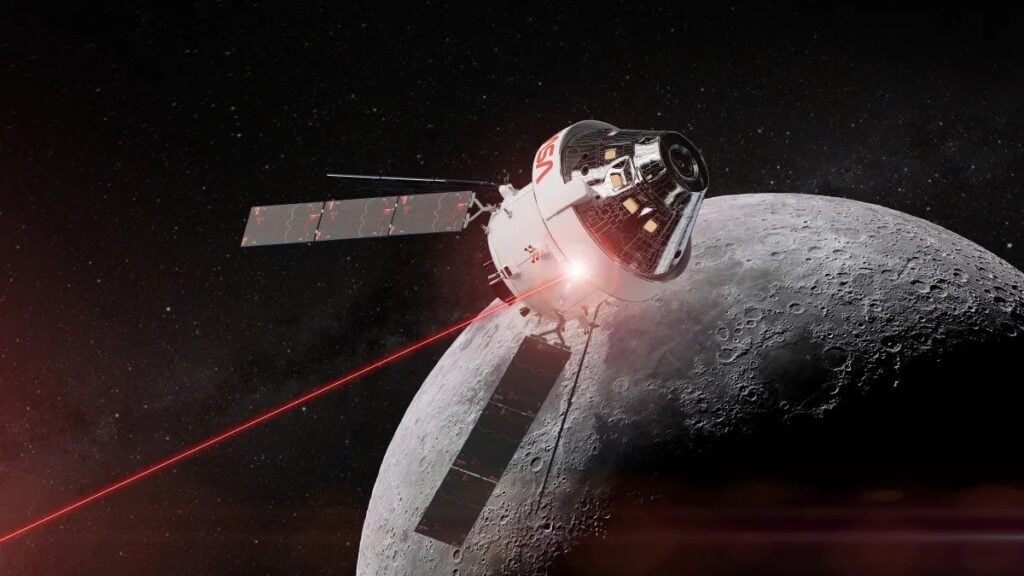
NASA has selected 34 volunteer organizations and individuals from around the world to help track the Orion spacecraft during the upcoming crewed Artemis II mission, which will carry four astronauts on a journey around the Moon. The selected participants include commercial service providers, universities, government agencies, nonprofit organizations, and individual amateur radio operators, reflecting a broad international collaboration supporting humanity’s return to deep space.

While NASA’s Near Space Network and Deep Space Network will provide primary communications and navigation support, the volunteers will passively track radio signals transmitted by Orion during its approximately 10-day mission. Participants were chosen from proposals submitted in August 2025. They will submit tracking data to NASA for analysis, helping the agency evaluate broader aerospace and amateur radio tracking capabilities. No funding is exchanged as part of this collaborative effort.

“This is a real step toward SCaN’s commercial-first vision,” said Kevin Coggins, NASA’s deputy associate administrator for Space Communications and Navigation (SCaN). “By inviting external organizations to demonstrate their capabilities during a human spaceflight mission, we’re strengthening the marketplace we’ll rely on as we explore farther into the solar system. This isn’t about tracking one mission, but about building a resilient, public-private ecosystem that will support the Golden Age of innovation and exploration.”

NASA’s Orion spacecraft will also use infrared optical communications to return high-rate data during Artemis II. [Credit: NASA]
The initiative builds on a similar effort during Artemis I in 2022, when 10 volunteers successfully tracked Orion and provided valuable lessons on data formatting, quality, and standards compliance. For Artemis II, SCaN now requires all submitted tracking data to meet its system standards. Public interest has increased significantly, with about 47 ground assets across 14 countries expected to support the mission.

Amateur radio organizations and enthusiasts are well represented in the selected group. Participants include AMSAT Argentina, AMSAT Deutschland, the Amateur Radio Exploration Ground Station Consortium, CAMRAS in the Netherlands, the Deep Space Exploration Society in Colorado, and several individual operators, including Scott Tilley of Canada. Their involvement highlights the growing technical capability of the global amateur radio community to contribute meaningfully to deep-space missions.

Although NASA has formally selected a limited group to submit official tracking data, anyone with appropriate equipment can attempt to track Artemis II independently, either by monitoring Orion’s radio emissions or by observing the spacecraft optically with a telescope during its trans-lunar coast. NASA has emphasized that it is simply accepting data from a designated group and is not restricting independent observation. For amateur astronomers and radio operators alike, Artemis II offers a rare opportunity to witness — and participate in — humanity’s return to deep-space exploration.

Read the full article at: https://www.nasa.gov/technology/space-comms/nasa-selects-participants-to-track-artemis-ii-mission/

[ANS thanks Katrina Lee, NASA, and Scott Tilley, VE7TIL, for the above information]


Thailand’s KNACKSAT-2 CubeSat Preparing for Deployment from the ISS

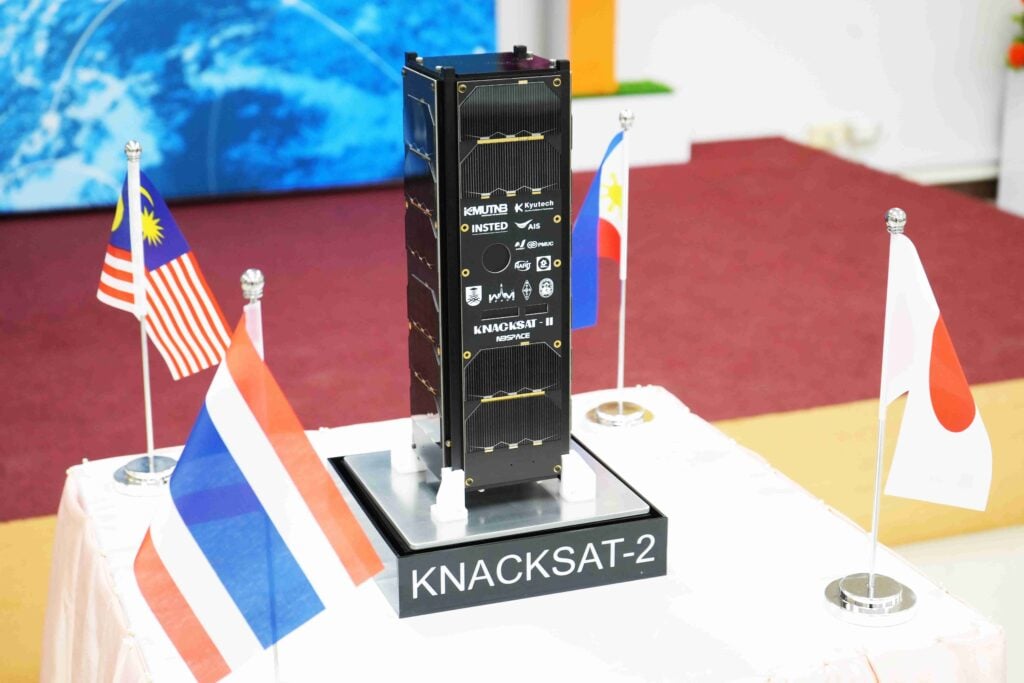
Thailand’s KNACKSAT-2 satellite is preparing for deployment from the International Space Station, with release currently scheduled for February 3, 2026 at 08:55 UTC (03:55 AM EST). The mission continues Thailand’s university-led CubeSat development program following the earlier KNACKSAT-1 mission. The project is led by King Mongkut’s University of Technology North Bangkok in Thailand, working with domestic and international partners to advance satellite engineering, payload integration, and on-orbit operations. The deployment is expected to be viewable live online via the project livestream at https://www.youtube.com/watch?v=aB4PIOS-hSs.

KNACKSAT-2 was transported to the International Space Station in late 2025 and is a 3U CubeSat designed to host multiple payloads. The satellite expands on KNACKSAT-1, which demonstrated Thailand’s ability to design and build a satellite domestically. Development and testing were conducted in cooperation with NBSPACE and other academic and research partners. The mission is intended to help Thailand develop multi-payload CubeSat platforms and prepare for future ride-share launch opportunities.

The satellite carries both educational and research payloads. Non-amateur missions include an Earth imaging camera, a store-and-forward IoT data collection system for remote sensors, ultraviolet radiation measurement instrumentation, and in-orbit evaluation of space-qualified components. These payloads are part of broader national workforce development programs coordinated through the Thai Space Consortium and academic partner networks. The satellite will be operated in orbit using ground stations located in Thailand.

KNACKSAT-2 is a Thai-developed 3U CubeSat designed as a multi-payload platform for in-orbit technology demonstration. [Credit: PMUC]

KNACKSAT-2 also supports amateur radio operations through an APRS digipeater payload developed in cooperation with the Radio Amateur Society of Thailand. The amateur payload operates using coordinated frequencies through the International Amateur Radio Union (IARU) satellite frequency coordination process. The APRS digipeater system uses 145.825 MHz for uplink and downlink using FSK modulation at 9600 bps with AX.25 framing. The amateur satellite callsign assigned to the mission is HSØK.

In addition to amateur payloads, the spacecraft transmits engineering telemetry on 400.630 MHz using FSK at 9600 bps with AX.25 framing and a one-minute beacon interval. Following deployment, project coordinators have requested assistance from the monitoring community to receive, decode, and submit telemetry reports from the 400.630 MHz downlink, which is outside the amateur radio allocation. Many satellite observers actively search for newly deployed spacecraft and contribute reception reports, helping mission teams verify spacecraft health and early on-orbit performance. The satellite is expected to rotate in orbit, and ground stations are recommended to use circular polarization, with RHCP preferred, to improve reception reliability.

KNACKSAT-2 continues the growing trend of university-driven satellite programs contributing technical capability, education, and operational experience to the global amateur satellite community. University-built satellites are playing an increasing role in expanding access to space while supporting educational outreach and new opportunities for amateur radio experimentation.

For more information:

[ANS thanks Tanan Rangseeprom, HS1JAN, and the IARU for the above information]


SDR Gen 2 Ad - 2026


CubeSatSim Satellite Emulator Kits Now Available in the AMSAT Store

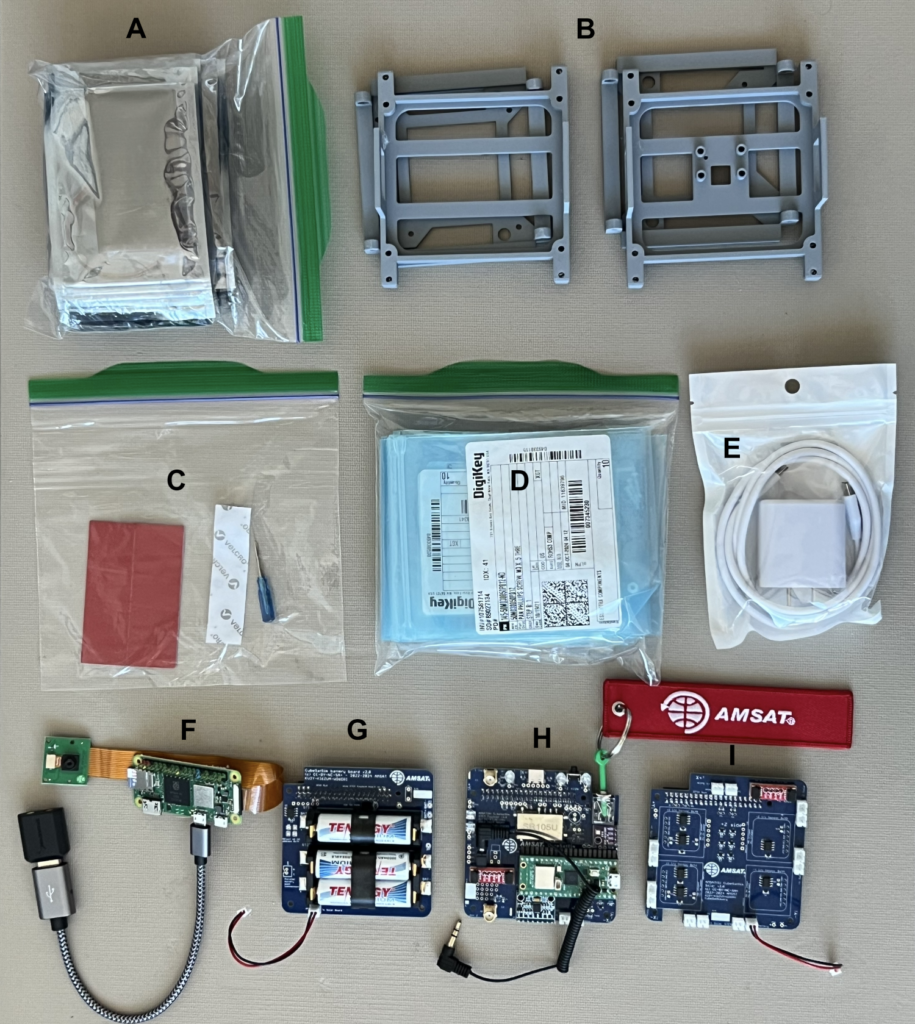
CubeSatSim is an educational satellite emulator designed to provide a hands-on introduction to space communications, telemetry, and satellite systems. Kits are now available for purchase through the AMSAT Store (https://www.amsat.org/product/cubesatsim-kit). Priced at $550 with shipping included for U.S. addresses, the CubeSatSim Kit requires no soldering and only minimal assembly, making it ideal for educational use and public demonstrations.

The CubeSatSim Kit includes:

  • Fully assembled and tested PCBs (Main, Solar, and Battery Boards)
  • Raspberry Pi Zero 2 with a Pi Camera and fully programmed micro-SD card, along with a fully programmed Raspberry Pi Pico WH
  • AMSAT logo “Remove Before Flight” tag switch
  • 3D printed frame, nylon screws, and nuts, with a mini screwdriver included for assembly
  • Metal standoffs, stacking headers, and JST jumpers for stacking the PCBs and Pi Zero 2
  • 10 solar panels with pre-soldered JST connectors and mounting tape
  • BME280 sensor (pressure, temperature, altitude, humidity) and MPU6050 IMU/gyro pre-soldered
  • Two 6″ SMA coax cables and two SMA antennas

The kit also comes with an instruction sheet, parts inventory, and links to online instructions. Assembly time is estimated to be under two hours, with scissors and the provided mini screwdriver.

CubeSatSim kit hardware and components are now available for purchase through the AMSAT Store.

The v2.0 CubeSatSim features improvements over v1.2, such as an FM transceiver, Raspberry Pi Pico microcontroller, and RF command and control using DTMF or APRS packets. It can also be modified to function as a 500 mW high altitude balloon payload.

For those interested in creating their own CubeSatSim, v2.0 blank PCB sets are available at the AMSAT Store for $35. These require additional components, which can be purchased for approximately $400 using the provided Bill of Materials.

Additional resources include:

Kit Instructions https://cubesatsim.org/kit
Kit Videos https://cubesatsim.org/kit-videos
Discussion Forum https://github.com/alanbjohnston/CubeSatSim/discussions
Quick Start Guide https://cubesatsim.org/qsg

How to Order
Kits are sold exclusively through the AMSAT Store.
Only U.S. shipping addresses are eligible; orders with non-U.S. addresses will be refunded and closed.

About CubeSatSim
CubeSatSim is a low-cost satellite emulator powered by solar panels and batteries. It transmits UHF radio telemetry and can be expanded with additional sensors and modules, making it ideal for educational and public demonstrations.

[ANS thanks Alan Johnston, KU2Y, AMSAT Vice President Educational Relations for the above information]


Open.Space Phased Array Project Targets Low-Cost EME for Hams

An upcoming open-source hardware project called Open.Space aims to lower the barrier to Earth-Moon-Earth (EME) communications for amateur radio operators by using a modular, software-defined phased-array system instead of traditional large dish antennas. EME, or moonbounce, involves transmitting a signal toward the Moon, reflecting it off the lunar surface, and receiving it back on Earth. Historically, this has required large high-gain antennas, high-power transmitters, and precise mechanical tracking, putting it out of reach for many amateurs.

Open.Space proposes using electronically steerable phased arrays built from small, low-cost software-defined radio (SDR) tiles. A phased array combines the signals from many small antennas using precise timing delays, allowing radio beams to be steered electronically without motors or moving parts. This enables rapid tracking, improved interference rejection, and compact, low-profile installations. A familiar consumer example of phased-array technology is the flat-panel antenna used by Starlink satellite internet terminals.

At the core of the system is the Open.Space Quad tile, a 4-antenna SDR module covering 4.9 to 6.0 GHz in the C-band. Each tile supports 40 MHz of bandwidth using an 8-bit ADC and delivers about 1 watt of transmit power per antenna. The tiles can operate as standalone 4×4 MIMO SDRs for RF experimentation, direction finding, or digital communications, or they can be combined into larger phased-array structures.

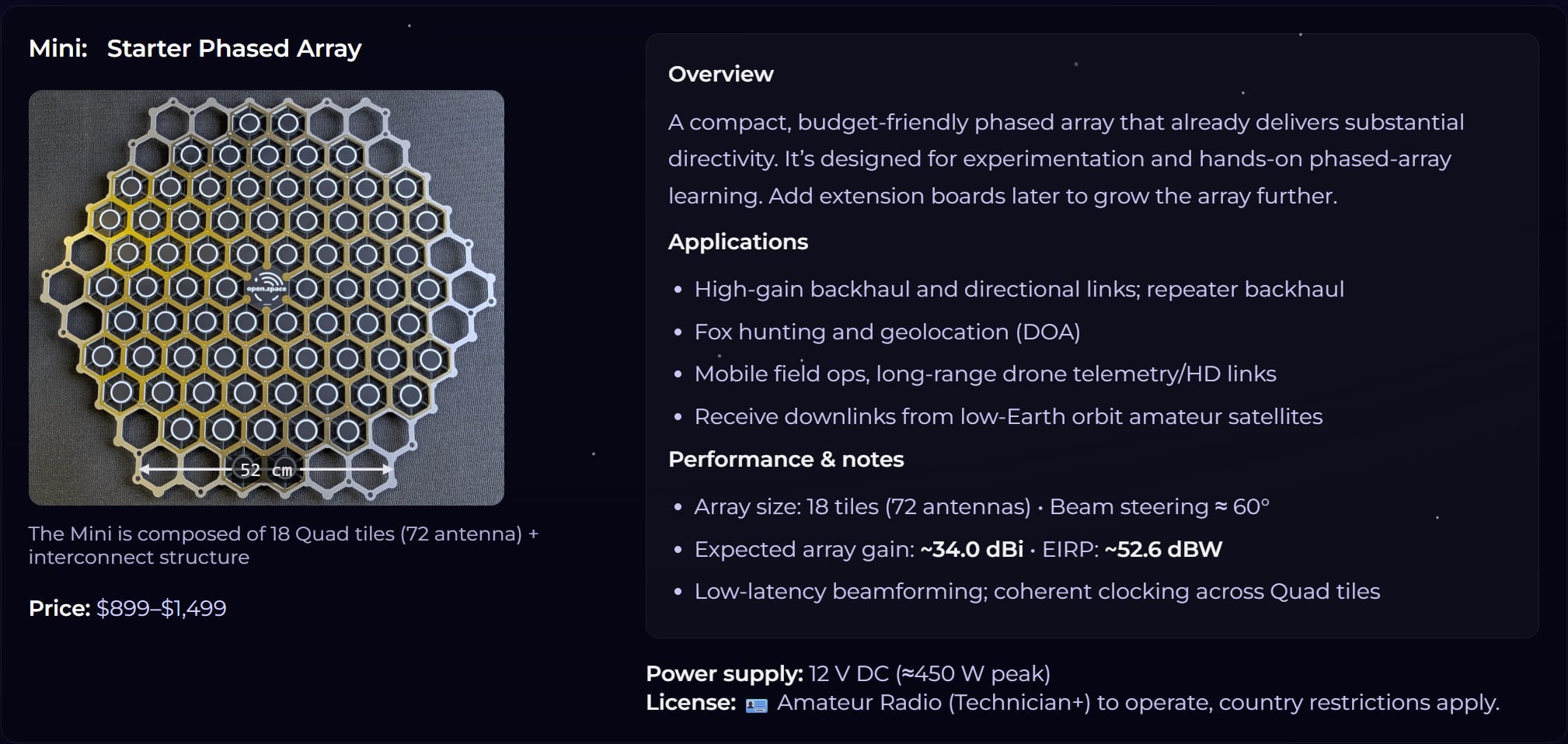
The Open.Space Mini phased array uses 18 Quad tiles to form a compact, electronically steerable antenna system. [Credit: Open.Space]

Multiple tiles can be assembled into phased arrays using a modular lattice frame. The “Mini” starter array consists of 18 tiles, totaling 72 antennas. It is expected to provide roughly 34 dBi of gain, about 52.6 dBW of EIRP, and up to 60 degrees of electronic beam steering. While the Mini configuration is not large enough for moonbounce, it is intended for learning, experimentation, satellite downlinks, and long-range directional links.

For full EME capability, Open.Space proposes the “Moon” array, built from 60 tiles and 240 antennas in a one-meter-wide aperture. This configuration is expected to deliver around 39.3 dBi of gain and 63.1 dBW of EIRP, making moonbounce experiments feasible. Additional planned applications include radio astronomy, RF imaging, and advanced phased-array research.

One of the most notable aspects of the project is its proposed cost in U.S. dollars. Individual tiles are expected to sell for approximately $49 to $99 USD. The Mini array is projected at $899 to $1,499 USD, and the Moon array at $2,499 to $4,999 USD—significantly less than traditional EME hardware setups. The Open.Space hardware has not yet been released, but the project website lists March 2026 as the expected shipping date. The developers note that the system is not intended for radar applications due to export-control restrictions. Those interested can sign up on the Open.Space website to receive email updates when the hardware becomes available.

[ANS thanks Open.Space and RTL-SDR.com for the above information]


The 2026 Coins Are Here! Help Support GOLF-TEE and FoxPlus.
Annual memberships start at only $120.

Presidents' Club 2026 Coin

Join the AMSAT President’s Club today and help Keep Amateur Radio in Space!
https://www.amsat.org/join-the-amsat-presidents-club/


Changes to AMSAT TLE Distribution for January 30, 2026

Two Line Elements or TLEs, often referred to as Keplerian elements or keps in the amateur community, are the inputs to the SGP4 standard mathematical model of spacecraft orbits used by most amateur tracking programs. Weekly updates are completely adequate for most amateur satellites. TLE bulletin files are updated daily in the first hour of the UTC day. New bulletin files will be posted immediately after reliable elements become available for new amateur satellites. More information may be found at https://www.amsat.org/keplerian-elements-resources/.

An alternate source for TLE for IO-86 has been identified, and it has been re-added to the AMSAT TLE distribution.

The following satellite has been removed from this week’s AMSAT TLE distribution:

GHS-01 NORAD Cat ID 65733, Decayed from orbit on or about 20 Jan 2025

[ANS thanks Joe Fitzgerald, KM1P, AMSAT Orbital Elements Manager, for the above information]


ARISS News

Amateurs and others around the world may listen in on contacts between amateurs operating in schools and allowing students to interact with astronauts and cosmonauts aboard the International Space Station. The downlink frequency on which to listen is 145.800 MHz worldwide.

Scheduled Contacts

+ Recently Completed

Conn Magnet Elementary School, Raleigh, NC., direct via K4EB
The ISS callsign was NA1SS
The scheduled crewmember was Chris Williams KJ5GEW
The ARISS mentor was AA6TB
Contact was successful: Fri 2026-01-30 15:10:30 UTC
Watch for Livestream at https://youtube.com/live/tOj-SpbmA30?feature=share and https://live.ariss.org/

+ Upcoming Contacts

Aznakaevsky District of the Republic of Tatarstan, Russia, direct via TBD
The ISS callsign is presently scheduled to be RSØISS
The scheduled crewmember is Sergey Mikaev
The ARISS mentor is RV3DR
Contact is go for: Mon 2026-02-02 09:55 UTC

School No. 4, Semenov, Nizhny Novgorod Region, Russia, direct via TBD
The ISS callsign is presently scheduled to be RSØISS
The scheduled crewmember is Sergey Mikaev
The ARISS mentor is RV3DR
Contact is go for: Tue 2026-02-03 10:45 UTC

Lyceum No. 23, Kaliningrad, Russia, direct via TBD
The ISS callsign is presently scheduled to be RSØISS
The scheduled crewmember is Sergey Mikaev
The ARISS mentor is RV3DR
Contact is go for: Thu 2026-02-05 10:45 UTC

Klimop Tongeren, Tongeren-Borgloon, Belgium, telebridge via ON4ISS
The ISS callsign is presently scheduled to be OR4ISS
The scheduled crewmember is Chris Williams KJ5GEW
The ARISS mentor is ON6TI
Contact is go for: Thu 2026-02-05 12:21:51 UTC

Many times, a school makes a last-minute decision to do a Livestream or runs into a last-minute glitch requiring a change of the URL, but we at ARISS may not get the URL in time for publication. You can always check https://live.ariss.org/ to see if a school is Livestreaming.

As always, if there is an EVA, a docking, or an undocking; the ARISS radios are turned off as part of the safety protocol.

The crossband repeater remains configured in the Columbus Module (145.990 MHz up {PL 67} & 437.800 MHz down). If a crewmember decides to pick up the microphone and turn up the volume, you may hear them on the air—so keep listening, as you never know when activity might occur.

The service module IORS is not currently in APRS configuration and is being used only for voice contacts at this time. HamTV in the Columbus Module is configured for scheduled digital amateur television operations on 2395.00 MHz.

Note, all times are approximate. It is recommended that you do your own orbital prediction or start listening about 10 minutes before the listed time.

The latest information on the operation mode can be found at https://www.ariss.org/current-status-of-iss-stations.html

The latest list of frequencies in use can be found at https://www.ariss.org/contact-the-iss.html

[ANS thanks Charlie Sufana, AJ9N, one of the ARISS operation team mentors for the above information]


AMSAT Ambassador Activities

AMSAT Ambassadors provide presentations, demonstrate communicating through amateur satellites, and host information tables at club meetings, hamfests, conventions, maker faires, and other events.
AMSAT Ambassador Clint Bradford, K6LCS, says,

“Think a 75-minute presentation on “working the easy satellites” would be appropriate for your club or event? Let me know by emailing me at k6lcsclint (at) gmail (dot) com or calling me at 909-999-SATS (7287)!”

Clint has NEVER given the exact same show twice: EACH of the 150+ presentations so far has been customized/tailored to their audiences.

Scheduled Events

Hamcation 2026 – February 13 thru 15, 2026
Central Florida Fairgrounds and Expo Park
4603 West Colonial Drive
Orlando, FL 32808
https://www.hamcation.com/
AMSAT will have a table and many items available for purchase
Contact Dave Jordan, AA4KN to volunteer n4csitwo [at] bellsouth.net

Midwinter Madness Hamfest 2026 – March 21, 2026
Maple Grove Radio Club
Buffalo Civic Center
1306 County Road 134
Buffalo, Minnesota 55313
https://k0ltc.org/midwinter-madness/
KØJM, ADØHJ, KEØPBR

For more information go to: https://www.amsat.org/ambassador/

[ANS thanks Bo Lowrey, W4FCL, Director – AMSAT Ambassador Program, for the above information]


AMSAT Remove Before Flight Key Tags Now Available
Yes, These are the Real Thing!

Your $20 Donation Goes to Help Fly a Fox-Plus Satellite
Includes First Class Postage (Sorry – U.S. Addresses Only)
Order Today at https://www.amsat.org/product/amsat-remove-before-flight-keychain


Satellite Shorts from All Over

+ AMSAT-HB has announced the dates for the next edition of the HB9RG Trophy, which will take place from March 2 through March 15, 2026. The competition commemorates the first amateur radio satellite contact achieved on March 10, 1965, by Hans Rudolf Lauber, HB9RG, and Alfons Häring, DL6EZA, a milestone in amateur satellite communications. Organizers report that the event will return following strong international participation and enthusiastic feedback from previous editions of the Trophy. Based on participant input, AMSAT-HB is currently revising the competition rules to improve fairness, accessibility, and the overall operating experience. These adjustments are intended to better reflect the needs and operating practices of the global satellite amateur radio community. Complete rules, participation procedures, and event updates are available on the AMSAT-HB website at https://www.amsat-hb.org/hb9rg_trophy. (ANS thanks AMSAT-HB for the above information)

+ AMSAT-Francophone has opened ticketing for the 9th Amateur Radio Space Meeting, scheduled for March 7–8, 2026, in Nanterre, France. The annual gathering brings together amateur satellite operators, spacecraft designers, students, researchers, and space enthusiasts to share projects, ideas, and technical advances. The event will be hosted at the ElectroLab Fab Lab, with free admission to all conference sessions. Attendees are asked to reserve tickets in advance to assist with organization, with meals available on site. A call for contributions remains open to everyone, offering formats that include 15–25 minute conferences, five-minute “T-minus 5” presentations, and short videos of up to three minutes. Ticket reservations and event details are available at https://www.billetweb.fr/9-eme-rencontre-spatial-radioamateur, with presentation and video submissions due by February 10, 2026. (ANS thanks AMSAT-Francophone for the above information)

+ Blue Origin successfully completed the 38th flight of its New Shepard suborbital vehicle on January 22, marking the program’s first mission of 2026. The mission, designated NS-38, launched from Blue Origin’s Launch Site One in West Texas during a morning launch window. The flight carried six people on a brief suborbital journey above the Kármán line, the internationally recognized boundary of space. The crew included Tim Drexler, Dr. Linda Edwards, Alain Fernandez, Alberto Gutiérrez, Jim Hendren, and Dr. Laura Stiles. Stiles joined the mission shortly before launch after another crew member was unable to fly due to illness. With this flight, New Shepard has now flown 98 people to space. New Shepard is Blue Origin’s operational human spaceflight system and serves as a testbed for reusable launch technologies and crewed operations. The program continues to support Blue Origin’s long-term goals for expanding human access to space. (ANS thanks Blue Origin for the above information)

+ For 21 years, from 1999 to 2020, millions of volunteers worldwide used their home computers to support SETI@home, one of the largest citizen-science efforts ever conducted. Operated by scientists at the University of California, Berkeley, the project analyzed radio data from the Arecibo Observatory and identified roughly 12 billion signals of interest. After a decade of follow-up analysis, researchers narrowed those detections to about one million candidates and then to 100 signals worthy of further investigation. Since July 2025, those targets have been reobserved using China’s Five-hundred-meter Aperture Spherical Telescope, or FAST radio telescope, which has eight times the collecting area of Arecibo. While researchers do not expect these signals to be extraterrestrial in origin, the results helped establish new sensitivity limits for large-scale SETI searches. Scientists say the project’s biggest legacy may be the lessons learned about filtering radio-frequency interference and designing future all-sky technosignature surveys. (ANS thanks UC Berkeley News for the above information)


Join AMSAT today at https://launch.amsat.org/

In addition to regular membership, AMSAT offers membership to:

  • Societies (a recognized group, clubs or organization).
  • Students enrolled in at least half-time status are eligible for free membership to age 25.
  • Memberships are available for annual and lifetime terms.

Contact info [at] amsat.org for additional membership information.

73 and remember to help Keep Amateur Radio in Space!

This week’s ANS Editor,

Mitch Ahrenstorff, ADØHJ
mahrenstorff [at] amsat.org

ANS is a service of AMSAT, the Radio Amateur Satellite Corporation, 712 H Street NE, Suite 1653, Washington, DC 20002
AMSAT is a registered trademark of the Radio Amateur Satellite Corporation.