AMSAT News Service
ANS-172
June 21, 2026
In this edition:
* 2026 AMSAT Field Next Weekend!
* 2026 AMSAT Space Symposium & Annual General Meeting
* Satellites Are The New Fire Towers
*
* Changes to AMSAT-NA TLE Distribution
* Dragon Returns Packed with Space Station Science
* ARISS News
* AMSAT Ambassador Activities
* Satellite Shorts From All Over
The AMSAT® News Service bulletins are a free, weekly news and information service of AMSAT, The Radio Amateur Satellite Corporation. ANS publishes news related to Amateur Radio in Space including reports on the activities of a worldwide group of Amateur Radio operators who share an active interest in designing, building, launching and communicating through analog and digital Amateur Radio satellites.
The news feed on https://www.amsat.org publishes news of Amateur Radio in Space as soon as our volunteers can post it.
Please send any amateur satellite news or reports to: ans-editor [at] amsat.org
You can sign up for free e-mail delivery of the AMSAT News Service Bulletins via the ANS List; to join this list see: https://mailman.amsat.org/postorius/lists/ans.amsat.org/
2026 AMSAT Field Next Weekend!
It’s that time of year again; summer and Field Day! Each year the American Radio Relay League (ARRL) sponsors Field Day as a “picnic, a campout, practice for emergencies, an informal contest and, most of all, FUN!” The event takes place during a 27-hour period on the fourth weekend of June.
For 2026 the event takes place from 1800 UTC on Saturday June 27, 2026 through 2100 UTC on Sunday June 28, 2026. Those who set up prior to 1800 UTC on June 27 can operate only 24 hours. The Radio Amateur Satellite Corporation (AMSAT) promotes its own version of Field Day for operation via the amateur satellites, held concurrently with the ARRL event.

This year should be as much fun as last year since we have more than 10 transponders and repeaters available. For AMSAT purposes, a transponder on a satellite would count as two if you could do phone and CW. We count them by modes, not the satellite names.
Users should check the AMSAT status page at http://www.amsat.org/status/ and the pages at https://www.amsat.org/two-way-satellites/ for what is available in the weeks leading up to field day. To reduce the amount of time to research each satellite, see the current FM satellite table at https://www.amsat.org/fm-satellite-frequency-summary/ and the current linear satellite table at https://www.amsat.org/linear-satellite-frequency-summary/ .
If you are considering ONLY the FM voice satellites, there are ISS and SO-50. It might be easier this year to make that one FM contact for the ARRL bonus points with so many FM birds. The congestion on FM LEO satellites is always so intense that we must continue to limit their use to one-QSO-per-FM-satellite. This includes the International Space Station. You will be allowed one QSO if the ISS is operating Voice.
It was suggested during past field days that a control station be allowed to coordinate contacts on the FM satellites. There is nothing in the rules that would prohibit this. This is nothing more than a single station working multiple QSO’s. If a station were to act as a control station and give QSO’s to every other field day station, the control station would still only be allowed to turn in one QSO per FM satellite while the other station would be able to submit one QSO.
The format for the message exchange on the ISS or other digital packet satellite is an unproto packet to the other station (3-way exchange required) with all the same information as normally exchanged for ARRL Field Day, e.g.:
W6NWG de KK5DO 2A STX
KK5DO de W6NWG QSL 5A SDG
W6NWG de KK5DO QSL
If you have worked the satellites on Field Day in recent years, you may have noticed a lot of good contacts can be made on some of the less-populated, low-earth-orbit satellites like AO-7, RS-44, AO-73, FO-29 and JO-97. During Field Day the transponders come alive like 20 meters on a weekend. The good news is that the transponders on these satellites will support multiple simultaneous contacts. The bad news is that you can’t use FM, just low duty-cycle modes like SSB and CW.
[ANS thanks Bruce Paige, KK5DO, AMSAT Director of Contests and Awards for the above information.]
Buying from Ham Radio Outlet? Add AMSAT’s Getting Started With Amateur Satellites to your order. 
Available for $29.95 from HRO https://www.hamradio.com/
2026 AMSAT Space Symposium & Annual General Meeting
The 44th AMSAT Space Symposium & Annual General Meeting will be held in Jacksonville, FL on October 8-11, 2026 at the Crowne Plaza Jacksonville Airport/I-95.
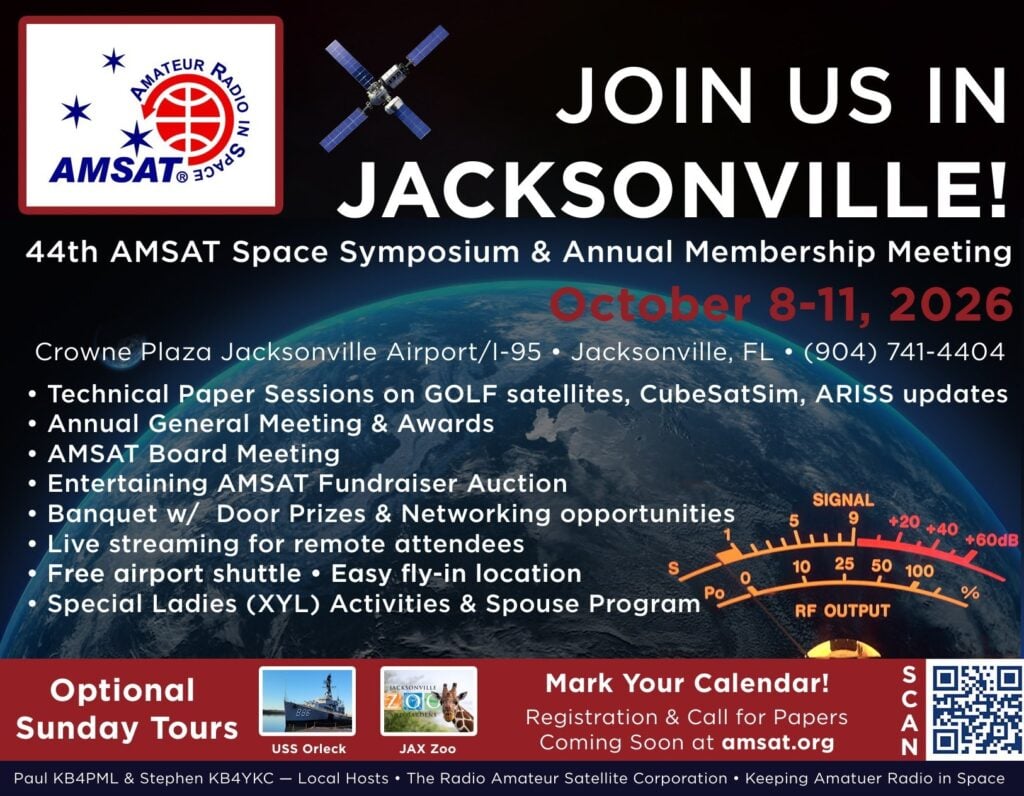 Registration details and Call for Papers will be coming soon.
To book hotel rooms online, click here: AMSAT Conference Rooms
Reservations can also be made by phone at 1-800-227-6963. The group code is AMS. The direct hotel phone number is 1-904-741-4404.
[ANS thanks AMSAT for the above information.]
The 2026 Coins Are Here! Help Support GOLF-TEE and Fox-Plus.
Annual memberships start at only $120.
Join the AMSAT President’s Club today and help Keep Amateur Radio in Space!
https://www.amsat.org/join-the-amsat-presidents-club/
Satellites Are The New Fire Towers
The Bezos Earth Fund announced a $26 million grant for the nonprofit Earth Fire Alliance and its satellite-based wildfire detection program, Axios’ Ben Geman reports.
The money — alongside support from Google and others — will help fund the launch of three FireSat satellites this summer.
The groups say they’ll “provide wildfire monitoring at least twice daily over critical geographies, including a focus on the Amazon Basin — one of the most fire-vulnerable regions on Earth.”
The funding is the largest-ever single philanthropic grant for wildfire detection, the groups say. They add that the program could help protect homes, communities and biodiversity — and cut CO2 emissions from wildfires by up to 10% annually.
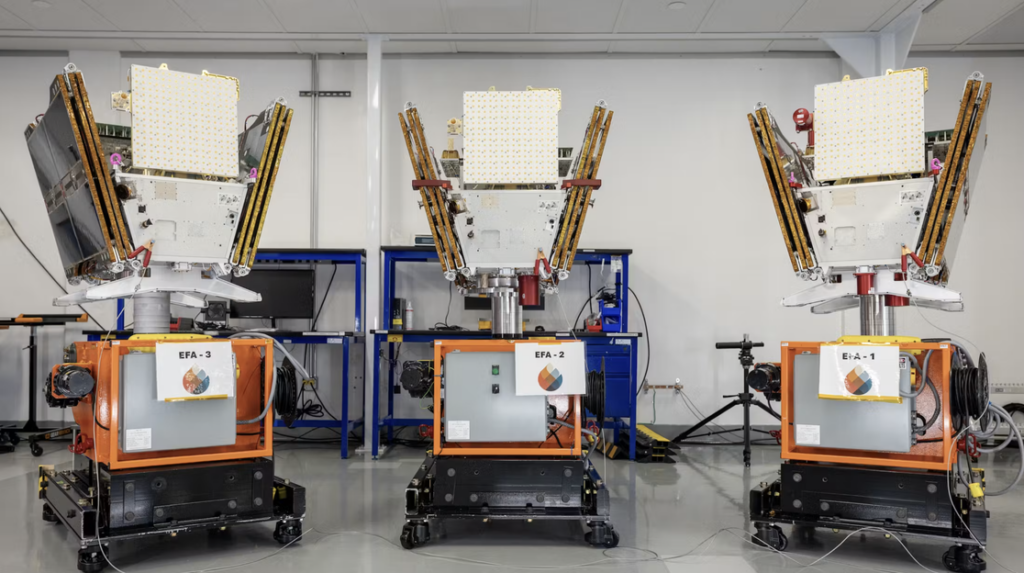
Earth Fire Alliance’s first three FireSats at a clean room in Mountain View, Calif. (Photo: Muon Space)
Wildfires are a major driver of deforestation, which worsens climate change. They accounted for 42% of tree cover loss in 2025, per World Resources Institute data.
The Earth Fire Alliance says it hopes to have dozens of satellites operating by the early 2030s that can “monitor every point on Earth every 20 minutes.”
[ANS thanks Axios for the above information. Read the full article at https://www.axios.com/newsletters/axios-pm-f6fe1278-52eb-43c8-8bfe-7a1fe85b1c56.html?utm_source=newsletter&utm_medium=email&utm_campaign=newsletter_axiospm&stream=top]
AMSAT Remove Before Flight Key Tags Now Available
Yes, These are the Real Thing!
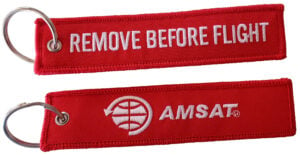
Your $20 Donation Goes to Help Fly a Fox-Plus Satellite
Includes First Class Postage (Sorry – U.S. Addresses Only)
Order Today at https://www.amsat.org/product/amsat-remove-before-flight-keychain
Changes to AMSAT TLE Distribution for May 29, 2026
Two Line Elements or TLEs, often referred to as Keplerian elements or keps in the amateur community, are the inputs to the SGP4 standard mathematical model of spacecraft orbits used by most amateur tracking programs. Weekly updates are completely adequate for most amateur satellites. TLE bulletin files are updated daily in the first hour of the UTC day. New bulletin files will be posted immediately after reliable elements become available for new amateur satellites. More information may be found at https://www.amsat.org/keplerian-elements-resources/.
The following satellites have been removed from this week’s AMSAT TLE distribution:
General Perturbations Data Support
AMSAT is pleased to announce that modern forms of what are called General Perturbations data are being disseminated via modern formats including JSON, XML and KVN at https://newark192.amsat.org/gpdata/current/. The reason this change is being made is that we are running out of 5-digit catalog numbers and the TLE format is not viable for satellites launched after July of this year. See https://celestrak.org/NORAD/documentation/gp-data-formats.php for details.
These data are presently considered in beta test for the next two months while hosted on the test server newark192.amsat.org, and we are very open to community feedback at [email protected]. Testers may experience outages and errors while we make improvements. We intend to put this into production on our main web server in July as we expect that satellites launched after this summer will require one of the new formats to accommodate longer object numbers. AMSAT will continue to publish TLE bulletins for satellites launched before July 2026 indefinitely.
[ANS thanks Joe Fitzgerald, KM1P, AMSAT Orbital Elements Manager, for the above information.]
Dragon Returns Packed with Space Station Science
Scientists await a big splash in the Pacific Ocean as one of the most research-packed Dragon spacecraft to date returns, completing the 34th SpaceX commercial resupply mission to the International Space Station for NASA. Biological and materials samples, along with tested hardware, are heading back to research teams on Earth for further analysis, advancing NASA’s work to prepare humans for exploration beyond low Earth orbit and to deliver benefits back home.
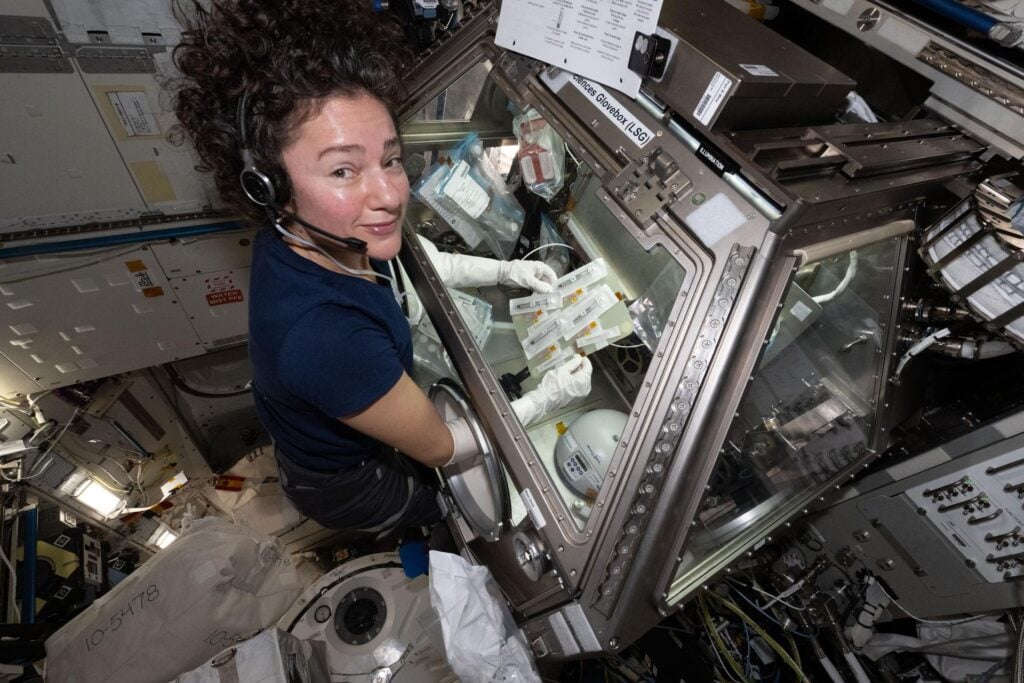
NASA astronaut Jessica Meir prepares samples in the Life Sciences Glovebox to study how weightlessness affects crew blood clotting and immune function for the Megakaryocyte Flying-One investigation. (Photo Credit: NASA)
Some samples returning are for NASA’s Hematopoietic Stem Cell Expansion in Space: Pathfinder Investigation (InSPA-StemCellEX-H2), which seeks to use the microgravity environment to scale up the production of stems cells. On Earth, lab-produced blood stem cells lose their ability to form different cell types, like red and white blood cells that are critical to treating patients with certain blood diseases and cancers. In microgravity, researchers believe this ability will be better preserved while also growing these stem cells in greater numbers. The returning samples will undergo further analysis to determine if space-based efforts produce larger quantities of enhanced stem cells suitable for clinical use.
The team behind NASA’s Streptococcus pneumoniae (Spn) Infection of Cardiac Tissue (MVP Cell-09) experiment is awaiting the return of stem cell-derived heart tissues that were intentionally infected with a pneumonia-causing bacterium as part of ongoing microgravity research. Pneumonia increases the risk of heart disease, which is not fully understood. Because bacteria tend to become more active and virulent in microgravity, this experiment could amplify their effects, making it possible to detect cellular responses that cannot be observed on Earth.
NASA’s Megakaryocyte Flying-One (MeF1) samples are returning to Earth to help understand how large cells found in bone marrow, known as megakaryocytes, and the platelets they produce adapt to spaceflight. Megakaryocytes and platelets play important roles in the formation of blood clots and immune responses. The returning samples, including those taken from astronauts, could show us how the human immune system reacts aboard the space station and help prepare for future exploration missions.
Semiconductor research samples as part of NASA’s In-Space Production of Semimetal-Semiconductor Composite Bulk Crystals in Microgravity (SUBSA-InSPA-SSCug) investigation are returning to Earth for further analysis. This study manufactured semimetal-semiconductor composite alloy crystals in space, which have applications in many electronics, including sensors and lasers. Researchers believe microgravity could enable the production of significantly greater and higher-quality crystals, supporting the development of next-generation semiconductor technologies.
Additional experiments being returned include NASA’s Zero Boil-Off Tank Noncondensables (ZBOT-NC) investigation, NASA’s DNA Nano Therapeutics-3 space-assembled DNA-inspired materials, NASA’s InSPA-Sachi Nanoligomer investigation, European Space Agency’s (ESA’s) Green Bone investigation, NASA’s 3D Bone Marrow Analog research, and NASA’s InSPA-Auxilium Bioprinter-Cell Printing is investigation. To read more about these experiments, see the full article at https://www.nasa.gov/missions/station/iss-research/nasas-spacex-crs-34-dragon-returns-packed-with-space-station-science/.
[ANS thanks NASA for the above information.]
ARISS News
Amateurs and others around the world may listen in on contacts between amateurs operating in schools and allowing students to interact with astronauts and cosmonauts aboard the International Space Station. The downlink frequency on which to listen is 145.800 MHz worldwide.
Scheduled Contacts
+ Recently Completed
Youth on the Air Camp 2026 (YOTA Camp 2026), Huntsville, AL, direct via W4Y
The ISS callsign is presently scheduled to be NA1SS
The scheduled crewmember is Chris Williams KJ5GEW
The ARISS mentor is K4RGK
Contact is for: Thu 2026-06-18 16:36:25 UTC 37 degrees maximum elevation
Watch for Livestream at https://www.youtube.com/live/eVo288DAH4U
Congratulations!
+ Upcoming Contacts
National STEM Festival, Washington, DC, telebridge via VK6MJ
The ISS callsign is presently scheduled to be NA1SS
The scheduled crewmember is Chris Williams KJ5GEW
The ARISS mentor is W4NTR/ KM4YHZ
Contact is go for: Thu 2026-06-25 13:31:42 UTC 49 degrees maximum elevation
Many times, a school makes a last-minute decision to do a Livestream or runs into a last-minute glitch requiring a change of the URL, but we at ARISS may not get the URL in time for publication. You can always check https://live.ariss.org/ to see if a school is Livestreaming.

There is a lot of traffic on Facebook and on other social media sites with people asking why they are not hearing the crew make general contacts. First off the crew is very busy on the ISS and they simply may not have the time to just pick up the microphone and talk. Also, one needs to be aware of their normal daily schedule:
Wakeup to Workday start= 1.5 hours
Workday start to Workday end=12 hours
Workday end to Sleep= 2 hours
Sleep to wakeup= 8.5 hours
The crew’s usual waking period is 07:30 – 19:30 UTC. The most common times to find a crew member making casual periods are about one hour after waking up and about an hour before sleeping, when they have personal time. They’re usually free most of the weekend, as well.
The APRS packet system is also active (437.825 MHz up & down).
Ham TV is currently transmitting a test signal at 2395.00 MHz. The color bar test generator portion of the Ham TV system is experiencing unexpected technical issues. ARISS is working to troubleshoot the issue with NASA’s payloads support team and the ISS crew.
As always, if there is an EVA, a docking, or an undocking; the ARISS radios are turned off as part of the safety protocol. Radios will be powered down in support of an upcoming spacewalk in late June: Power down: June 29 at 15:15 UTC Power up: July 1 at 10:15 UTC
Note, all times are approximate. It is recommended that you do your own orbital prediction or start listening about 10 minutes before the listed time.
The latest information on the operation mode can be found at https://www.ariss.org/current-status-of-iss-stations.html
The latest list of frequencies in use can be found at https://www.ariss.org/contact-the-iss.html
[ANS thanks Charlie Sufana, AJ9N, one of the ARISS operation team mentors for the above information.]
AMSAT Ambassador Activities
AMSAT Ambassadors provide presentations, demonstrate communicating through amateur satellites, and host information tables at club meetings, hamfests, conventions, maker faires, and other events.
 Scheduled Events
June 27, 1800 UTC – June 28, 2100 UTC, 2026
ARRL Field Day
https://www.amsat.org/field-day/
July 11, 2026
Moon Day
Frontiers of Flight Museum
6911 Lemmon Ave.
Dallas, TX 75209
https://flightmuseum.com/events/moonday/
N5HYP
October 8-11, 2026
44th AMSAT Space Symposium and Annual Membership Meeting
Crowne Plaza JAX Airport
14670 Duval Road
Jacksonville, FL 32218
Details to follow
For more information go to: https://www.amsat.org/ambassador/
[ANS thanks Bo Lowrey, W4FCL, Director – AMSAT Ambassador Program, for the above information.]
Satellite Shorts from All Over
+ The upper stage from a commercial Chinese rocket that launched last week has broken apart in space, spreading debris in a heavily trafficked part of low-Earth orbit — home to the International Space Station and a significant portion of SpaceX’s Starlink broadband network. The breakup occurred shortly after the Zhuque-2E rocket reached orbit on June 9 with two satellites providing direct-to-cell communications, perhaps around the time the upper stage was expected to perform a disposal burn. The U.S. Space Force confirmed the breakup event stating, “There are currently no threats to human spaceflight.” (ANS thanks ArsTechica for the above information. Read the full article at https://arstechnica.com/space/2026/06/a-chinese-rocket-breaks-apart-dangerously-close-to-the-starlink-constellation/.)
+ A new paper from researchers at NASA’s Ames Research Center in California reports that 73.3 percent of images the agency’s new SPHEREx space telescope collected between May and September of last year were contaminated by at least one artificial satellite trail. Typically this type of light pollution is associated with ground telescopes. But SPHEREx is an orbital satellite about 700 kilometers above the Earth’s surface. Apparently even that wasn’t enough to escape from the light trails. (ANS thanks IEEE Spectrum for the above information. See the full article at https://spectrum.ieee.org/satellite-light-pollution-spherex-hubble.)
+ A dazzling fireball streaked through the skies above the Midwest on June 14, crashing through Earth’s atmosphere at a staggering 56,000 mph (90,123 km.h per hour) before burning up. More than 500 witnesses reported the event to the American Meteor Society,— some of whom uploaded footage of the fiery event. NASA’s all-sky camera network also captured the fireball from three locations. (ANS thanks Space.com for the above information. Read the full article, with some of the images, at https://www.space.com/stargazing/meteor-showers/watch-a-fireball-burn-a-300-mile-path-above-the-midwest-us-video.)
+ An Ariane 6 with upgraded solid rocket boosters successfully launched three dozen Amazon Leo satellites June 17. So far, 367 Amazon Leo satellites have launched on Ariane 6, Atlas V and Falcon 9. However, there is only one more Atlas 5 launch for Amazon Leo, scheduled for July 3, forcing Amazon to lean more on Arianespace. The company still has a July 2029 deadline to deploy the full constellation, as part of the FCC’s waiver decision on June 5. (ANS thanks SpaceNews for the above information. If registered with a SpaceNews account, see the full article at https://spacenews.com/upgraded-ariane-6-launches-amazon-leo-satellites/.)
+ NASA Administrator Jared Isaacman, responding to questions about the agency’s selection of an all-male crew for the Artemis 3 mission, said the astronauts were chosen based solely on their experience, skill sets and availability. Isaacman strongly defended the crew selection, saying he had “personally been to space twice with 50 percent female crews. My closest advisors and some of the smartest engineers I know are women. In our latest NASA leadership organization, nearly 50 percent of the center directors and mission directorate leadership are women.” (ANS thanks SpaceflightNow for the above information. Read the full article at https://spaceflightnow.com/2026/06/10/nasa-chief-defends-selection-of-all-male-artemis-iii-crew/.)
Join AMSAT today at https://launch.amsat.org/
In addition to regular membership, AMSAT offers membership to:
- Societies (a recognized group, clubs or organization).
- Students enrolled in at least half-time status are eligible for free membership to age 25.
- Memberships are available for annual and lifetime terms.
Contact info [at] amsat.org for additional membership information.
73 and remember to help Keep Amateur Radio in Space!
This week’s ANS Editor,
Mark Johns, KØJM
mjohns [at] amsat.org
ANS is a service of AMSAT, the Radio Amateur Satellite Corporation, 712 H Street NE, Suite 1653, Washington, DC 20002
AMSAT is a registered trademark of the Radio Amateur Satellite Corporation.