AMSAT News Service
ANS-018
January 18, 2026
In this edition:
- November/December 2025 Issue of The AMSAT Journal Now Available
- REMINDER: AMSAT Membership Now Includes Getting Started Guide
- PSLV-C62 Mission Experiences Anomaly
- Message to U.S. Educators: ARISS Contact Opportunity Call for Proposals
- Changes to AMSAT TLE Distribution for January 15, 2026
- ARISS News
- AMSAT Ambassador Activities
- Satellite Shorts From All Over
The AMSAT® News Service bulletins are a free, weekly news and information service of AMSAT, The Radio Amateur Satellite Corporation. ANS publishes news related to Amateur Radio in Space including reports on the activities of a worldwide group of Amateur Radio operators who share an active interest in designing, building, launching and communicating through analog and digital Amateur Radio satellites.
The news feed on https://www.amsat.org publishes news of Amateur Radio in Space as soon as our volunteers can post it.
Please send any amateur satellite news or reports to: ans-editor [at] amsat.org
You can sign up for free e-mail delivery of the AMSAT News Service Bulletins via the ANS List; to join this list see: https://mailman.amsat.org/postorius/lists/ans.amsat.org/
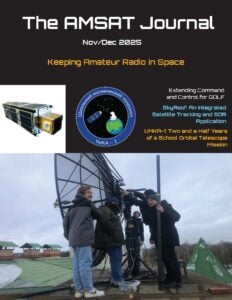
November/December 2025 Issue of The AMSAT Journal Now Available
The November/December 2025 issue of The AMSAT Journal is now available to members on AMSAT’s Member Portal.
The AMSAT Journal is a bi-monthly digital magazine for amateur radio in space enthusiasts, published by the Radio Amateur Satellite Corporation (AMSAT). Each issue is your source for hardware and software projects, technical tips, STEM initiatives, operational activities, and news from around the world.
Inside the Current Issue:
-
Apogee View – Drew Glasbrenner, KO4MA
-
Educational Relations Update – Alan Johnston, KU2Y
-
Extending Command and Control for GOLF – Heimir Thor Sverrisson, W1ANT/TF3ANT
-
SkyRoof: An Integrated Satellite Tracking and SDR Application – Alex Shovkoplyas, VE3NEA
-
UMKA-1: Two and a Half Years of a School Orbital Telescope Mission – Alexsey Shafiev, RA3PPY
[ANS thanks The AMSAT Journal team for the above information]
AMSAT Remove Before Flight Key Tags Now Available
Yes, These are the Real Thing!
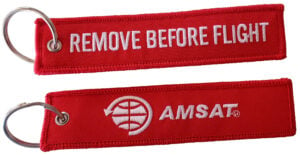
Your $20 Donation Goes to Help Fly a Fox-Plus Satellite
Includes First Class Postage (Sorry – U.S. Addresses Only)
Order Today at https://www.amsat.org/product/amsat-remove-before-flight-keychain
REMINDER: AMSAT Membership Now Includes “Getting Started” Guide
AMSAT is offering a limited-time promotion for new and renewing members that includes a free digital copy of Getting Started with Amateur Satellites. The promotion is being offered as AMSAT begins the 2026 membership year.
Anyone who joins or renews their AMSAT membership during the promotional period will receive a download link for the latest edition of Getting Started with Amateur Satellites in their membership confirmation email. The guide is designed to help radio amateurs understand the fundamentals of satellite operation and serves as a practical reference for both newcomers and operators returning to the hobby. Additional information about AMSAT membership is available at https://launch.amsat.org.

In addition to this limited-time promotion, AMSAT membership includes a subscription to The AMSAT Journal, access to archived issues, discounts on selected items in the AMSAT online store, and opportunities to participate in AMSAT elections, committees, awards programs, and other AMSAT activities and programs. Members may also access archived proceedings from past AMSAT Space Symposiums through the AMSAT member portal.
Beyond these tangible benefits, AMSAT membership supports the development, launch, and operation of amateur radio satellites, along with education and outreach efforts. Joining AMSAT is not just about individual benefits — it is about being part of the community that builds and operates amateur satellites for radio amateurs worldwide. As AMSAT looks ahead to 2026, the promotion helps launch another year of growth and opportunity for amateur radio in space.
[ANS thanks Drew Glasbrenner, KO4MA, AMSAT President for the above information]
The 2026 President’s Club Coin is Now Here!
Help Support GOLF and FoxPlus.
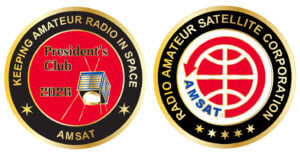
Annual memberships start at only $120
Join the AMSAT President’s Club today and help
Keep Amateur Radio in Space!
https://www.amsat.org/join-the-amsat-presidents-club/
PSLV-C62 Mission Experiences Anomaly
The Polar Satellite Launch Vehicle (PSLV)-C62 mission carrying the ‘Anvesha’/EOS-N1 satellite and 15 co-passenger satellites launched by India on Monday encountered an anomaly during the end of the PS3 burn stage with ISRO chairman V Naryanan stating that “a deviation in the vehicle’s flight path” was observed.
“A detailed analysis has been initiated,” the Indian Space Research Organisation (ISRO) posted on X.
ISRO Chairman V Narayanan said a disturbance was observed in the vehicle at the end of the third stage, which was otherwise proceeding as expected.
“Today, we have attempted the PSLV C62 / EOS – N1 Mission. The PSLV vehicle is a four-stage vehicle with two solid stages and two liquid stages. The vehicle’s performance near the end of the third stage was as expected. (However), near the end of the third stage, we are seeing increased disturbance in the vehicle. Subsequently, a deviation in the vehicle’s flight path is observed. We are analysing the data and will come back at the earliest,” Narayanan said.
This is ISRO’s first major launch of 2026. The mission aimed to place an Earth observation satellite into orbit from the First Launch Pad (FLP) at Sriharikota.
The mission was carried out by NewSpace India Limited and represents the ninth dedicated commercial mission to build and launch an Earth Observation satellite.
For the first time, a single Indian private company, Dhruva Space, based in Hyderabad, contributed seven satellites to the mission. Chaitanya Dora Surapureddy, CFO and Co-founder of Dhruva Space, said they also launched four satellites that they built.
“We launched four satellites that we have built, three for customers and one for us, and we also help other companies with part of the integration of the satellite onto the rocket. Essentially, a total of nine of our systems, which we have built, are going onto the rocket. So, quite exciting that that’s a good number,” he said.
Surapureddy said their satellites are for low-data-rate communication, which can be utilised by amateur radio operators.
“The satellites that we launched are all for low data rate communication. Amateur radio operators can utilise it towards that, and also a good demonstration for these satellites, and also for low data rate communication that can be done,” he added
[ANS thanks ANI for the above information]
Need new satellite antennas?
Purchase M2 LEO-Packs from the AMSAT Store.
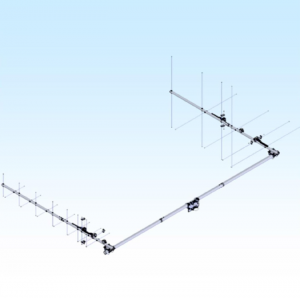
When you purchase through AMSAT, a portion of the proceeds goes towards
Keeping Amateur Radio in Space.
https://amsat.org/product-category/hardware/
Message to U.S. Educators: ARISS Contact Opportunity Call for Proposals
The Amateur Radio on the International Space Station (ARISS) Program is seeking formal and informal education institutions and organizations, individually or working together, to host an Amateur Radio contact with a crew member on board the ISS. ARISS anticipates that the contact would be held between July 1, 2026 and December 31, 2026. Crew scheduling and ISS orbits will determine the exact contact dates. To maximize these radio contact opportunities, ARISS is looking for organizations that will draw large numbers of participants and integrate the contact into a well-developed education plan.
The deadline to submit a proposal is February 27, 2026. Proposal information and more details such as expectations, proposal guidelines and the proposal form can be found at www.ariss.org. An informational webinar session will be held on February 5, 2026 at 8 PM ET.
The Zoom link to sign up is: https://us06web.zoom.us/meeting/register/hijg24mPRK69uGC0gUq8zw
The Opportunity
Crew members aboard the International Space Station will participate in scheduled Amateur Radio contacts. These radio contacts are approximately 10 minutes in length and allow students to interact with the astronauts through a question-and-answer session.
An ARISS contact is a voice-only communication opportunity via Amateur Radio between astronauts and cosmonauts aboard the space station and classrooms and communities. ARISS contacts afford education audiences the opportunity to learn firsthand from astronauts what it is like to live and work in space and to learn about space research conducted on the ISS. Students also will have an opportunity to learn about satellite communication, wireless technology, and radio science. Because of the nature of human spaceflight and the complexity of scheduling activities aboard the ISS, organizations must demonstrate flexibility to accommodate changes in dates and times of the radio contact.
Amateur Radio organizations around the world with the support of NASA and space agencies in Russia, Canada, Japan and Europe present educational organizations with this opportunity. The ham radio organizations’ volunteer efforts provide the equipment and operational support to enable communication between crew on the ISS and students around the world using Amateur Radio.
Please direct any questions to [email protected]
[ANS thanks Dave Jordan, AA4KN, ARISS PR, for the above information]
Changes to AMSAT TLE Distribution for January 15, 2026
Two Line Elements or TLEs, often referred to as Keplerian elements or keps in the amateur community, are the inputs to the SGP4 standard mathematical model of spacecraft orbits used by most amateur tracking programs. Weekly updates are completely adequate for most amateur satellites. TLE bulletin files are updated daily in the first hour of the UTC day. New bulletin files will be posted immediately after reliable elements become available for new amateur satellites. More information may be found at https://www.amsat.org/keplerian-elements-resources/.
The following satellite has been removed from this week’s AMSAT TLE distribution:
BEE-1000 NORAD Cat ID 66650 Non-amateur satellite.
The following satellites have been added to this week’s AMSAT TLE distribution:
QMR-KWT NORAD Cat ID 67291 Downlink 436.950 MHz.
SAKHACUBE-CHOLBON NORAD Cat ID 67290 Downlink 437.350 MHz.
[ANS thanks Joe Fitzgerald, KM1P, AMSAT Orbital Elements Manager, for the above information.]
ARISS News
Amateurs and others around the world may listen in on contacts between amateurs operating in schools and allowing students to interact with astronauts and cosmonauts aboard the International Space Station. The downlink frequency on which to listen is 145.800 MHz worldwide.
Scheduled Contacts
None scheduled for the coming week.
Many times a school may make a last minute decision to do a Livestream or run into a last minute glitch requiring a change of the URL but we at ARISS may not get the URL in time for publication. You can always check https://live.ariss.org/ to see if a school is Livestreaming.
As always, if there is an EVA, a docking, or an undocking; the ARISS radios are turned off as part of the safety protocol.
The crossband repeater continues to be active (145.990 MHz up {PL 67} & 437.800 MHz down), If any crew member is so inclined, all they have to do is pick up the microphone, raise the volume up, and talk on the crossband repeater. So give a listen, you just never know.
Service Module radio: Not in APRS configuration; only being used for voice contacts at this time. Default mode is for packet operations (145.825 MHz up & down) but occasionally used for SSTV (145.800 MHz down).
Ham TV – Configured. Default mode is for scheduled digital amateur television operations (2395.00 MHz).
Note, all times are approximate. It is recommended that you do your own orbital prediction or start listening about 10 minutes before the listed time.
The latest information on the operation mode can be found at https://www.ariss.org/current-status-of-iss-stations.html
The latest list of frequencies in use can be found at https://www.ariss.org/contact-the-iss.html
[ANS thanks Charlie Sufana, AJ9N, one of the ARISS operation team mentors for the above information.]
Want to fly the colors on your own grid expedition?
Get an AMSAT car flag and other neat stuff from our Zazzle store!
25% of the purchase price of each product goes towards Keeping Amateur Radio in Space
AMSAT Ambassador Activities
AMSAT Ambassadors provide presentations, demonstrate communicating through amateur satellites, and host information tables at club meetings, hamfests, conventions, maker faires, and other events.
February 13-15, 2026
HamCation
Central Florida Fairgrounds and Expo Park
4603 West Colonial Drive
Orlando, Florida 32808
AA4KN
March 21, 2026
Midwinter Madness Hamfest
Buffalo Civic Center
1306 County Rd 134
Buffalo Minnesota 55313
KØJM, ADØHJ
Interested in becoming an AMSAT Ambassador? AMSAT Ambassadors provide presentations, demonstrate communicating through amateur satellites, and host information tables at club meetings, hamfests, conventions, maker faires, and other events.
For more information go to: https://www.amsat.org/ambassador/
[ANS thanks Bo Lowrey, W4FCL, Director – AMSAT Ambassador Program, for the above information.]
Satellite Shorts from All Over
+ As of this writing, 4 complete AMSAT CubeSatSim Kits are still available for purchase from the AMSAT store. This kit allows you to build a CubeSat Simulator with no soldering, just assembly. CubeSatSim is a low-cost satellite emulator that runs on solar panels and batteries, transmits UHF radio telemetry, has a 3D printed frame, and can be extended by additional sensors and modules. It is perfect for the classroom or for public demonstrations. The kit can be purchased from the AMSAT store. Sorry, shipping is only available to U.S. addresses. (ANS thanks AMSAT Education for the above information)
+ AMSAT-EA’s latest PocketQube, HADES-SA (aka SpinnyOne) has been coordinated by the IARU. A 1.5 PocketQube. HADES-SA / SpinnyONE is a satellite operated by AMSAT-EA members to promote the use of CODEC2 voice and SSDV in satellite communications, both of which are open protocols. As secondary objectives, the satellite is also intended to test its Doppler-resistant modem and a new antenna deployment mechanism. The satellite includes a BBS that allows amateurs to send text messages and, optionally, upload CODEC2 recordings for transmission by the satellite. A sample CODEC2 transmission has been pre-recorded in Flash memory until new transmissions from Earth arrive. HADES-SA / SpinnyONE includes a digital camera provided (along with its dedicated software) by the UK-based company Spinning Around. The camera will capture images of the deployment mechanism —which contains a small commemorative plaque— as well as whatever lies within its field of view at that moment. Every three days, a new picture will be taken and transmitted to the ground using the SSDV protocol. Image transmissions will occur continuously every few minutes so that stations worldwide can receive the frames. In the event of a camera failure, an internally stored image will be transmitted instead. Tools and detailed instructions on how to use them will be published on the AMSAT-EA website at https://www.amsat-ea.org/proyectos. The satellite is scheduled to launch on the SpaceX Transporter-16 mission approximately March 14, 2026. (ANS thanks AMSAT-EA and the IARU for the information)
+ NASA’s SpaceX Crew-11 mission safely splashed down early Thursday morning in the Pacific Ocean off the coast of San Diego, concluding a more than five-month mission aboard the International Space Station. Crew-11 returned home about a month earlier than planned because of a medical concern teams are monitoring with one of the crew members, who remains stable. (ANS thanks NASA for the information)
+ If everything has gone to plan, the rollout of NASA’s Space Launch System rocket and Orion spacecraft for the Artemis II mission around the moon commenced about 12 hours prior to publication (Saturday, January 17th at 7:00am EST). The Artemis II launch window opens as early as February 6th. (ANS thanks NASA for the information)
+ NASA, along with the U.S. Department of Energy (DOE), announced on Tuesday, January 13th a renewed commitment to their longstanding partnership to support the research and development of a fission surface power system for use on the Moon under the Artemis campaign and future NASA missions to Mars. (ANS thanks NASA for the information)
Join AMSAT today at https://launch.amsat.org/
In addition to regular membership, AMSAT offers membership to:
- Societies (a recognized group, clubs or organization).
- Students are eligible for FREE membership up to age 25.
- Memberships are available for annual and lifetime terms.
Contact info [at] amsat.org for additional membership information.
73 and remember to help Keep Amateur Radio in Space!
This week’s ANS Editor,
Paul Stoetzer, N8HM
n8hm [at] amsat.org
ANS is a service of AMSAT, the Radio Amateur Satellite Corporation, 712 H Street NE, Suite 1653, Washington, DC 20002
AMSAT is a registered trademark of the Radio Amateur Satellite Corporation.