ANS-102 AMSAT News Service Weekly Bulletins

AMSAT News Service

ANS-102
April 12, 2026

In this edition:

  • Reminder: AMSAT at Hamvention
  • AMSAT to Attend CubeSat Developers Workshop 2026
  • AMSAT Satellite Status Page: The Story Behind the New Colors and Satellite Naming Convention
  • IARU Coordination Requested for VemanaReddySat
  • FO-29 Update
  • Changes to AMSAT TLE Distribution for April 10, 2026
  • ARISS News
  • AMSAT Ambassador Activities
  • Satellite Shorts From All Over

The AMSAT® News Service bulletins are a free, weekly news and information service of AMSAT, The Radio Amateur Satellite Corporation.

ANS publishes news related to Amateur Radio in Space including reports on the activities of a worldwide group of Amateur Radio operators who share an active interest in designing, building, launching and communicating through analog and digital Amateur Radio satellites.

The news feed on https://www.amsat.org publishes news of Amateur Radio in Space as soon as our volunteers can post it.

Please send any amateur satellite news or reports to: ans-editor [at] amsat.org

You can sign up for free e-mail delivery of the AMSAT News Service Bulletins via the ANS List; to join this list see: https://mailman.amsat.org/postorius/lists/ans.amsat.org/


Reminder: AMSAT at Hamvention

The 2026 Dayton Hamvention will be held Friday through Sunday, May 15–17, 2026, at the Greene County Fairgrounds in Xenia, Ohio. AMSAT will once again have a strong presence throughout the event, including booth activities, social gatherings, and the annual AMSAT Forum.

The 17th annual TAPR/AMSAT Banquet will be held Friday, May 15 at 6:30 PM EDT (18:30 EDT) at the Kohler Presidential Banquet Center, 4548 Presidential Way, Kettering, Ohio 45429, located approximately 20 minutes from the Greene County Fairgrounds. This dinner is a highlight of the TAPR (Tucson Amateur Packet Radio) and AMSAT (Radio Amateur Satellite Corporation) activities during Hamvention. The banquet speaker will be announced at a later date.

Tickets are $75 each and may be purchased through the AMSAT store. The deadline to purchase banquet tickets is Monday, May 11 at 17:00 EDT (21:00 UTC). Tickets must be purchased in advance and will not be sold at the AMSAT booth or at the door. There will be no tickets available for pickup at the AMSAT booth. Tickets purchased online will be maintained on a list, with check-in at the door at the banquet center. Seating is limited to the number of meals reserved with the Kohler caterers based on ticket sales by the deadline.

The annual AMSAT “Dinner at Tickets” gathering will take place Thursday, May 14 from 6:00 PM to 8:00 PM EDT at Tickets Pub & Eatery, 7 W. Main Street, Fairborn, Ohio 45324. Telephone (937) 878-9022. This informal event features no program or speaker, offering an opportunity for conversation and camaraderie. All are welcome, regardless of participation in booth setup or operations. Food may be ordered from the menu, and drinks, including beer, wine, sodas, and iced tea, are available at the bar. No reservations are required.

AMSAT is seeking volunteers to assist at the AMSAT booth, located in Building 1, booths 1007–1010 and 1107–1110. Volunteers are encouraged to contribute as much time as they are able, whether for a few hours or the entire weekend. In 2025, approximately 20 volunteers supported AMSAT’s activities and engagement with attendees.

Those interested in volunteering or requesting additional information may contact Phil Smith, W1EME, AMSAT Hamvention Team Leader, via email at w1eme [at] astrocom.net. Volunteer participation plays an important role in supporting AMSAT’s presence and outreach within the amateur radio community.

The AMSAT Forum will be held Saturday, May 16 from 1:50 PM to 3:10 PM EDT in Forum Room 2.

Additional details, including the banquet speaker announcement, will be provided as they become available.
[ANS thanks the AMSAT Hamvention team for the above information]


AMSAT Remove Before Flight Key Tags Now Available Yes, These are the Real Thing!
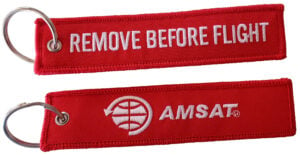
Your $20 Donation Goes to Help Fly a FoxPlus Satellite Includes First Class Postage (Sorry – U.S. Addresses Only) Order Today at https://www.amsat.org/product/amsat-remove-before-flight-keychain


AMSAT to Attend CubeSat Developers Workshop 2026

AMSAT will participate in the CubeSat Developers Workshop 2026 (CDW26), scheduled for April 14–16, 2026, at the Performing Arts Center on the campus of California Polytechnic State University (Cal Poly) in San Luis Obispo, California.

The CubeSat Developers Workshop is the premier annual gathering for the small satellite community. Hosted by the Cal Poly CubeSat Laboratory, the event typically draws more than 500 industry professionals, researchers, educators, and students. Attendees engage in three days of technical presentations, Q&A panels, exhibit booths, and extensive networking opportunities focused on CubeSat and small satellite design, development, testing, launch, and operations. The workshop is especially valuable for newcomers, offering direct access to experienced developers and lessons learned from real missions.

AMSAT’s presence at CDW26 underscores its long-standing commitment to advancing amateur radio in space through CubeSat platforms. AMSAT members and representatives plan to engage with the broader CubeSat community, share expertise on amateur satellite communications (including transponders, telemetry, and ground station operations), and explore collaboration opportunities with universities, educational groups, and commercial developers. This participation helps strengthen ties between the amateur radio satellite service and the wider smallsat ecosystem, where many university and student projects seek reliable, low-cost communication solutions that align with IARU-coordinated amateur frequencies.

[ANS thanks AMSAT for the above information]
 

AMSAT Satellite Status Page: The Story Behind the New Colors and Satellite Naming Convention

If you’ve visited the AMSAT Satellite Status page recently, you may have noticed the color scheme and satellite naming convention look a bit different. These changes have prompted some questions from the community, and we wanted to take a moment to explain the reasoning behind the updates.

Accessibility First

We received a request to change “Transponder/Repeater Operational” from blue to green, since green often means “good.” That made sense, so we made the change along with a few other minor color adjustments. When we rolled it out, however, we quickly heard from users who couldn’t distinguish “Transponder/Repeater Operational” from “No Signal Heard.” After some research, we learned that red-green color blindness affects roughly 10% of the population, and that’s just one of three prominent types of color vision deficiency, each affecting a different part of the spectrum.

After further research, we adopted the IBM Colorblind Palette, which allows 99.998% of people to reliably distinguish between five colors. While some users have suggested alternative color schemes, many of those proposals would reintroduce the same accessibility conflicts we set out to solve.

Handling Multiple Modes

As satellites grow more capable, many now carry multiple operating modes. Rather than assigning a separate color to each mode, which quickly becomes impractical when a single satellite may support five or six, we’ve given each mode its own line on the Status page. To accommodate this, we updated the naming convention from just the satellite name to the satellite name plus mode. For example, SSTV operations on the International Space Station now appear as ISS_[SSTV]. This approach scales cleanly as new multi-mode satellites come online.

We also renamed “Transponder/Repeater Operational” to “Satellite Active,” which simply means the mode you selected to report on is active. We made this change because “Transponder” and “Repeater” are two-way modes, and an increasing number of satellites are now being launched with interesting one-way modes other than just telemetry and beacons.

We’re always open to suggestions, but please remember, we are all volunteers at AMSAT!

[ANS thanks David Spoelstra, N9KT, AMSAT Web Manager, for the above information]


The 2026 President’s Club Coin is Now Here! Help Support GOLF and FoxPlus.
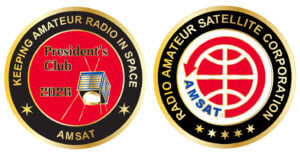
Annual memberships start at only $120

Join the AMSAT President’s Club today and help Keep Amateur Radio in Space! https://www.amsat.org/join-the-amsat-presidents-club/


IARU Coordination Requested for VemanaReddySat

A new 1U CubeSat project from Vemana Institute of Technology in Bengaluru, India, has submitted a frequency coordination request to the IARU.

VemanaReddySat  represents a student-led effort focused on educational and technology demonstration objectives. The project involves collaboration with the institute’s engineering departments, building on Vemana Institute of Technology’s growing interest in satellite image processing, CubeSat development, and space-data analytics.

According to the coordination application dated April 9, 2026, the satellite is planned as a 1U CubeSat carrying:

  • A UHF downlink for telemetry and occasional Robot 36 SSTV image transmissions.
  • LoRa capability intended for inter-satellite or experimental links.

The primary downlink will use 9k6 GFSK modulation. The mission aims to provide hands-on experience for students in spacecraft systems, communications, and payload operations while demonstrating low-cost amateur radio techniques in space.

Launch and Orbit Plans

The team targets a mid-2026 rideshare launch opportunity aboard an ISRO PSLV or SSLV vehicle. The planned orbit is approximately 450–500 km altitude with an inclination in the range of 35–60 degrees.

[ANS thanks the IARU for the above information]


Need new satellite antennas? Purchase M2 LEO-Packs from the AMSAT Store.
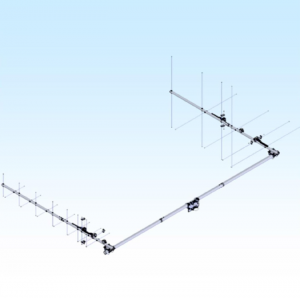
When you purchase through AMSAT, a portion of the proceeds goes towards Keeping Amateur Radio in Space. https://amsat.org/product-category/hardware/


FO-29 Update

Fuji-OSCAR 29 (FO-29 / JAS-2), the long-lived Japanese amateur radio satellite launched in 1996, continues to operate its V/U inverting analog linear transponder under the control of the Japan Amateur Radio League (JARL). Because the onboard batteries have failed years ago, the satellite depends entirely on solar power and can only function when its solar panels are illuminated.

Current Status (April 2026)

  • FO-29 entered a full-sunlight orbit around March 9, 2026. During full-sunlight periods, the satellite experiences no or negligible eclipses, allowing the analog transponder to operate continuously on illuminated passes without scheduled command activations.
  • The first full-sunlight window began in early March 2026 and lasted approximately 40 days.
  • According to the JARL schedule, this continuous operation ends around April 21, 2026, after which the satellite will enter an eclipse period for about one month.
  • A second, longer full-sunlight period is expected from approximately May 20 to mid-November 2026, during which continuous operation should resume.

Transponder Details

  • Mode: V/U inverting linear transponder (SSB and CW only)
    • Uplink: 145.900 – 146.000 MHz (LSB)
    • Downlink: 435.800 – 435.900 MHz (USB)
  • CW Beacon: 435.795 MHz (typically 100 mW)
  • Digitalker: 435.910 MHz FM (rarely activated)
  • The digital BBS (1k2/9k6) remains non-operational.
  • Important Restriction: Digital modes are generally not permitted on the linear transponder due to licensing and operational constraints.

Operating Procedure

  • During eclipse periods (or the transition out of full sunlight), the JARL control team sends specific commands to activate the transponder at designated UTC times. If the transponder does not turn on within about 2 minutes of the command start, the team terminates the attempt.
  • During confirmed full-sunlight periods, no regular command schedule is needed — the transponder stays active whenever the satellite is in sunlight.
  • Operators should always check real-time status via AMSAT Live Satellite Status, OSCAR Status pages, or recent community reports, as voltage instability in the aging satellite can occasionally cause unexpected behavior.

April 2026 Specifics

In early-to-mid April 2026 (while still in the March full-sunlight window), expect the transponder to be available on most or all illuminated passes with no fixed on/off times. After approximately April 21, operation will shift back to scheduled command activations until the next full-sunlight season begins in late May.

The scheduled activations for the eclipse period are:

April
24th 22:22~
25th 21:27~
28th 22:11~

May 
1st 22:56~
2nd 22:00~
3rd 22:51~
4th 21:55~
5th 22:45~
6th 21:50~
7th 22:40~
8th 21:44~
9th 22:35~
15th 22:19~
16th 23:10~

Amateurs are reminded to:

  • Use proper Doppler correction.
  • Follow linear transponder etiquette (listen before transmitting, keep signals clean).
  • Limit uplink power to avoid overloading the transponder (typically no more than a few watts with a modest antenna).

The JARL page provides the detailed historical and upcoming command schedules for eclipse periods across 2025–2026. For the absolute latest status and any updates from the Japanese control team, monitor the official JARL FO-29 page, AMSAT.org, and AMSAT bulletins.

FO-29’s continued operation nearly 30 years after launch remains a testament to robust engineering and the dedication of the JARL team.

[ANS thanks JARL for the above information]
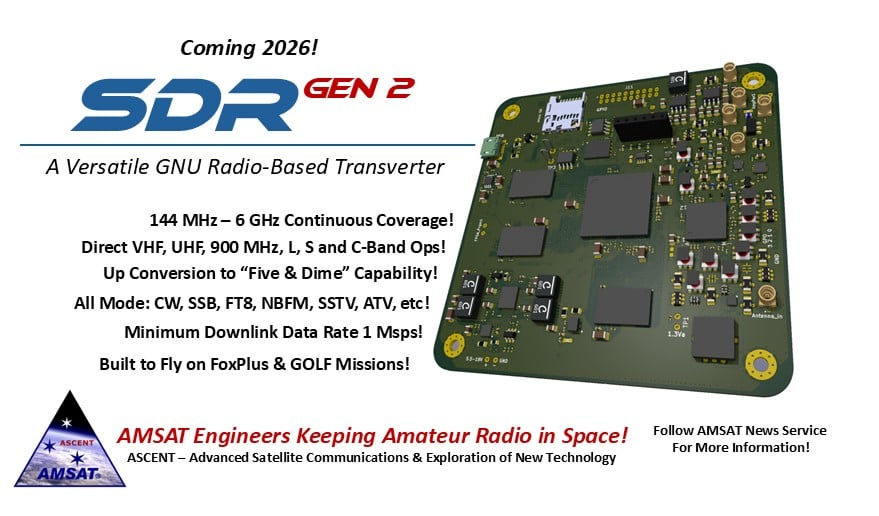

SDR Gen 2 Ad - 2026


Changes to AMSAT TLE Distribution for April 10, 2026

Two Line Elements or TLEs, often referred to as Keplerian elements or keps in the amateur community, are the inputs to the SGP4 standard mathematical model of spacecraft orbits used by most amateur tracking programs. Weekly updates are completely adequate for most amateur satellites. TLE bulletin files are updated daily in the first hour of the UTC day. New bulletin files will be posted immediately after reliable elements become available for new amateur satellites. More information may be found at https://www.amsat.org/keplerian-elements-resources/.

There are no changes to this week’s TLE distribution.

[ANS thanks Joe Fitzgerald, KM1P, AMSAT Orbital Elements Manager, for the above information]


Join AMSAT or Renew Now. . .
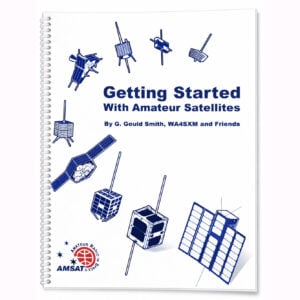
Download a Free ‘Getting Started with Amateur Satellites’ Book!
Getting Started w Shadow

Get the latest edition just for doing the right thing! Visit https://www.amsat.org/membership-specials/ for more details.


ARISS News

Amateurs and others around the world may listen in on contacts between amateurs operating in schools and allowing students to interact with astronauts and cosmonauts aboard the International Space Station. The downlink frequency on which to listen is 145.800 MHz worldwide.

Scheduled Contacts

Elementary School “Slava Raskaj”, Ozalj, Croatia, direct via 9A1CUA

The ISS callsign is presently scheduled to be OR4ISS
The scheduled crewmember is Chris Williams KJ5GEW
The ARISS mentor is IZ2GOJ  

Contact is go for: Mon 2026-04-13 08:55:30 UTC 28 deg

Watch for Livestream at https://youtube.com/@radioclubozalj?si=KO2QyAdcsaCTieJa

Scouts Australia Western Australia Branch, Mount Hawthorn, Western Australia, Australia, telebridge via AB1OC

The ISS callsign is presently scheduled to be NA1SS 
The scheduled crewmember is Jack Hathaway KJ5NIV  
The ARISS mentor is VK4KHZ

Contact is go for: Fri 2026-04-17 10:20:48 UTC 71 deg

Many times a school may make a last minute decision to do a Livestream or run into a last minute glitch requiring a change of the URL but we at ARISS may not get the URL in time for publication.  You can always check https://live.ariss.org/ to see if a school is Livestreaming.

As always, if there is an EVA, a docking, or an undocking; the ARISS radios are turned off as part of the safety protocol.

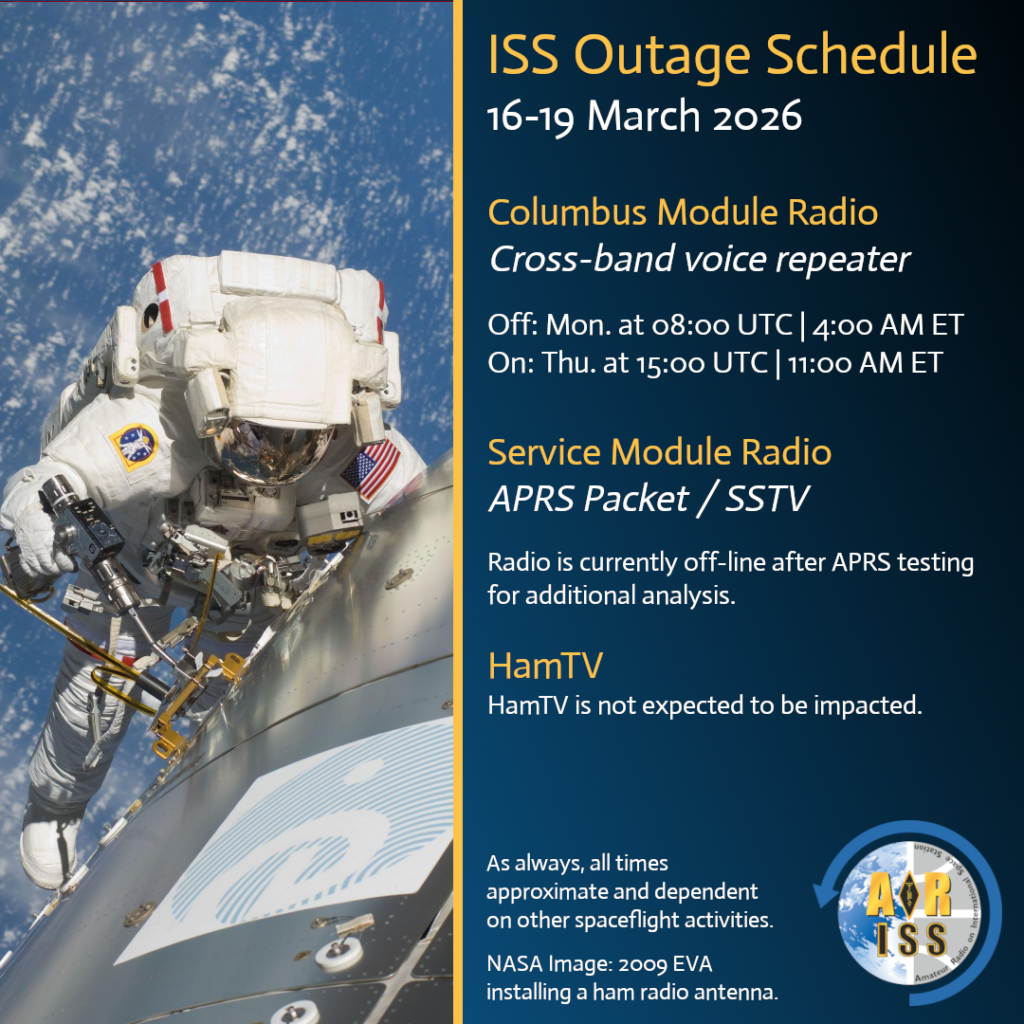
The crossband repeater continues to be active (145.990 MHz up {PL 67} & 437.800 MHz down), If any crew member is so inclined, all they have to do is pick up the microphone, raise the volume up, and talk on the crossband repeater. So give a listen, you just never know. ​​Service Module radio: Not in APRS configuration; only being used for voice contacts at this time. Default mode is for​​​ packet operations (145.825 MHz up & down) but occasionally used for SSTV (145.800 MHz down)​​.

​​​​​​​​​​​​​​​​​​​​​​​​​​​​​​​​​​ Ham TV – Configured. ​​ Default mode is for​​​ scheduled digital amateur television operations (2395.00 MHz). Note, all times are approximate. It is recommended that you do your own orbital prediction or start listening about 10 minutes before the listed time. The latest information on the operation mode can be found at https://www.ariss.org/current-status-of-iss-stations.html The latest list of frequencies in use can be found at https://www.ariss.org/contact-the-iss.html
[ANS thanks Charlie Sufana, AJ9N, one of the ARISS operation team mentors for the above information]


Want to fly the colors on your own grid expedition? Get an AMSAT car flag and other neat stuff from our Zazzle store!
25% of the purchase price of each product goes towards Keeping Amateur Radio in Space


AMSAT Ambassador Activities
AMSAT Ambassador News Logo

AMSAT Ambassadors provide presentations, demonstrate communicating through amateur satellites, and host information tables at club meetings, hamfests, conventions, maker faires, and other events.

May 15-17, 2026
Dayton Hamvention
Greene County Fair and Expo Center
210 Fairground Road
Xenia 45385
https://hamvention.org/

October 8-11, 2026
44th AMSAT Space Symposium and Annual Membership Meeting
Crowne Plaza JAX Airport
14670 Duval Road
Jacksonville, FL 32218
Details to follow

Interested in becoming an AMSAT Ambassador? AMSAT Ambassadors provide presentations, demonstrate communicating through amateur satellites, and host information tables at club meetings, hamfests, conventions, maker faires, and other events. For more information go to: https://www.amsat.org/ambassador/

[ANS thanks Bo Lowrey, W4FCL, Director – AMSAT Ambassador Program, for the above information]


Satellite Shorts from All Over

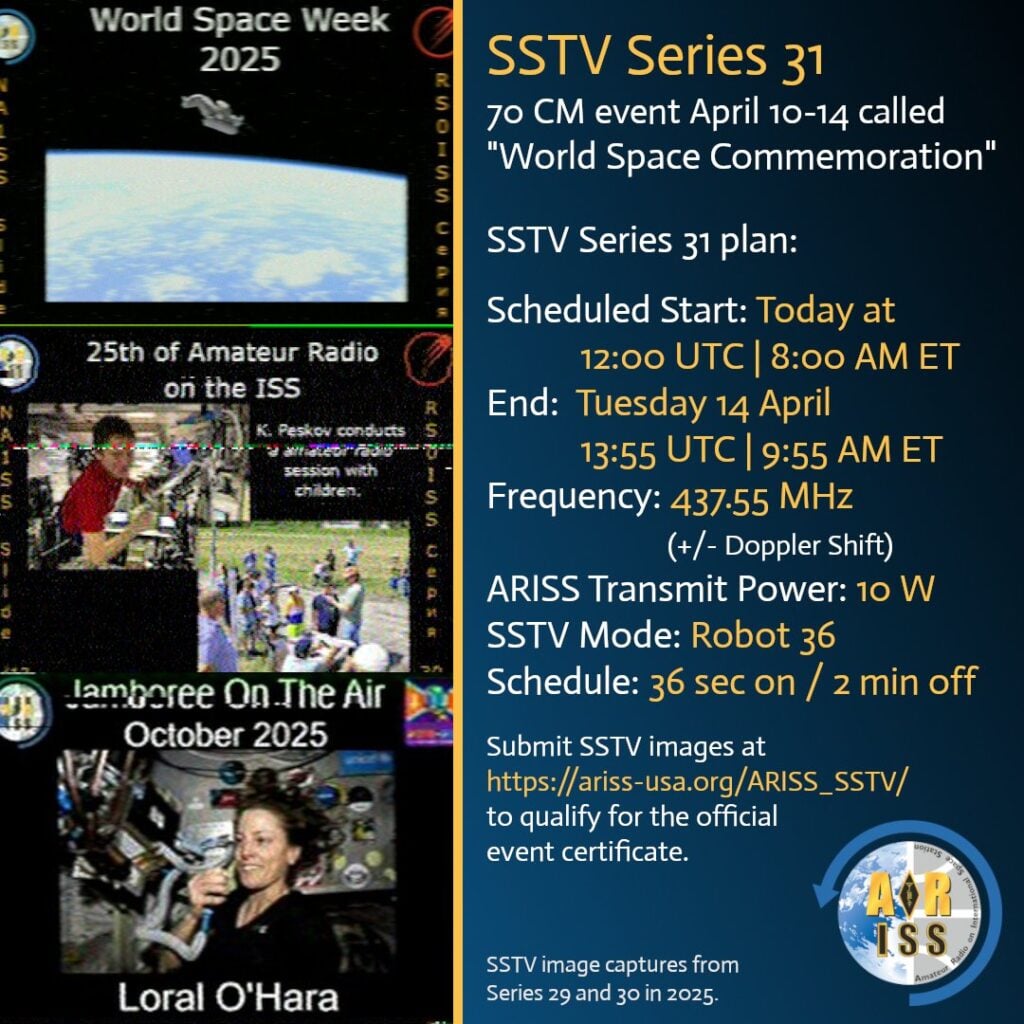
+ ARISS SSTV Series 31 “World Space Commemoration” kicked off  on April 10, 2026, on 437.550 MHz FM using Robot 36 mode. Transmissions run through April 14 and feature images honoring Cosmonautics Day, the 100th anniversary of liquid-fueled rockets, the first Space Shuttle launch, and SuitSat. Operators worldwide are actively tracking passes and sharing receptions.

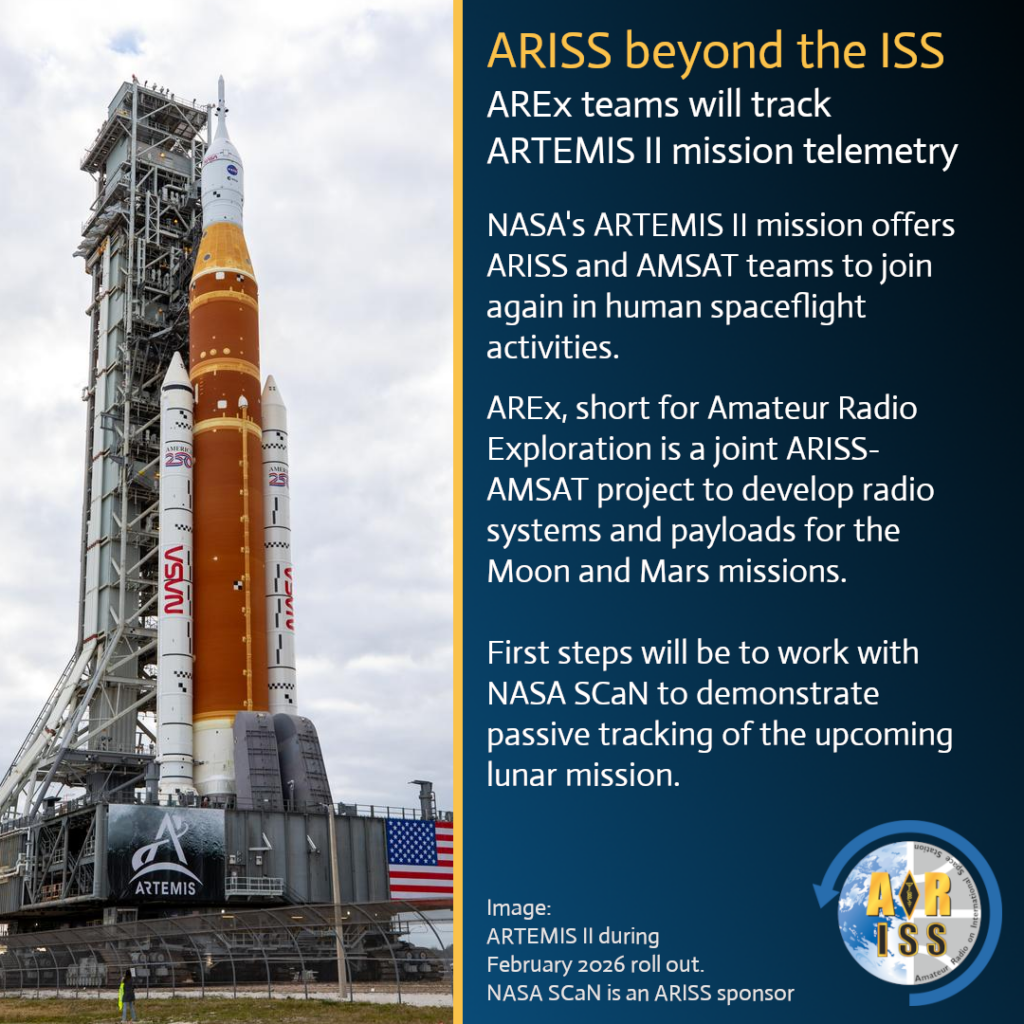
+ Amateur radio operators continued supporting NASA’s Artemis II lunar flyby mission. A network of 34 ARISS- and AMSAT-affiliated stations is providing supplementary tracking of the Orion spacecraft’s S-band signals, with notable contributions from experienced satellite tracker Scott Tilley, VE7TIL. The mission splashed down on April 10th in the Pacific Ocean.

+ A new version of the UZ7HO SoundModem software for HADES-SA/SpinnyONE is now available, with bug fixes and supporting tools for SSDV image decoding and CODEC2. Downloads are posted on the AMSAT-EA website.


Join AMSAT today at https://launch.amsat.org/

In addition to regular membership, AMSAT offers membership to:

  • Societies (a recognized group, clubs or organization).
  • Students are eligible for FREE membership up to age 25.
  • Memberships are available for annual and lifetime terms.

Contact info [at] amsat.org for additional membership information.

73 and remember to help Keep Amateur Radio in Space!

This week’s ANS Editor,

Paul Stoetzer, N8HM
n8hm [at] amsat.org

ANS is a service of AMSAT, the Radio Amateur Satellite Corporation, 712 H Street NE, Suite 1653, Washington, DC 20002. AMSAT is a registered trademark of the Radio Amateur Satellite Corporation.
ANS-088 AMSAT News Service Weekly Bulletins

AMSAT News Service

ANS-088
March 29, 2026

In this edition:

* AMSAT Announces Full Lineup of Events and Activities for Hamvention 2026
* AMSAT CubeSatSim Lite Available Again for Purchase Through AMSAT Store
* New “Ground Station” Software Streamlines Satellite Tracking and Decoding
* KrakenRF Announces Discovery Drive Az/El Rotator for Satellite Operations
* Artemis II to Deploy International CubeSats into High Earth Orbit
* Changes to AMSAT TLE Distribution for March 27, 2026
* ARISS News
* AMSAT Ambassador Activities
* Satellite Shorts From All Over

The AMSAT® News Service bulletins are a free, weekly news and information service of AMSAT, The Radio Amateur Satellite Corporation. ANS publishes news related to Amateur Radio in Space including reports on the activities of a worldwide group of Amateur Radio operators who share an active interest in designing, building, launching and communicating through analog and digital Amateur Radio satellites.
The news feed on https://www.amsat.org publishes news of Amateur Radio in Space as soon as our volunteers can post it.

Please send any amateur satellite news or reports to: ans-editor [at] amsat.org

You can sign up for free e-mail delivery of the AMSAT News Service Bulletins via the ANS List; to join this list see: https://mailman.amsat.org/postorius/lists/ans.amsat.org/


AMSAT Announces Full Lineup of Events and Activities for Hamvention 2026

The 2026 Dayton Hamvention will be held Friday through Sunday, May 15–17, 2026, at the Greene County Fairgrounds in Xenia, Ohio. AMSAT will once again have a strong presence throughout the event, including booth activities, social gatherings, and the annual AMSAT Forum.

The 17th annual TAPR/AMSAT Banquet will be held Friday, May 15 at 6:30 PM EDT (18:30 EDT) at the Kohler Presidential Banquet Center, 4548 Presidential Way, Kettering, Ohio 45429, located approximately 20 minutes from the Greene County Fairgrounds. This dinner is a highlight of the TAPR (Tucson Amateur Packet Radio) and AMSAT (Radio Amateur Satellite Corporation) activities during Hamvention. The banquet speaker will be announced at a later date.

Tickets are $75 each and may be purchased through the AMSAT store. The deadline to purchase banquet tickets is Monday, May 11 at 17:00 EDT (21:00 UTC). Tickets must be purchased in advance and will not be sold at the AMSAT booth or at the door. There will be no tickets available for pickup at the AMSAT booth. Tickets purchased online will be maintained on a list, with check-in at the door at the banquet center. Seating is limited to the number of meals reserved with the Kohler caterers based on ticket sales by the deadline.

The annual AMSAT “Dinner at Tickets” gathering will take place Thursday, May 14 from 6:00 PM to 8:00 PM EDT at Tickets Pub & Eatery, 7 W. Main Street, Fairborn, Ohio 45324. Telephone (937) 878-9022. This informal event features no program or speaker, offering an opportunity for conversation and camaraderie. All are welcome, regardless of participation in booth setup or operations. Food may be ordered from the menu, and drinks, including beer, wine, sodas, and iced tea, are available at the bar. No reservations are required.

AMSAT is seeking volunteers to assist at the AMSAT booth, located in Building 1, booths 1007–1010 and 1107–1110. Volunteers are encouraged to contribute as much time as they are able, whether for a few hours or the entire weekend. In 2025, approximately 20 volunteers supported AMSAT’s activities and engagement with attendees.

Those interested in volunteering or requesting additional information may contact Phil Smith, W1EME, AMSAT Hamvention Team Leader, via email at w1eme [at] astrocom.net. Volunteer participation plays an important role in supporting AMSAT’s presence and outreach within the amateur radio community.

The AMSAT Forum will be held Saturday, May 16 from 1:50 PM to 3:10 PM EDT in Forum Room 2.

Additional details, including the banquet speaker announcement, will be provided as they become available.

[ANS thanks Paul Stoetzer, N8HM, Executive Vice President for the above information]


AMSAT CubeSatSim Lite Available Again for Purchase Through AMSAT Store

The AMSAT CubeSatSim Lite, a low-cost, fully assembled satellite simulator, is once again available for purchase through the AMSAT Store. The device is designed to help users learn about satellite communications by transmitting simulated telemetry signals that can be received with common amateur radio equipment.

Operating on the 70 cm amateur band at 434.900 MHz, the CubeSatSim Lite allows users to receive and decode signals using a wide range of radios and software-defined radio (SDR) setups. Digital telemetry and images can be decoded using software such as FoxTelem, APRS decoders, or SSTV applications.

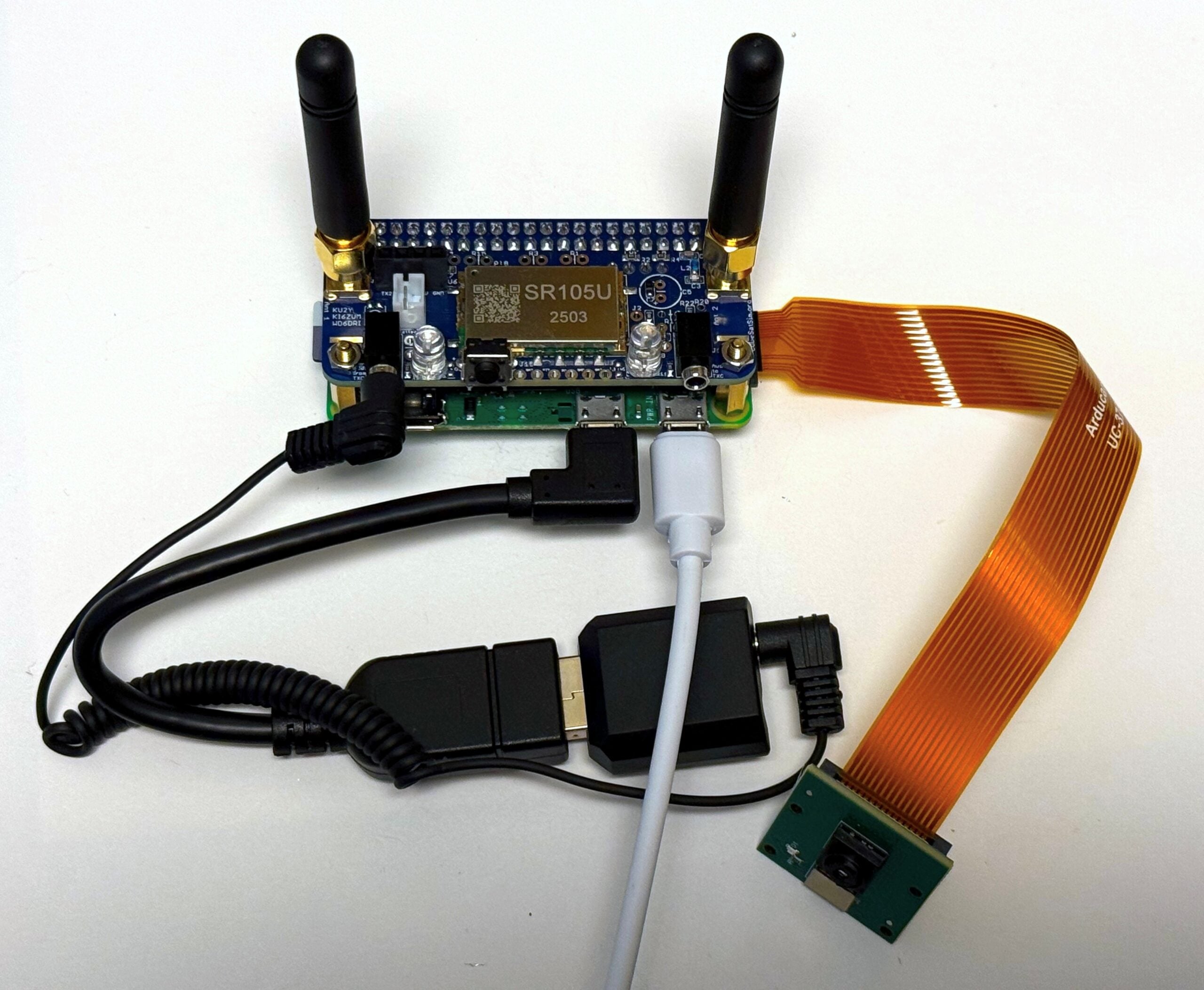
The CubeSatSim Lite provides a low-cost platform for simulated satellite telemetry and experimentation. [Credit: AMSAT]
Once powered, the unit immediately begins transmitting simulated telemetry in seven different modes, including FUNcube and a cross-band repeater mode.

The CubeSatSim Lite comes fully assembled and includes:

  • Raspberry Pi Zero 2W with preloaded microSD card
  • SMA antennas
  • USB sound card
  • Pi Camera
  • USB power cable and power supply

The unit includes a pushbutton and LED indicators for control and status. Users can also connect the CubeSatSim Lite to a network via the built-in Wi-Fi capability of the Raspberry Pi, allowing for configuration changes, mode selection, and further customization.

The CubeSatSim Lite is priced at $150, including shipping to U.S. addresses. Additional information, including documentation and operating details, is available through the CubeSatSim Wiki and README resources.

For more information or to purchase the CubeSatSim Lite, visit:
https://www.amsat.org/product/cubesatsim-lite-complete/

Additional documentation is available at:
https://github.com/alanbjohnston/CubeSatSim/wiki/CubeSatSim-Lite
https://cubesatsim.org/download/cubesatsim-lite-readme.pdf

[ANS thanks Alan Johnston, KU2Y, for the above information]


New “Ground Station” Software Streamlines Satellite Tracking and Decoding

A new open-source software project called “Ground Station” is gaining attention among amateur satellite operators as a unified platform for tracking, receiving, and decoding satellite signals. The software combines multiple functions typically handled by separate tools into a single system, offering a more streamlined approach to satellite operations.

Tracking programs, SDR control software, recording tools, and decoding utilities are often used together, sometimes requiring manual setup for each pass. “Ground Station” aims to simplify this process by automating the workflow from pass prediction through signal reception and decoding.

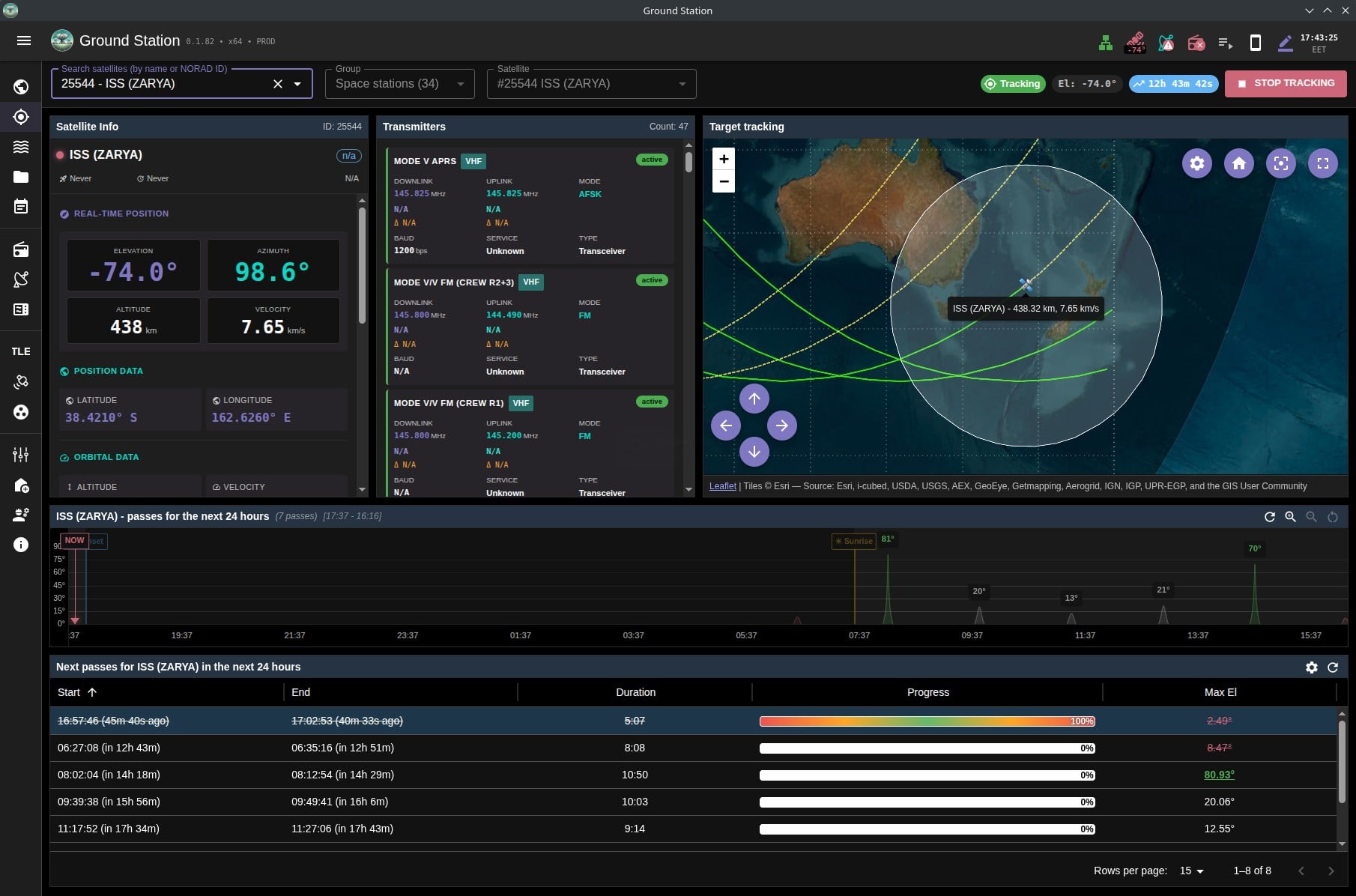
At its core, the software provides real-time satellite tracking using orbital data, along with automatic updates of satellite elements. It supports a variety of software-defined radios, allowing users to monitor and record signals from multiple satellites. The system also includes automated antenna rotator control and Doppler correction, helping keep signals centered during a pass.

The Ground Station satellite tracking view displays real-time position, orbital data, and pass predictions. [Credit: Ground Station GitHub]
The platform is capable of scheduling and executing satellite observations automatically, reducing the need for operator intervention. During a pass, it can record IQ or audio data and process common digital modes, including telemetry formats used by many amateur satellites. This is useful for operators interested in telemetry collection, CubeSat monitoring, and general satellite experimentation.

In addition to amateur radio satellites, the software integrates with tools such as SatDump to decode weather satellite transmissions, including NOAA APT and other imaging formats. This expands its usefulness beyond traditional amateur satellites to include weather satellite reception and other downlink services commonly monitored by the amateur community.

“Ground Station” is an early-stage, actively developed open-source project available on GitHub at https://github.com/sgoudelis/ground-station. Users can learn more about the software and access installation instructions there. As development continues, it offers a path toward more fully integrated ground stations, lowering the barrier to entry for satellite reception while providing experienced operators with a flexible new tool to explore.

[ANS thanks RTL-SDR.com, Efstratios Goudelis, and Jacob Seman for the above information]


SDR Gen 2 Ad - 2026


KrakenRF Announces Discovery Drive Az/El Rotator for Satellite Operations

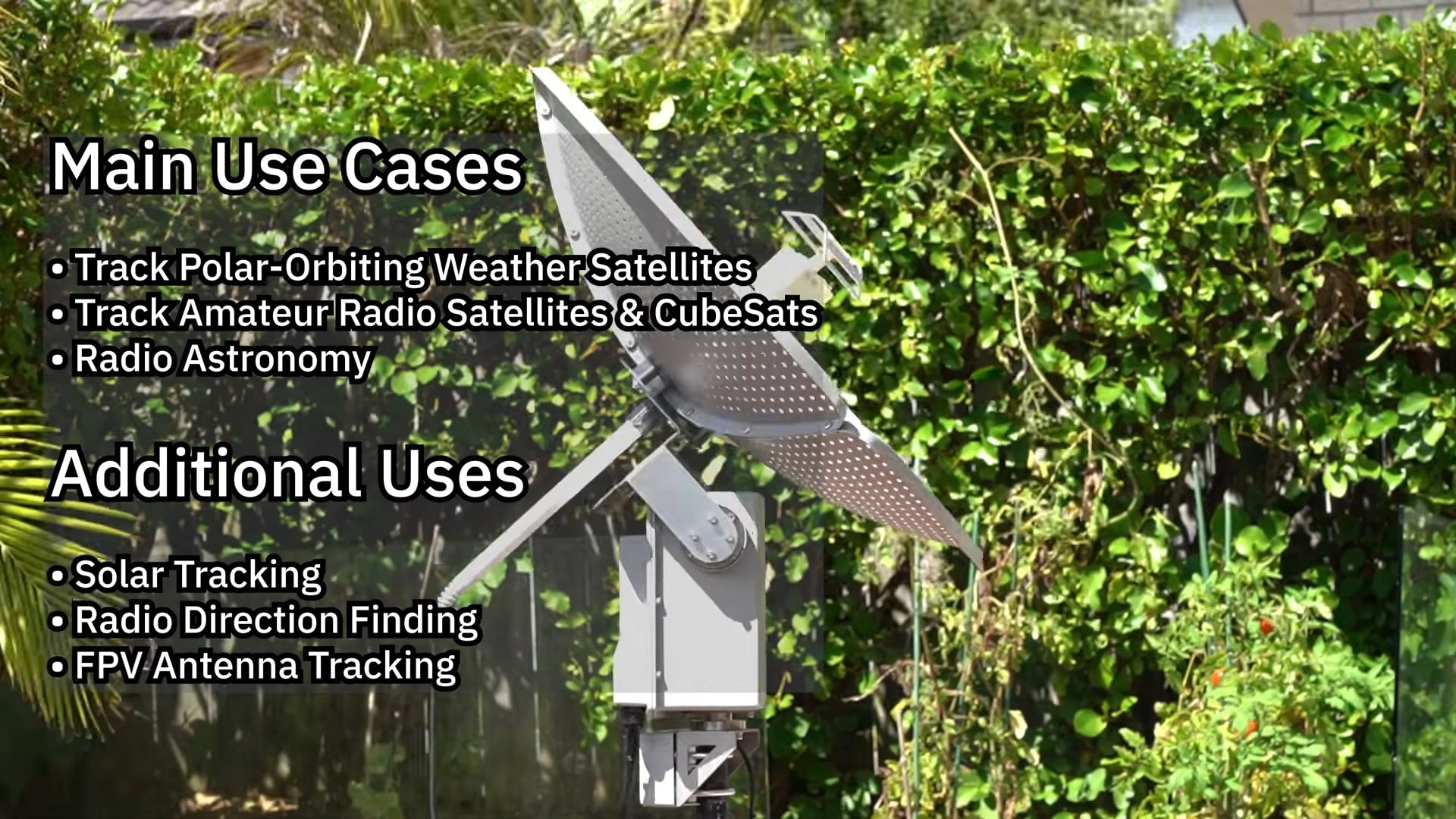
KrakenRF has announced its Discovery Drive, a motorized azimuth/elevation antenna rotator now in a crowdfunding campaign on Crowd Supply. As of late March, the project has raised more than $117,000 toward its $314,550 goal, reaching approximately 37 percent of its funding goal with several weeks remaining in the campaign.

Discovery Drive is designed as a turnkey solution for satellite tracking using directional antennas such as dishes and Yagis. The unit arrives fully assembled and weatherproof, eliminating the need for mechanical assembly or custom controller integration. Setup consists of mounting the rotator to a mast or tripod, applying 12 V power, connecting via Wi-Fi or USB, and aligning the system to true north.

The rotator is intended to support a range of satellite operations, including polar-orbiting weather satellites such as METEOR-M2 and MetOp, as well as CubeSat and amateur radio satellite tracking. KrakenRF also highlights additional experimental applications, including hydrogen line radio astronomy using compatible dish systems and software such as Stellarium.

Discovery Drive azimuth/elevation rotator shown with a Discovery Dish for automated tracking applications. [Credit: KrakenRF]
A recent video review from the SaveItForParts YouTube channel demonstrates a prototype unit in operation, including setup with a Discovery Dish and reception of multiple weather satellites. The video also shows use with a handheld Yagi antenna, with future testing of amateur radio satellites anticipated. The review is available at https://www.youtube.com/watch?v=A7FiVWaXuXE.

Discovery Drive integrates with commonly used satellite tracking software through a rotctl-compatible network interface, allowing automatic control from applications such as SatDump, GPredict, and Look4Sat. It also supports USB serial control using the EasyComm II protocol via Hamlib. A browser-based web interface provides direct manual control and system configuration.

According to published specifications, the unit provides approximately ±1.5 degrees of pointing accuracy, with an azimuth range of ±360 degrees and elevation from 0 to 90 degrees. The system delivers up to 108 lb-in (12.25 N·m) of torque, supporting antennas up to approximately 11 pounds (5 kilograms). During the campaign, Discovery Drive is priced at $699, with a planned increase to at least $799 following the funding period. KrakenRF estimates a manufacturing timeline of approximately two months, followed by one to two months for fulfillment and delivery to backers.

Additional information is available at https://www.crowdsupply.com/krakenrf/discovery-drive.

[ANS thanks RTL-SDR.com, KrakenRF, and SaveItForParts for the above information]


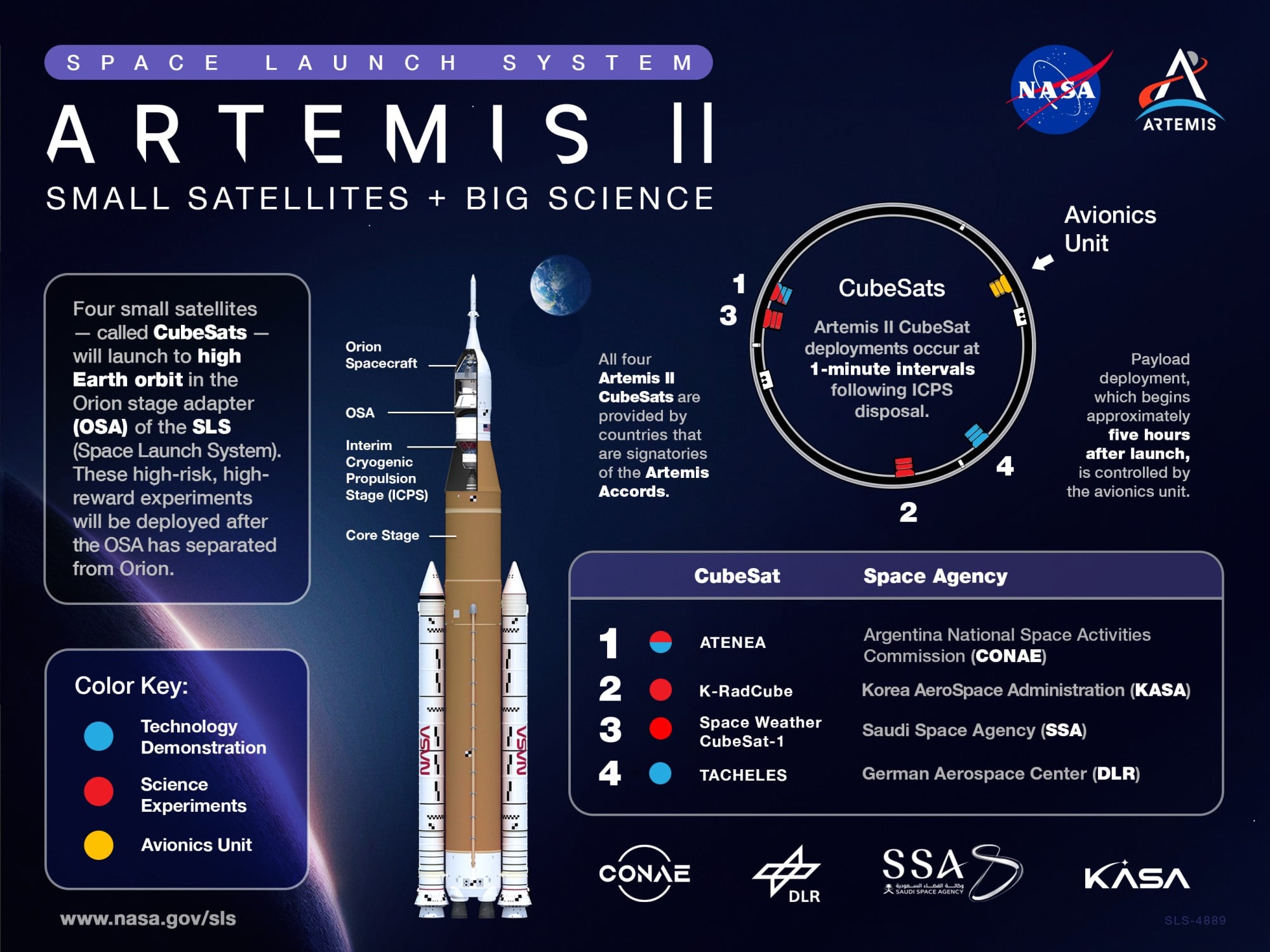
Artemis II to Deploy International CubeSats into High Earth Orbit

When Artemis II lifts off on NASA’s Space Launch System in early April, four international CubeSats will be carried into space inside the Orion stage adapter. The satellites will be deployed into High Earth Orbit approximately five hours after launch, following separation from the upper stage and the Orion spacecraft.

The CubeSats will ride within a ring-shaped adapter structure that connects NASA’s Orion spacecraft to the SLS interim cryogenic propulsion stage. After Orion separates and establishes a safe distance, an onboard avionics unit inside the adapter will control deployment, releasing each CubeSat at one-minute intervals. This system ensures the satellites are deployed safely and without interference as the stage continues on its trajectory.

Although Artemis II’s primary objective is to send four astronauts on a crewed lunar flyby, the CubeSats will carry out independent scientific and technology demonstration missions. By flying as secondary payloads, these satellites provide additional research opportunities without affecting the main objectives of the mission.

Artemis II will carry four international CubeSats that deploy into High Earth Orbit after Orion fully separates. [Credit: NASA]
Participating space agencies include the German Aerospace Center, the Korea Aerospace Administration, the Saudi Space Agency, and Argentina’s National Commission on Space Activities. The four CubeSats are named TACHELES from Germany, K-RadCube from South Korea, Space Weather CubeSat-1 from Saudi Arabia, and ATENEA from Argentina.

Each satellite is designed to carry out a unique mission. Germany’s TACHELES will study the effects of the space environment on electrical components, helping inform future deep-space systems. Other payloads will focus on radiation measurements, space weather monitoring, and validation of new technologies in a High Earth Orbit environment.

NASA officials note that CubeSats offer a relatively low-cost method for testing new technologies, though their small size presents challenges for long-duration missions. The Artemis II CubeSat program highlights the growing role of international cooperation under the Artemis Accords, while expanding access to space and enabling new scientific investigations beyond Earth orbit.

[ANS thanks NASA for the above information]


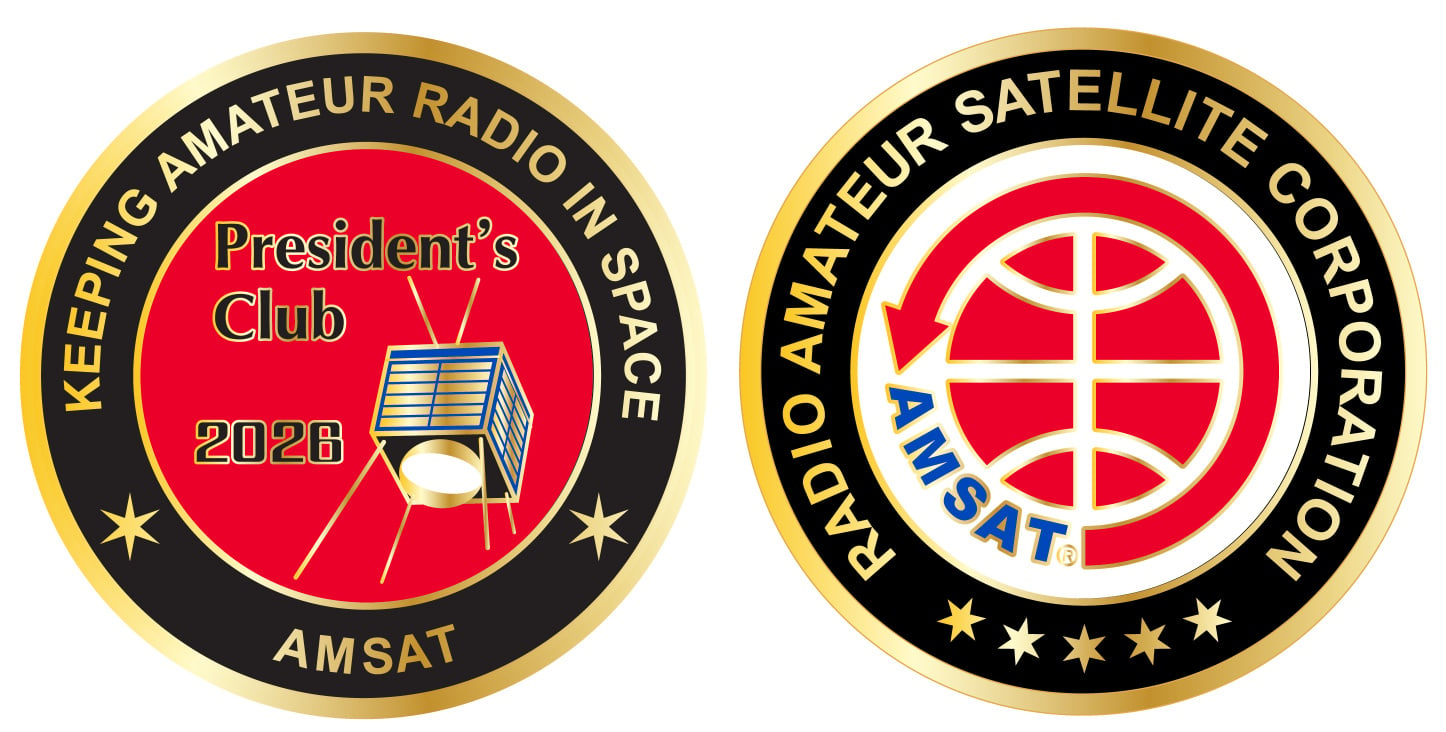
The 2026 Coins Are Here! Help Support GOLF-TEE and FoxPlus.
Annual memberships start at only $120.

Presidents' Club 2026 Coin

Join the AMSAT President’s Club today and help Keep Amateur Radio in Space!
https://www.amsat.org/join-the-amsat-presidents-club/


Changes to AMSAT TLE Distribution for March 27, 2026

Two Line Elements or TLEs, often referred to as Keplerian elements or keps in the amateur community, are the inputs to the SGP4 standard mathematical model of spacecraft orbits used by most amateur tracking programs. Weekly updates are completely adequate for most amateur satellites. TLE bulletin files are updated daily in the first hour of the UTC day. New bulletin files will be posted immediately after reliable elements become available for new amateur satellites. More information may be found at https://www.amsat.org/keplerian-elements-resources/.

+ This week there are no additions or deletions to the AMSAT TLE distribution.

[ANS thanks Joe Fitzgerald, KM1P, AMSAT Orbital Elements Manager, for the above information]


ARISS News

Amateurs and others around the world may listen in on contacts between amateurs operating in schools and allowing students to interact with astronauts and cosmonauts aboard the International Space Station. The downlink frequency on which to listen is 145.800 MHz worldwide.

Scheduled Contacts

+ Recently Completed

Vauban, Ecole et Lycée français de Luxembourg, Luxembourg City, Luxembourg, direct via LX26LV
The ISS callsign was scheduled to be OR4ISS
The scheduled crewmember was Sophie Adenot KJ5LTN
The ARISS mentor was ON6TI
Contact was successful: Wed 2026-03-25 15:47:34 UTC

Amur State University, Blagoveshchensk, Russia, direct via TBD
The ISS callsign was scheduled to be RSØISS
The scheduled crewmember was Andrey Fedyaev
The ARISS mentor was RV3DR
Contact was successful: Thu 2026-03-26 08:50 UTC

MOBU, Ufa, Republic of Bashkortostan, Russia, direct via TBD
The ISS callsign was scheduled to be RSØISS
The scheduled crewmember was Sergey Kud-Sverchkov
The ARISS mentor was RV3DR
Contact was successful: Thu 2026-03-26 13:30 UTC

Immanuel Kant Baltic Federal University, Kaliningrad, Russia, direct via TBD
The ISS callsign was scheduled to be RSØISS
The scheduled crewmember was Sergey Mikaev
The ARISS mentor was RV3DR
Contact was successful: Fri 2026-03-27 15:50 UTC

+ Upcoming Contacts

Aznakaevsky District, Republic of Tatarstan, Russia, direct via TBD
The ISS callsign is presently scheduled to be RSØISS
The scheduled crewmember is Andrey Fedyaev
The ARISS mentor is RV3DR
Contact is go for: Mon 2026-03-30 11:55 UTC

Simon Langton Grammar School for Boys The Langton, Canterbury, United Kingdom, direct via GB4SLS
The ISS callsign is presently scheduled to be NA1SS
The scheduled crewmember is Jack Hathaway KJ5NIV
The ARISS mentor is MØXTD
Contact is go for: Mon 2026-03-30 13:28:38 UTC
Watch for Livestream at https://live.ariss.org/ AND watch HamTV at https://live.ariss.org/hamtv/

Istituto Comprensivo “Gabriele D’Annunzio” Lanciano, Chieti, Italy, direct via IQ6LN
Istituto Comprensivo “Mohandas Karamchand Gandhi”, Pontedera, Italy, telebridge via IQ6LN
The ISS callsign is presently scheduled to be OR4ISS
The scheduled crewmember is Sophie Adenot KJ5LTN
The ARISS mentor is IKØWGF
Contact is go for: Wed 2026-04-01 11:55:45 UTC
Watch for Livestream at:
Lanciano: https://www.youtube.com/watch?v=RUtvnVa2NBo
Pontedera: http://www.youtube.com/live/KrEtbdTEAfA

Walnut Grove Elementary School, Suwanee, GA, direct via KR4HPC
The ISS callsign is presently scheduled to be NA1SS
The scheduled crewmember is Chris Williams KJ5GEW
The ARISS mentor is K4RGK
Contact is go for: Thu 2026-04-02 15:40:55 UTC
Watch for Livestream at https://youtube.com/live/J1XJHvr4UlU? and/or https://live.ariss.org/

Many times, a school makes a last-minute decision to do a Livestream or runs into a last-minute glitch requiring a change of the URL, but we at ARISS may not get the URL in time for publication. You can always check https://live.ariss.org/ to see if a school is Livestreaming.

As always, if there is an EVA, a docking, or an undocking; the ARISS radios are turned off as part of the safety protocol.

ARISS has announced that SSTV Series 31 is being planned for April 10–14, 2026, on 437.55 MHz (± Doppler shift). Transmissions are expected to use Robot 36 mode with approximately 10 watts of transmit power, operating on a schedule of 36 seconds on and 2 minutes off. The SSTV Series 31 images are expected to include tributes to Cosmonautics Day, the 100th anniversary of liquid-fueled rockets, the inaugural Space Shuttle launch, and SuitSat. Additional details and confirmation of the event schedule are expected as planning continues.

The crossband repeater remains configured in the Columbus Module (145.990 MHz up {PL 67} & 437.800 MHz down). If a crewmember decides to pick up the microphone and turn up the volume, you may hear them on the air—so keep listening, as you never know when activity might occur.

​Kenwood D710GA in the Zvezda Service Module – Call sign RS0ISS. Please note we’re still in the process of troubleshooting and testing this radio. HamTV in the Columbus Module is configured for scheduled digital amateur television operations on 2395.00 MHz.

Note, all times are approximate. It is recommended that you do your own orbital prediction or start listening about 10 minutes before the listed time.

The latest information on the operation mode can be found at https://www.ariss.org/current-status-of-iss-stations.html

The latest list of frequencies in use can be found at https://www.ariss.org/contact-the-iss.html

[ANS thanks Charlie Sufana, AJ9N, one of the ARISS operation team mentors for the above information]


AMSAT Ambassador Activities

AMSAT Ambassadors provide presentations, demonstrate communicating through amateur satellites, and host information tables at club meetings, hamfests, conventions, maker faires, and other events.

AMSAT Ambassador Clint Bradford, K6LCS, says,

“Think a 75-minute presentation on “working the easy satellites” would be appropriate for your club or event? Let me know by emailing me at k6lcsclint [at] gmail [dot] com or calling me at 909-999-SATS (7287)!”

Clint has NEVER given the exact same show twice: EACH of the 150+ presentations so far has been customized/tailored to their audiences.

Scheduled Events

Tucson Area Spring Hamfest – April 11, 2026
Radio Society of Tucson
Calvary Tucson Church
8711 East Speedway
Tucson, AZ 85710
https://k7rst.club/
N1UW

Southeastern VHF Society Conference – April 17-19, 2026
Holiday Inn Macon North
3953 River Place Drive
Macon, Georgia 31201
https://svhfs.org/wp/2026-2/
W4FCL

For more information go to: https://www.amsat.org/ambassador/

[ANS thanks Bo Lowrey, W4FCL, Director – AMSAT Ambassador Program, for the above information]


AMSAT Remove Before Flight Key Tags Now Available
Yes, These are the Real Thing!

Your $20 Donation Goes to Help Fly a Fox-Plus Satellite
Includes First Class Postage (Sorry – U.S. Addresses Only)
Order Today at https://www.amsat.org/product/amsat-remove-before-flight-keychain


Satellite Shorts from All Over

+ Roscosmos launched Progress 94 cargo spacecraft at 11:59 UTC (7:59 a.m. EDT) on Sunday, March 22, aboard a Soyuz rocket from the Baikonur Cosmodrome in Kazakhstan, carrying approximately three tons of food, fuel, and supplies for the Expedition 74 crew aboard the International Space Station. The spacecraft was originally expected to dock autonomously at the space-facing port of the Poisk module on Tuesday, March 24, following a two-day flight. Shortly after reaching orbit, one of its two KURS automated rendezvous antennas failed to deploy as planned, though all other systems continued to operate normally. As a result, cosmonaut Sergey Kud-Sverchkov manually piloted the spacecraft during final approach using the TORU remote control system from inside the Zvezda Service Module. Progress 94 successfully docked at 13:40 UTC (9:40 a.m. EDT) on Tuesday, March 24, completing the resupply mission despite the earlier anomaly. The spacecraft is expected to remain docked for about six months before departing the station for a planned destructive re-entry, disposing of trash loaded by the crew. (ANS thanks NASA for the above information)

+ About a month after an onboard anomaly caused a loss of contact with the Proba-3 Coronagraph spacecraft, mission controllers have successfully re-established communication. The Villafranca ground station in Spain, operated by the European Space Agency (ESA), received telemetry from the spacecraft, confirming it is once again transmitting health and status data. The Coronagraph is currently in a stable safe mode while engineers conduct detailed system checks to assess any potential damage. Its solar panel is properly oriented toward the Sun, allowing essential systems to remain powered and the battery to recharge. After weeks exposed to extreme cold, the spacecraft’s components will require time to warm up before normal operations can resume. Mission officials say the recovery is an encouraging milestone, though careful analysis and gradual recovery steps will be required before the mission can fully return to nominal activities. (ANS thanks the ESA for the above information)

+ NASA’s Double Asteroid Redirection Test (DART) mission has demonstrated that a kinetic impact can alter the motion of an asteroid system, with new analysis confirming effects beyond the initial impact. The 2022 impact into the small asteroid Dimorphos not only shortened its orbit around the larger asteroid Didymos, but also slightly changed the motion of the entire binary system around the Sun. Scientists measured a change in orbital speed of about 11.7 microns per second, a tiny shift that could have significant long-term implications for planetary defense. The impact generated a cloud of ejecta that enhanced the momentum transfer, effectively doubling the push delivered by the spacecraft. Observations from both professional and amateur astronomers, including stellar occultation campaigns, were critical in confirming these results. Researchers note that even such small orbital changes, if applied early enough, could be sufficient to deflect a potentially hazardous asteroid away from Earth. (ANS thanks Space.com for the above information)

+ A unique NASA astronomy satellite may soon undergo an unprecedented rescue attempt as it faces an early end in orbit. The Neil Gehrels Swift Observatory, launched in 2004 to study gamma-ray bursts, has been out of operation for more than a month and is gradually losing altitude due to atmospheric drag. NASA has awarded a $30 million contract to Katalyst Space Technologies to develop a robotic servicing spacecraft that will attempt to rendezvous with Swift and raise its orbit, extending the mission’s life. The planned rescue mission, scheduled for launch as early as June, would mark one of the first commercial attempts to dock with and service a satellite not originally designed for in-orbit repair. Engineers face significant challenges, including tight timelines, uncertain spacecraft conditions, and the risks associated with docking two large objects in low-Earth orbit. If successful, the mission could demonstrate a lower-cost approach to satellite servicing while preserving a valuable scientific asset. (ANS thanks Ars Technica for the above information)


Join AMSAT today at https://launch.amsat.org/

In addition to regular membership, AMSAT offers membership to:

  • Societies (a recognized group, clubs or organization).
  • Students enrolled in at least half-time status are eligible for free membership to age 25.
  • Memberships are available for annual and lifetime terms.

Contact info [at] amsat.org for additional membership information.

73 and remember to help Keep Amateur Radio in Space!

This week’s ANS Editor,

Mitch Ahrenstorff, ADØHJ
mahrenstorff [at] amsat.org

ANS is a service of AMSAT, the Radio Amateur Satellite Corporation, 712 H Street NE, Suite 1653, Washington, DC 20002
AMSAT is a registered trademark of the Radio Amateur Satellite Corporation.
ANS-081 AMSAT News Service Bulletins

AMSAT News Service

ANS-081 March 22, 2026

In this edition:

* Digital Modes on FO-29 Not Permitted per Licensing Restrictions
* Ten-Koh 2 Satellite With Linear Transponder Update
* Catsat Request for Activation
* SpaceX Plan For 1 Million Centers Poses Dangerous Risk
* Changes to AMSAT-NA TLE Distribution
* Astronauts Complete Prep For New ISS Solar Array
* ARISS News
* AMSAT Ambassador Activities
* Satellite Shorts From All Over

The AMSAT® News Service bulletins are a free, weekly news and information service of AMSAT, The Radio Amateur Satellite Corporation. ANS publishes news related to Amateur Radio in Space including reports on the activities of a worldwide group of Amateur Radio operators who share an active interest in designing, building, launching and communicating through analog and digital Amateur Radio satellites.
The news feed on https://www.amsat.org publishes news of Amateur Radio in Space as soon as our volunteers can post it.

Please send any amateur satellite news or reports to: ans-editor [at] amsat.org

You can sign up for free e-mail delivery of the AMSAT News Service Bulletins via the ANS List; to join this list see: https://mailman.amsat.org/postorius/lists/ans.amsat.org/


Digital Modes on FO-29 Not Permitted per Licensing Restrictions

Fuji-OSCAR 29 (FO-29 / JAS-2), the Japanese amateur radio satellite launched in August 1996, has entered a period of full sunlight, resulting in renewed and more frequent transponder activity. The inverting analog transponder operates with an uplink passband of 145.900–146.000 MHz (LSB) and a downlink of 435.800–435.900 MHz (USB), along with a CW beacon at 435.795 MHz. The satellite’s 1-watt PEP output is shared across the 100 kHz bandwidth, making careful power management essential for all users.

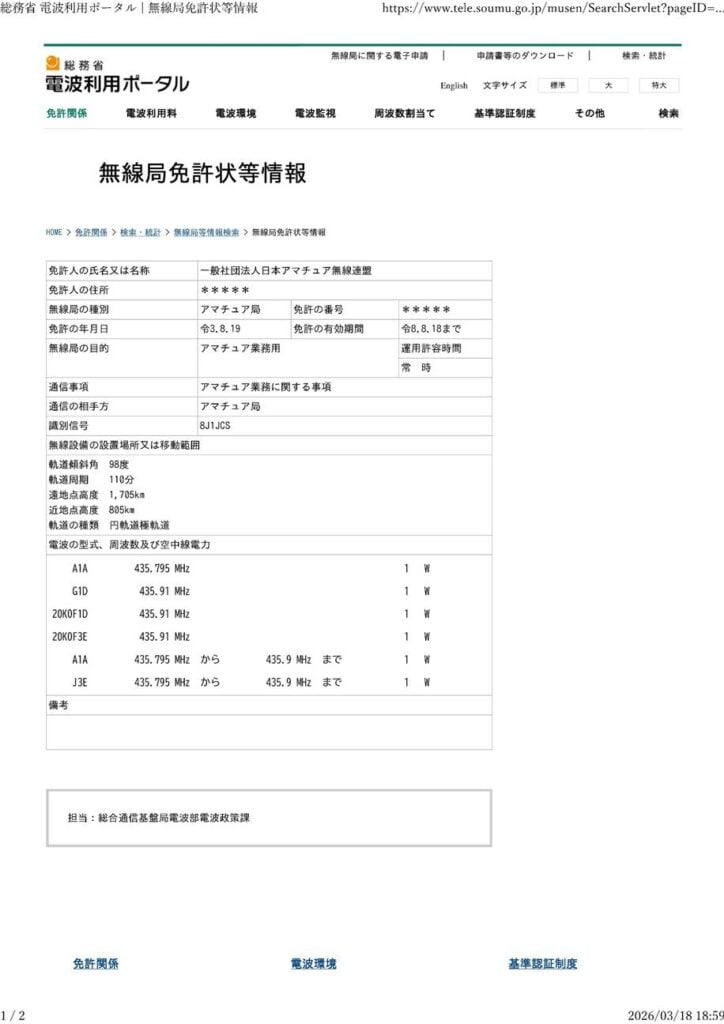
Although the FO-29 linear transponder is technically capable of passing narrowband digital signals such as FT8, FT4, PSK31, or Olivia, such operations are not permitted under the satellite’s original licensing from Japanese authorities. The transponder is explicitly licensed for SSB and CW modes only. This restriction stems from the satellite’s operational permit issued by Japan’s Ministry of Internal Affairs and Communications (MIC), which does not authorize digital emissions on the linear transponder frequencies.

Japanese license information indicating emission modes A1A (CW) and J3E (SSB)
are the only modulations permitted in the linear transponder downlink.

Operators attempting digital modes risk non-compliance with international amateur radio etiquette and could contribute to transponder overload, distortion, or temporary shutdowns—issues exacerbated by the high-duty-cycle nature of many digital signals.

AMSAT urges all users to limit their operations on FO-29 to SSB and CW and to practice good satellite etiquette:

  • Use the minimum power necessary to produce a readable downlink signal.
  • Ensure your downlink signal strength does not exceed the CW beacon level.
  • Monitor the transponder before and during your transmission; if the beacon weakens or the passband becomes noisy, reduce power immediately.
  • Keep signals clean and within the passband.

Share the limited resource responsibly so that the maximum number of amateurs worldwide can enjoy FO-29 while it remains active.

With the satellite now enjoying extended full-sunlight operation in 2026, this is an excellent time to explore its capabilities through permitted modes. Experimentation with unauthorized modes is discouraged to preserve the satellite’s health and comply with licensing.

[ANS thanks AMSAT, JARL, and JK2XXK for the above information.]


LIMITED TIME OFFER!!!

AMSAT is offering a limited-time promotion for new and renewing members
that includes a free digital copy of Getting Started with Amateur Satellites.
The promotion is being offered as AMSAT begins the 2026 membership year.

Getting Started

Anyone who joins or renews their AMSAT membership
during the promotional period will receive a download link
for the latest edition of Getting Started with Amateur Satellites
in their membership confirmation email. JOIN TODAY at
https://launch.amsat.org/
(Remember! Students join for FREE!)


Ten-Koh 2 Satellite With Linear Transponder Update

The 6U CubeSat Ten-Koh 2 (also written as Tenkoh-2 or てんこう2) from Japan’s Nihon University was successfully deployed into orbit on March 11, 2026, at approximately 09:34 UTC. The satellite was released from JAXA’s new HTV-X1 cargo spacecraft using the HTV-X Small Satellite Orbital Deployer (H-SSOD) after the vehicle departed the International Space Station (ISS) on March 6 and raised its altitude to around 500 km. This marks the first use of the H-SSOD mechanism for satellite deployment from HTV-X.

Developed by the Okuyama Laboratory in the Department of Aerospace Engineering at Nihon University’s College of Science and Technology, Ten-Koh 2 builds on the legacy of its predecessor, Ten-Koh (launched in 2018). The mission focuses on low-Earth orbit environmental observations to gather data for future space development, alongside in-orbit demonstrations of next-generation communication technologies. Key goals include evaluating high-speed data transmission and enabling global access for amateur radio operators to collect telemetry and experiment with the payloads.

The satellite carries an amateur radio payload coordinated by the International Amateur Radio Union (IARU) and supported by JAMSAT (Japan Amateur Satellite Association):

V/U Linear Transponder (inverting, 40 kHz bandwidth):
     Uplink (LSB): 145.895–145.935 MHz
     Downlink (USB): 435.875–435.915 MHz
Additional Downlinks/Experiments:
     CW beacon, Digitalker, AFSK 1.2 kbps, GMSK up to 19.2 kbps on 435.860 MHz
     High-speed experiments (GMSK 4.8–19.2 kbps, 4FSK 38.4 kbps) and photo/picture downlinks on 435.895 MHz
     5.839 GHz CW beacon for microwave-band communication demos (SHF experimenters take note—this provides a great target for testing dishes, feeds, and LNAs)

The transponder is expected to operate on a scheduled basis (initially two days per week, with details forthcoming from the team). Operations began shortly after deployment, with the university’s ground station confirming reception of the CW beacon for basic telemetry (voltage, temperature, etc.).

Post-deployment updates from the Okuyama Lab indicate the signal level is currently weaker than anticipated, prompting ongoing monitoring and appeals for reception reports via networks like SatNOGS to aid diagnostics and performance assessment. Early passes over Japan and other regions have yielded mixed results, with some operators reporting no signals yet. Ten-Koh 2 currently only transmits very weak CW data on 435.860 MHz.

Ten-Koh 2 Keplerian data (TLE) are now available in the regular satellite catalog under catalog number 68261.

[ANS thanks the Okuyama Laboratory at Nihon University and Nico Janssen, PA0DLO, for the above information.]


The 2026 Coins Are Here! Help Support GOLF-TEE and FoxPlus.
Annual memberships start at only $120

Presidents' Club 2026 Coin

Join the AMSAT President’s Club today and help Keep Amateur Radio in Space!
https://www.amsat.org/join-the-amsat-presidents-club/


CatSat Request for Activation

For those who might be getting ready to try and track the Catsats’ 10 GHz beacon, be advised that it is not always on.

The University of Arizona team has a web page setup to allow requests for activation of either the beacon (10.47 GHz) or linear transponder (C/x 5.663/10.47 GHz). The link is here:

https://forms.cloud.microsoft/pages/responsepage.aspx?id=BVXjXo7rKUmTfWRd9QEyiOQw4K6AJHFOolv4Eb8VNu1UQVdaS1VFS1o3RkJSSVE0T1lKMFdTU0xXWS4u&route=shorturl

Once you have submitted your request, if it’s possible, you can see it scheduled on their calendar page located here:

https://catsat.arizona.edu/calendar

[ANS thanks Mike Seguin, N1JEZ, for the above information.]


Need new satellite antennas?
Purchase M2 LEO-Packs from the AMSAT Store.

When you purchase through AMSAT,
a portion of the proceeds goes towards

Keeping Amateur Radio in Space.
https://amsat.org/product-category/hardware/


SpaceX Plan For 1 Million Centers Poses Dangerous Risk

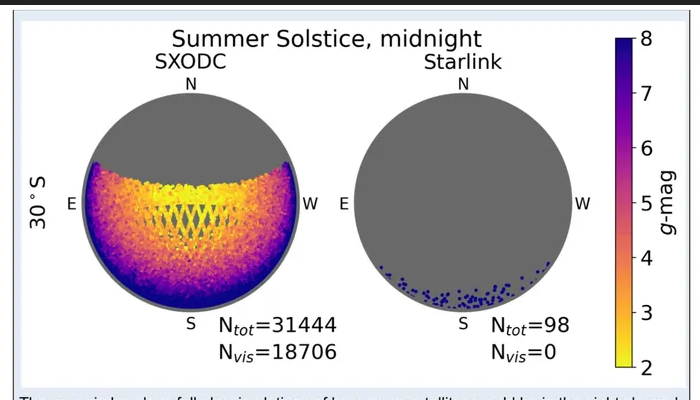
A SpaceX plan for 1 million orbital data centers proposes a massive constellation of sunlit objects that could severely impair ground-based astronomy and increase atmospheric pollution through frequent reentries in the upper atmosphere.

Astronomers warn that these 100-meter-long structures will remain illuminated even at midnight. This constant visibility threatens observations at ground-based observatories, such as the Vera Rubin Observatory and the Extremely Large Telescope currently under construction in Chile.

These orbital data centers, potentially 100 meters long, create persistent light streaks that obstruct astronomical research. Positioned in high-inclination orbits at 500-2,000 km, they remain illuminated by sunlight even at midnight, significantly outshining traditional broadband satellites.

Comparison of Starlink satellite visibility and that of SpaceX’s proposed data center constellation. (Credit: nasaspacenews)

Astronomers have filed formal objections with the FCC regarding the January 30 application. This new constellation poses a challenge unlike any encountered in the commercial space era, undermining years of progress.

Further, this much hardware results in one spacecraft burning up in the atmosphere every three minutes. This mass incineration releases dangerous concentrations of aluminum oxide and lithium, potentially depleting the protective ozone layer and altering global temperatures.

Environmental experts highlight risks, but the FCC’s fast-track approval process bypasses standard environmental reviews, placing the burden of proof on the scientific community to prevent damage.

[ANS thanks nasaspacenews for the above information. Read the full article at https://nasaspacenews.com/2026/03/spacex-plan-for-1-million/.]


SDR Gen 2 Ad - 2026


Changes to AMSAT TLE Distribution for March 20, 2026

Two Line Elements or TLEs, often referred to as Keplerian elements or keps in the amateur community, are the inputs to the SGP4 standard mathematical model of spacecraft orbits used by most amateur tracking programs. Weekly updates are completely adequate for most amateur satellites. TLE bulletin files are updated daily in the first hour of the UTC day. New bulletin files will be posted immediately after reliable elements become available for new amateur satellites. More information may be found at https://www.amsat.org/keplerian-elements-resources/.

Ten-Koh 2 has been added under its own NORAD Cat ID 68261

[ANS thanks Joe Fitzgerald, KM1P, AMSAT Orbital Elements Manager, for the above information.]


AMSAT Remove Before Flight Key Tags Now Available
Yes, These are the Real Thing!

Your $20 Donation Goes to Help Fly a Fox-Plus Satellite
Includes First Class Postage (Sorry – U.S. Addresses Only)
Order Today at https://www.amsat.org/product/amsat-remove-before-flight-keychain


Astronauts Complete Prep For New ISS Solar Array

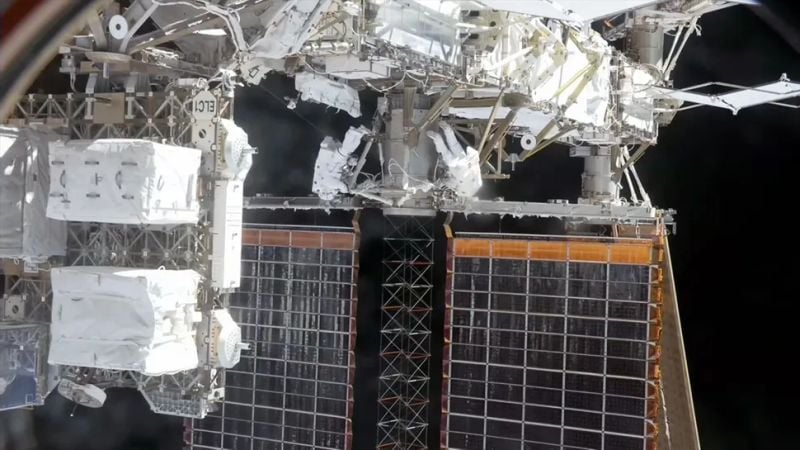
Two NASA astronauts prepared the International Space Station (ISS) for the addition of a new solar array on the first U.S. spacewalk in almost a year.

Expedition 74 crewmates Jessica Meir and Chris Williams, KJ5GEW, ventured outside of the space station’s Quest airlock at 1252 UTC on Wednesday, March 18 to install a mount for an advanced power-producing solar panel. The pair worked on the left (or port) side of the space station’s backbone truss, where they first assembled and then attached the bracket structure that will support an ISS Roll-Out Array (iROSA), to be installed on a future spacewalk.

NASA astronauts Jessica Meir (at left) and Chris Williams prepare the
International Space Station for the addition a new solar array during
a spacewalk on Wednesday, March 18, 2026. (Image credit: NASA)

NASA had scheduled for the iROSA kit to be installed during a spacewalk in January, but one of the then-assigned spacewalkers, Mike Fincke, KE5AIT, had an undisclosed medical issue that required the excursion to be canceled and he and his crewmates to return to Earth a month early.

The space station’s original solar arrays have degraded, having exceeded their 15-year service life. When all of them are in place, the new iROSAs will increase the orbiting lab’s electricity supply by 20% to 30%. The additional power on the ISS will help support expanded commercial activities and the upcoming transition from the ISS to commercially operated space stations.

Wednesday’s spacewalk ended at 19:54 UTC, 7 hours and 2 minutes after it began.

[ANS thanks Space.com for the above information. Read the full article at https://www.space.com/space-exploration/international-space-station/astronauts-complete-prep-for-new-iss-solar-array-on-1st-nasa-spacewalk-in-10-months.]


ARISS News

Amateurs and others around the world may listen in on contacts between amateurs operating in schools and allowing students to interact with astronauts and cosmonauts aboard the International Space Station. The downlink frequency on which to listen is 145.800 MHz worldwide.

ARISS News

RECENTLY COMPLETED
Lewis Center for Educational Research, Apple Valley, CA, telebridge via IK1SLD
The ISS callsign was OR4ISS
The scheduled crewmember was Sophie Adenot KJ5LTN
The ARISS mentor was AA6TB
Contact was successful: Thu 2026-03-19 17:15:13 UTC 48 degrees max. elevation
Congratulations to the Lewis Center for Educational Research students, Sophie, mentor AA6TB, and telebridge station IK1SLD!
Watch for Livestream at https://live.ariss.org/

UPCOMING
Vauban, Ecole et Lycée français de Luxembourg, Luxembourg City, Luxembourg, direct via LX26LV
The ISS callsign is presently scheduled to be OR4ISS
The scheduled crewmember is Sophie Adenot KJ5LTN
The ARISS mentor is ON6TI
Contact is go for: Wed 2026-03-25 15:47:34 UTC 73 degrees max. elevation

Amur State University, Blagoveshchensk, Russia, direct via TBD
The ISS callsign is presently scheduled to be RSØISS
The scheduled crewmember is Andrey Fedyaev
The ARISS mentor is RV3DR
Contact is go for Thu 2026-03-26 08:50 UTC

MOBU, Ufa, Republic of Bashkortostan, Russia, direct via TBD
The ISS callsign is presently scheduled to be RSØISS
The scheduled crewmember is Sergey Kud-Sverchkov
The ARISS mentor is RV3DR
Contact is go for Thu 2026-03-26 13:30 UTC

Immanuel Kant Baltic Federal University, Kaliningrad, Russia, direct via TBD
The ISS callsign is presently scheduled to be RSØISS
The scheduled crewmember is Sergey Mikaev
The ARISS mentor is RV3DR
Contact is go for 2026-03-27 15:50 UTC

Aznakaevsky District, Republic of Tatarstan, Russia, direct via TBD
The ISS callsign is presently scheduled to be RSØISS
The scheduled crewmember is Andrey Fedyaev
The ARISS mentor is RV3DR
Contact is go for 2026-03-30 11:55 UTC

POIC at Marshall Space Flight Center, Huntsville, AL, telebridge via IK1SLD
The ISS callsign is presently scheduled to be OR4ISS
The scheduled crewmember is Chris Williams KJ5GEW
The ARISS mentor is KI5SDP
Contact is go for: Fri 2026-03-27 19:05:04 UTC 40 degrees max. elevation


The crossband repeater continues to be active (145.990 MHz up {PL 67} & 437.800 MHz down). If any crewmember is so inclined, all they have to do is pick up the microphone, raise the volume up, and talk on the crossband repeater. So give a listen, you just never know.

The packet system is still in the process of troubleshooting and testing (145.825 MHz up & down).

Ham TV is currently transmitting a test signal at 2395.00 MHz.

As always, if there is an EVA, a docking, or an undocking; the ARISS radios are turned off as part of the safety protocol.

Supporting Progress vehicle activities:
Powering down March 24 at 08:45 UTC
Powering back up March 24 at 18:30 UTC
*times subject to shift or change.

Note, all times are approximate. It is recommended that you do your own orbital prediction or start listening about 10 minutes before the listed time.

The latest information on the operation mode can be found at https://www.ariss.org/current-status-of-iss-stations.html

The latest list of frequencies in use can be found at https://www.ariss.org/contact-the-iss.html

[ANS thanks Charlie Sufana, AJ9N, one of the ARISS operation team mentors for the above information.]


Want to fly the colors on your own grid expedition?
Get an AMSAT car flag and other neat stuff from our Zazzle store!

25% of the purchase price of each product goes towards
Keeping Amateur Radio in Space
https://www.zazzle.com/amsat_gear


AMSAT Ambassador Activities

AMSAT Ambassadors provide presentations, demonstrate communicating through amateur satellites, and host information tables at club meetings, hamfests, conventions, maker faires, and other events.

AMSAT Ambassador News Logo

April 11, 2026
Tucson Area Spring Hamfest
Radio Society of Tucson
Calvary Tucson Church
8711 East Speedway
Tucson, AZ 85710
https://k7rst.club/
N1UW

Interested in becoming an AMSAT Ambassador? For more information go to: https://www.amsat.org/ambassador/

[ANS thanks Bo Lowrey, W4FCL, Director – AMSAT Ambassador Program, for the above information.]


Satellite Shorts from All Over

+ SilverSat’s SSDV schedule can be found at http://operations.silversat.org/ssdv (ANS thanks the SilverSat team for the information.)

+ NASA’s Moon rocket returned to the launch pad after repairs inside the Vehicle Assembly Building at the Kennedy Space Center. The rocket’s rollout to pad 39B was completed at noon local time on March 20 and sets up a launch attempt for the Artemis 2 mission no earlier than April 1. (ANS thanks Spaceflight Now for the above informatin. Read the full article at https://spaceflightnow.com/2026/03/19/live-coverage-nasa-to-roll-its-sls-rocket-back-to-the-launch-pad-ahead-of-planned-april-flight-of-artemis-2/.)

+ Prime Minister Mark Carney has announced that the Canadian government is investing $200 million towards Canada’s first launch pad. The site is owned by Maritime Launch Services, a Canadian commercial space company founded in 2016 and headquartered in Halifax, Nova Scotia. The funds will be put toward a 10-year lease on the launch pad, located near Canso, N.S., which is expected to finish construction by 2028. (ANS thanks Universe Today for the above information. Read the full article at https://www.universetoday.com/articles/canada-allocates-200-million-towards-the-creation-of-nations-first-spaceport.)

+ The Germany-wide Space Day will take place on Saturday, March 28, 2026. AMSAT-DL and the Bochum Observatory will participate with a varied program of interesting short talks and presentations on the topics of space travel, astronomy, STEM education and amateur radio. At the same time, an ESERO family day will take place on this day from 11 am to 5 pm in and around the radome of Bochum Observatory under the motto “Adventure Space”: Fun & interesting facts for young and old await visitors; they can embark on a journey of discovery and immerse themselves in the world of astronomy and space travel. For a complete schedule see https://amsat-dl.org/en/bochum-space-day-march-28-2026-space-day/ (ANS thanks AMSAT-DL for the above information.)

+ The JAMSAT Symposium is being held this weekend, March 21-22, at the Japan Museum of the Future Science and Technology in Tokyo. The program began with a hands-on activity for children and continues with technical presentations and demonstrations. (ANS thanks JAMSAT for the above information.)


Join AMSAT today at https://launch.amsat.org/

In addition to regular membership, AMSAT offers membership to:

  • Societies (a recognized group, clubs or organization).
  • Students are eligible for FREE membership up to age 25.
  • Memberships are available for annual and lifetime terms.

Contact info [at] amsat.org for additional membership information.

73 and remember to help Keep Amateur Radio in Space!

This week’s ANS Editor, Mark Johns, KØJM 
mjohns [at] amsat.org

ANS is a service of AMSAT, the Radio Amateur Satellite Corporation, 712 H Street NE, Suite 1653, Washington, DC 20002

AMSAT is a registered trademark of the Radio Amateur Satellite Corporation.
ANS-074 AMSAT News Service Weekly Bulletins

AMSAT News Service

ANS-074
March 15, 2026

In this edition:

  • January/February 2026 Issue of The AMSAT Journal Now Available
  • IARU Coordinates Two New Amateur Satellites
  • Ten-Koh 2 Satellite With Linear Transponder Deployed
  • FO-29 Enters Full Sunlight: Veteran Satellite Sees Renewed Activity in 2026
  • Changes to AMSAT TLE Distribution for March 13, 2026
  • ARISS News
  • AMSAT Ambassador Activities
  • Satellite Shorts From All Over

The AMSAT® News Service bulletins are a free, weekly news and information service of AMSAT, The Radio Amateur Satellite Corporation. ANS publishes news related to Amateur Radio in Space including reports on the activities of a worldwide group of Amateur Radio operators who share an active interest in designing, building, launching and communicating through analog and digital Amateur Radio satellites.
The news feed on https://www.amsat.org publishes news of Amateur Radio in Space as soon as our volunteers can post it.

Please send any amateur satellite news or reports to: ans-editor [at] amsat.org

You can sign up for free e-mail delivery of the AMSAT News Service Bulletins via the ANS List; to join this list see: https://mailman.amsat.org/postorius/lists/ans.amsat.org/


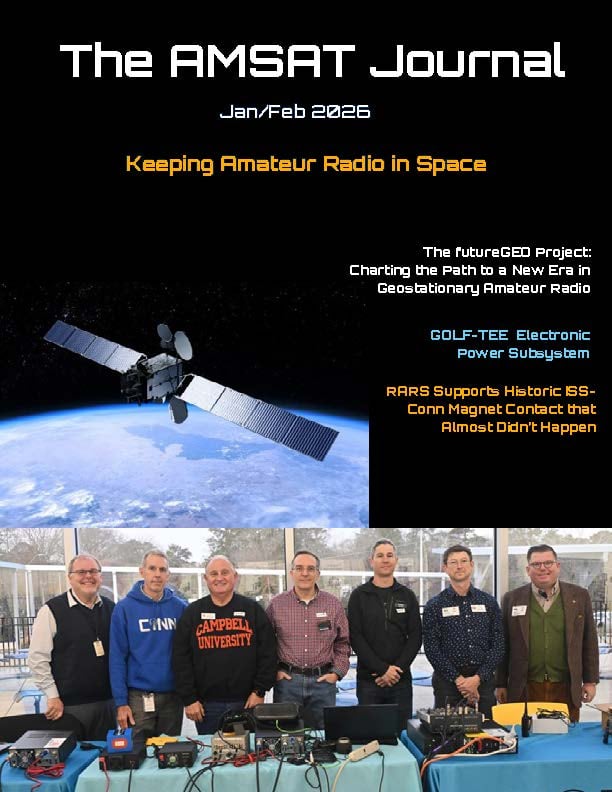
January/February 2026 Issue of The AMSAT Journal Now Available

The January/February 2026 issue of The AMSAT Journal is now available to AMSAT members on AMSAT’s Member Portal.

The AMSAT Journal is a bi-monthly digital magazine for amateur radio in space enthusiasts, published by the Radio Amateur Satellite Corporation (AMSAT). Each issue is your source for hardware and software projects, technical tips, STEM initiatives, operational activities, and news from around the world.

Inside the Current Issue:

  • Apogee View – Drew Glasbrenner, KO4MA
  • Educational Relations Update – Alan Johnston, KU2Y
  • The futureGEO Project: Charting the Path to a New Era in Geostationary Amateur Radio – Paul Stoetzer, N8HM
  • AMSAT GOLF-TEE Electronic Power Subsystem – Kip Moravec, AE5IB
  • RARS Supports Historic ISS-Conn Magnet Contact that Almost Didn’t Happen – Mike Nutt, K3LOE
  • AMSAT-INDIA Amateur Radio & Space Communication Gallery – Activity Report – Rajesh P. Vagadia, VU2EXP

[ANS thanks The AMSAT Journal team for the above information]


AMSAT Remove Before Flight Key Tags Now Available
Yes, These are the Real Thing!

Your $20 Donation Goes to Help Fly a FoxPlus Satellite
Includes First Class Postage (Sorry – U.S. Addresses Only)
Order Today at https://www.amsat.org/product/amsat-remove-before-flight-keychain


IARU Coordinates Two New Amateur Satellites

The International Amateur Radio Union (IARU) Satellite Frequency Coordination Committee has recently completed frequency coordination for two CubeSat missions: Taiwan’s Lilium-4 and Montenegro’s Luca-01. These coordinations ensure that the satellites can operate without interfering with other space-based communications, paving the way for their upcoming launches and contributions to scientific research, education, and ham radio communities worldwide.

Lilium-4, a 6U CubeSat developed by National Formosa University is set to enhance amateur radio connectivity and optical experimentation in space. The satellite, with callsign BN0YCA, will feature a 1200 bps AX.25 APRS digipeater on 145.825 MHz for global intercommunication among radio enthusiasts. It also includes UHF telemetry downlink at 437.850 MHz and a high-bandwidth S-band downlink at 2405.0 MHz for monitoring an onboard optical payload. Additional capabilities involve a V/U repeater with uplink at 145.980 MHz and downlink at 435.250 MHz, plus GNSS positioning using the L1 signal at 1575.42 MHz. The mission focuses on student-led studies of space-to-ground optical signal acquisition, with unencrypted telemetry encouraging public participation in decoding and link-budget validation. IARU coordination for Lilium-4 was finalized on January 31, 2026, following a submission in late December 2025. The satellite is slated for launch no earlier than mid-March 2026 aboard a SpaceX rocket from Vandenberg Space Force Base, targeting a 510 km polar orbit.

Luca-01 represents Montenegro’s entry into amateur satellite technology, spearheaded by Montenegro Space Research. This 1U CubeSat is designed for educational outreach, equipped with a charged particle sensor and a miniature camera to capture Earth’s surface images. It will transmit special Slow Scan Television (SSTV) images and telemetry data to engage radio amateurs, students, and schoolchildren, using an open protocol for easy reception with affordable equipment. The mission aims to inspire young people in amateur radio and space science, including efforts to image various orbital objects. Downlinks have been coordinated on UHF frequencies: 437.180 MHz primary and 436.150 MHz spare, employing GMSK modulation at rates between 2.4 kbps and 19.2 kbps. Coordination was completed on March 13, 2026, after an application submitted on February 6, 2026. Luca-01 is planned for a Roscosmos launch from the Vostochny Cosmodrome into a 500-600 km Sun-synchronous orbit.

[ANS thanks the IARU for the above information]


The 2026 President’s Club Coin is Now Here!
Help Support GOLF and FoxPlus.

Annual memberships start at only $120
Join the AMSAT President’s Club today and help
Keep Amateur Radio in Space!
https://www.amsat.org/join-the-amsat-presidents-club/


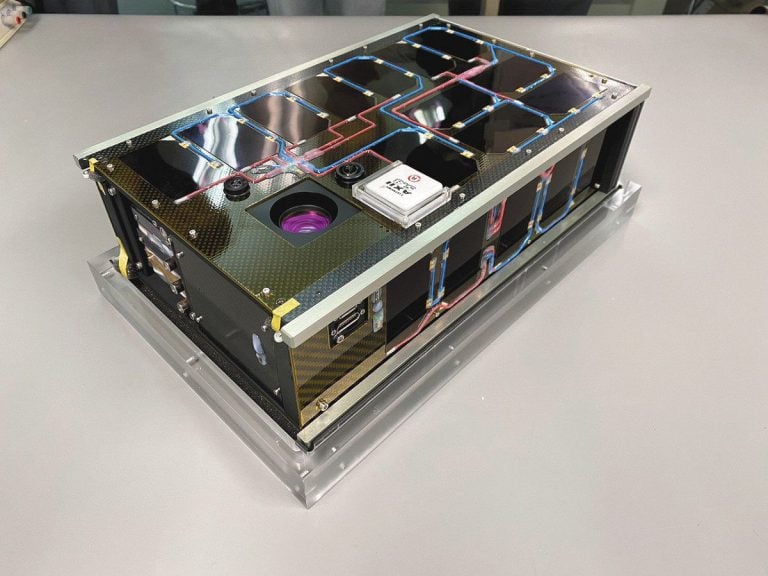
Ten-Koh 2 Satellite With Linear Transponder Deployed

The 6U CubeSat Ten-Koh 2 (also written as Tenkoh-2 or てんこう2) from Japan’s Nihon University was successfully deployed into orbit on March 11, 2026, at approximately 09:34 UTC. The satellite was released from JAXA’s new HTV-X1 cargo spacecraft using the HTV-X Small Satellite Orbital Deployer (H-SSOD) after the vehicle departed the International Space Station (ISS) on March 6 and raised its altitude to around 500 km. This marks the first use of the H-SSOD mechanism for satellite deployment from HTV-X.

Developed by the Okuyama Laboratory in the Department of Aerospace Engineering at Nihon University’s College of Science and Technology, Ten-Koh 2 builds on the legacy of its predecessor, Ten-Koh (launched in 2018). The mission focuses on low-Earth orbit environmental observations to gather data for future space development, alongside in-orbit demonstrations of next-generation communication technologies. Key goals include evaluating high-speed data transmission and enabling global access for amateur radio operators to collect telemetry and experiment with the payloads.

The satellite carries an amateur radio payload coordinated by the International Amateur Radio Union (IARU) and supported by JAMSAT (Japan Amateur Satellite Association):

  • V/U Linear Transponder (inverting, 40 kHz bandwidth):
    • Uplink (LSB): 145.895–145.935 MHz
    • Downlink (USB): 435.875–435.915 MHz
  • Additional Downlinks/Experiments:
    • CW beacon, Digitalker, AFSK 1.2 kbps, GMSK up to 19.2 kbps on 435.860 MHz
    • High-speed experiments (GMSK 4.8–19.2 kbps, 4FSK 38.4 kbps) and photo/picture downlinks on 435.895 MHz
    • 5.839 GHz CW beacon for microwave-band communication demos (SHF experimenters take note—this provides a great target for testing dishes, feeds, and LNAs)

The transponder is expected to operate on a scheduled basis (initially two days per week, with details forthcoming from the team). Operations began shortly after deployment, with the university’s ground station confirming reception of the CW beacon for basic telemetry (voltage, temperature, etc.).

Post-deployment updates from the Okuyama Lab indicate the signal level is currently weaker than anticipated, prompting ongoing monitoring and appeals for reception reports via networks like SatNOGS to aid diagnostics and performance assessment. Early passes over Japan and other regions have yielded mixed results, with some operators reporting no signals yet, while preliminary TLEs (e.g., temporary NORAD 98542) are circulating for tracking.

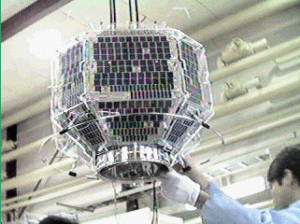
Ten-Koh 2 (Image Credit: Nihon University)

[ANS thanks the Okuyama Laboratory at Nihon University for the above information]


Need new satellite antennas?
Purchase M2 LEO-Packs from the AMSAT Store.

When you purchase through AMSAT, a portion of the proceeds goes towards
Keeping Amateur Radio in Space.
https://amsat.org/product-category/hardware/


FO-29 Enters Full Sunlight: Veteran Satellite Sees Renewed Activity in 2026

Fuji-OSCAR 29 (FO-29), also known as JAS-2, the Japanese amateur radio satellite launched in August 1996, has entered a new operational phase as of early March 2026. Now approaching its 30th anniversary in orbit, the satellite—long limited by failed batteries—relies entirely on solar panel illumination for power, meaning it only functions during sunlight periods and shuts down in eclipse.

In February 2026, the FO-29 control team (operated from Japan) continued scheduled activations of the linear transponder, with commands sent on specific dates to turn it on for limited windows. Operators noted the unstable situation due to the satellite’s age, with activations sometimes failing if the onboard voltage didn’t respond quickly enough. The transponder operates in Mode V/u (inverting SSB/CW): uplink LSB 145.900–146.000 MHz, downlink USB 435.800–435.900 MHz, with a CW beacon on 435.795 MHz.

Around March 9, 2026, when FO-29 transitioned into a full-sunlight orbit season. This eliminates periodic eclipses, allowing continuous operation as long as solar panels receive light. AMSAT highlighted this in early February bulletins, noting that shadow duration had decreased dramatically (from ~20 minutes to ~1 minute per orbit by mid-February), leading to the full-sun entry on March 9.

SatNOGS observers reported recent CW beacon and telemetry receptions as of March 12–13, 2026, with stations like EA5WA and DL7NDR logging data. On March 13, 2026, amateur operators reported successful SSB and CW QSOs during passes, including busy activity with calls from Japan (e.g., JO1XOK, JE6TSP), China (e.g., BA4QNR, BD5EUA, BG5FWV), and others (e.g., E27DPX). One operator described a “very busy pass” with multiple contacts, and another logged several SSB and CW exchanges despite windy conditions affecting reception.

AMSAT’s live linear satellite summaries and status pages list FO-29 as active under full sunlight conditions, with the transponder remaining on until voltage drops below safe thresholds—no longer an issue in continuous sun. The digital modes (1k2/9k6 BBS) remain inactive, and the Digitalker on 435.910 MHz is rarely used.

This full-sunlight period offers a welcome revival for one of the oldest active analog linear transponders in the amateur fleet. Enthusiasts are encouraged to monitor, log contacts via the AMSAT OSCAR Status Page, and share reports to help track performance.

FO-29 prior to launch

[ANS thanks AMSAT, SatNOGS, and various amateur radio operators for the above information]


SDR Gen 2 Ad - 2026


Changes to AMSAT TLE Distribution for March 13, 2026

Two Line Elements or TLEs, often referred to as Keplerian elements or keps in the amateur community, are the inputs to the SGP4 standard mathematical model of spacecraft orbits used by most amateur tracking programs. Weekly updates are completely adequate for most amateur satellites. TLE bulletin files are updated daily in the first hour of the UTC day. New bulletin files will be posted immediately after reliable elements become available for new amateur satellites. More information may be found at https://www.amsat.org/keplerian-elements-resources/.

Ten-Koh2 has been added to this week’s distribution.

[ANS thanks Joe Fitzgerald, KM1P, AMSAT Orbital Elements Manager, for the above information]


ARISS News

Amateurs and others around the world may listen in on contacts between amateurs operating in schools and allowing students to interact with astronauts and cosmonauts aboard the International Space Station. The downlink frequency on which to listen is 145.800 MHz worldwide.

Scheduled Contacts

Lewis Center for Educational Research, Apple Valley, CA, telebridge via IK1SLD

The ISS callsign is presently scheduled to be OR4ISS
The scheduled crewmember is Sophie Adenot KJ5LTN
The ARISS mentor is AA6TB

Contact is go for: Thu 2026-03-19 17:15:13 UTC 48 deg

Watch for Livestream at https://live.ariss.org/

Amur State University, Blagoveshchensk, Russia, direct via TBD

The ISS callsign is presently scheduled to be RSØISS
The scheduled crewmember is Andrey Fedyaev
The ARISS mentor is RV3DR

Contact is go for 2026-03-26 08:50 UTC

MOBU, Ufa, Republic of Bashkortostan, Russia, direct via TBD

The ISS callsign is presently scheduled to be RSØISS
The scheduled crewmember is Sergey Kud-Sverchkov
The ARISS mentor is RV3DR

Contact is go for 2026-03-26 13:30 UTC

Many times a school may make a last minute decision to do a Livestream or run into a last minute glitch requiring a change of the URL but we at ARISS may not get the URL in time for publication.  You can always check https://live.ariss.org/ to see if a school is Livestreaming.

As always, if there is an EVA, a docking, or an undocking; the ARISS radios are turned off as part of the safety protocol.

The crossband repeater continues to be active (145.990 MHz up {PL 67} & 437.800 MHz down),  If any crew member is so inclined, all they have to do is pick up the microphone, raise the volume up, and talk on the crossband repeater. So give a listen, you just never know.

​​Service Module radio: Not in APRS configuration; only being used for voice contacts at this time. Default mode is for​​​ packet operations (145.825 MHz up & down) but occasionally used for SSTV (145.800 MHz down)​​.​​​​​​​​​​​​​​​​​​​​​​​​​​​​​​​​​​

Ham TV – Configured. ​​ Default mode is for​​​ scheduled digital amateur television operations (2395.00 MHz).

Note, all times are approximate. It is recommended that you do your own orbital prediction or start listening about 10 minutes before the listed time.

The latest information on the operation mode can be found at https://www.ariss.org/current-status-of-iss-stations.html

The latest list of frequencies in use can be found at https://www.ariss.org/contact-the-iss.html

[ANS thanks Charlie Sufana, AJ9N, one of the ARISS operation team mentors for the above information]


Want to fly the colors on your own grid expedition?
Get an AMSAT car flag and other neat stuff from our Zazzle store!

25% of the purchase price of each product goes towards Keeping Amateur Radio in Space


AMSAT Ambassador Activities

AMSAT Ambassadors provide presentations, demonstrate communicating through amateur satellites, and host information tables at club meetings, hamfests, conventions, maker faires, and other events.

March 21, 2026
Midwinter Madness Hamfest
Buffalo Civic Center
1306 County Rd 134
Buffalo Minnesota 55313
KØJM, ADØHJ

April 11, 2026
Tucson Area Spring Hamfest
Radio Society of Tucson
Calvary Tucson Church
8711 East Speedway
Tucson, AZ 85710
https://k7rst.club/
N1UW

Interested in becoming an AMSAT Ambassador? AMSAT Ambassadors provide presentations, demonstrate communicating through amateur satellites, and host information tables at club meetings, hamfests, conventions, maker faires, and other events.

For more information go to: https://www.amsat.org/ambassador/

[ANS thanks Bo Lowrey, W4FCL, Director – AMSAT Ambassador Program, for the above information]


Satellite Shorts from All Over

+ NASA held a live news conference on March 12 following the Artemis II Flight Readiness Review, confirming the SLS rocket and Orion spacecraft remain in the Vehicle Assembly Building at Kennedy Space Center for final prep work. Repairs to the upper stage helium system (from a quick-disconnect seal issue) are complete, with rollout to the pad expected later this month. The mission targets the first crewed lunar flyby in over 50 years, now aiming for early April launch opportunities (starting April 1) (ANS thanks NASA for the  information. https://www.nasa.gov/2026-news-releases)

+ NASA’s retired Van Allen Probe A (launched 2012) made an uncontrolled reentry over the Pacific west of the Galapagos on March 11. Most of the spacecraft burned up, with a low risk (1-in-4,200) of debris causing harm; its twin Probe B remains in orbit but non-operational. The probes studied Earth’s radiation belts for years. (ANS thanks AP for the  information. See the full article at https://www.kbtx.com/2026/03/11/old-nasa-science-satellite-plunges-back-earth)

+ Roscosmos completed repairs to the damaged Soyuz pad (Pad 31) at Baikonur Cosmodrome after a November 2025 incident where an unsecured service structure fell during launch. Over 150 personnel restored the site; first relaunch (Progress cargo to ISS) targeted for March 22. (ANS thanks Ars Technica for the information. See the full article at https://arstechnica.com/space/2026/03/rocket-report-spacex-launch-prices-are-going-up-russia-fixes-broken-launch-pad)

+  The European Space Agency has confirmed that its Coronagraph spacecraft, part of the Proba-3 solar observation mission, has gone silent following an onboard anomaly in mid-February 2026. The incident led to the loss of attitude control, preventing the satellite’s solar panels from facing the Sun and draining its battery. The spacecraft has since entered survival mode, cutting off all communication with Earth.(ANS thanks MSN for the information. See the full article at https://www.msn.com/en-in/news/insight/europe-s-solar-mission-hit-by-satellite-blackout/gm-GM11D32319?gemSnapshotKey=GM11D32319-snapshot-1&uxmode=ruby.)

+ Texas-based Firefly Aerospace is celebrated on March 11 after successfully launching its Alpha rocket for the first time in nearly a year. The mission, called “Stairway to Seven,” was the seventh flight for Alpha, which suffered two major mishaps during 2025. The first occurred during the “Message in a Booster” mission last April, which carried a technology-demonstrating satellite for Lockheed Martin but failed to deliver it to orbit after an anomaly occurred during stage separation. Then, last September, an Alpha first stage exploded on the stand during prelaunch tests. This mishap added months to the mission development timeline as the company investigated a cause and got another booster ready for flight. Alpha Flight 7 achieved nominal performance and validated key systems ahead of the Block II configuration upgrade. This test flight also delivered a demonstrator payload for Lockheed Martin. (ANS thanks Space.com for the information. See the full article at https://www.space.com/space-exploration/launches-spacecraft/firefly-aerospaces-alpha-rocket-reaches-orbit-on-1st-mission-since-explosive-accidents-last-year-video.)
+ The second AMSAT Students on The Air Day is scheduled for Tuesday, March 17th. AMSAT’s new initiative for student satellite activity launched on March 3, with operations encouraged on the first and third Tuesdays of each month. A dedicated AMSAT Discord channel supports coordination, sharing, and youth engagement in making satellite contacts. Early participation has been positive as schools and students get on the birds. (ANS thanks AMSAT Operations for the information)
+ SilverSat’s SSDV schedule can be found at http://operations.silversat.org/ssdv (ANS thanks the SilverSat team for the information)

Join AMSAT today at https://launch.amsat.org/

In addition to regular membership, AMSAT offers membership to:

  • Societies (a recognized group, clubs or organization).
  • Students are eligible for FREE membership up to age 25.
  • Memberships are available for annual and lifetime terms.

Contact info [at] amsat.org for additional membership information.

73 and remember to help Keep Amateur Radio in Space!

This week’s ANS Editor,

Paul Stoetzer, N8HM
n8hm [at] amsat.org

ANS is a service of AMSAT, the Radio Amateur Satellite Corporation, 712 H Street NE, Suite 1653, Washington, DC 20002
AMSAT is a registered trademark of the Radio Amateur Satellite Corporation.