
AMSAT News Service
ANS-214
August 23, 2026
In this edition:
- Menon, Adenot Complete Spacewalk to Remove Failed Station Antenna
- Dr. Carlos Miranda Appointed ARISS-USA Director of Education
- Student-Built JAMX01 and BY70-4 Set for August 25 Launch
- Recent IARU Amateur Satellite Frequency Coordination Activity
- Petition Seeks Amateur Transponder Aboard Bangladesh Satellite-2
- Huntsville Hamfest Hosts ARRL National Convention This Weekend
- Radio Amateurs Support Earthquake Communications in Indonesia and Colombia
- AMSAT-UK Announces Colloquium and Gala Dinner Details
- OrbitDeck for iOS Enters Public Beta; Testers Sought
- Juan José Ruiz, HK4X, Earns AMSAT Rover Award #95
- Voting Still in Progress for Board of Directors
- Changes to AMSAT TLE Distribution for August 21, 2026
- ARISS News
- AMSAT Ambassador Activities
- Satellite Shorts From All Over
The AMSAT® News Service bulletins are a free, weekly news and information service of AMSAT, The Radio Amateur Satellite Corporation.
ANS publishes news related to Amateur Radio in Space including reports on the activities of a worldwide group of Amateur Radio operators who share an active interest in designing, building, launching and communicating through analog and digital Amateur Radio satellites.
The news feed on https://www.amsat.org publishes news of Amateur Radio in Space as soon as our volunteers can post it.
Please send any amateur satellite news or reports to: ans-editor [at] amsat.org
You can sign up for free e-mail delivery of the AMSAT News Service Bulletins via the ANS List; to join this list see: https://mailman.amsat.org/postorius/lists/ans.amsat.org/
Menon, Adenot Complete Spacewalk to Remove Failed Station Antenna
NASA astronaut Anil Menon and ESA astronaut Sophie Adenot, KJ5LTN, ventured outside the International Space Station on Tuesday, August 18, for U.S. Spacewalk 97, spending 6 hours and 23 minutes working to remove a failed Space-to-Ground antenna from the station’s Z1 truss segment. The excursion also carried a historic note: Adenot became the first French woman to conduct a spacewalk.
The pair switched their suits to battery power at 8:29 a.m. EDT (1229 UTC) to begin the spacewalk. The Space-to-Ground antenna, a critical link used to transmit high-rate data between the station and Mission Control in Houston via NASA’s Tracking and Data Relay Satellites, had been unable to track the relay satellites since November. Menon and Adenot completed the removal of the failed unit and performed a long-duration tie-down of the antenna on the station’s truss structure. Disconnecting electrical cables and loosening bolts took longer than expected, however, delaying installation of the replacement antenna, which is now expected to be completed on a future spacewalk. Near the end of the excursion, the crew performed cleanup tasks along with an inspection and swap of a portable foot restraint near the Quest airlock before re-entering the station at 2:52 p.m. EDT (1852 UTC). The station continues to operate with a fully functional Space-to-Ground antenna in the meantime.
The spacewalk was the 282nd in support of station assembly, maintenance, and upgrades, the second for Menon, and the first for Adenot. Radio amateurs will recognize Adenot as a familiar voice on 145.800 MHz – just six days before stepping outside, she spoke with students at the Challenger Learning Center National Conference in Framingham, Massachusetts, via ARISS. In keeping with standard safety protocol, the ARISS radios aboard the station were powered down on August 17 in support of the spacewalk, with service scheduled to be restored on August 19 at 10:45 UTC.
[ANS thanks NASA and Space.com for the above information]
LIMITED TIME OFFER!!!
AMSAT is offering a limited-time promotion for new and renewing members that includes a free digital copy of Getting Started with Amateur Satellites. The promotion is being offered as AMSAT begins the 2026 membership year.
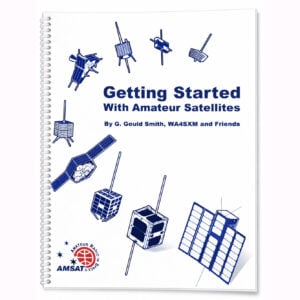
Anyone who joins or renews their AMSAT membership during the promotional period will receive a download link for the latest edition of Getting Started with Amateur Satellites in their membership confirmation email. JOIN TODAY at https://launch.amsat.org/ (Remember! Students join for FREE!)
Dr. Carlos Miranda Appointed ARISS-USA Director of Education
ARISS-USA announced August 17 that Dr. Carlos Miranda has been appointed Director of Education for Amateur Radio on the International Space Station (ARISS-USA).
In the new leadership role, Miranda will help advance ARISS-USA’s educational mission and expand opportunities for students and educators to engage with amateur radio, space exploration, and the International Space Station. ARISS-USA said Miranda brings more than 20 years of experience in formal and informal education, including developing STEM programs, leading professional development, and creating hands-on learning experiences for students and educators.
Education is central to the ARISS program, which gives students around the world opportunities to speak directly with amateur radio-licensed crew members aboard the International Space Station. The program combines those contacts with classroom and informal educational activities designed to introduce students to amateur radio, radio science, spaceflight, and science, technology, engineering, and mathematics.
ARISS conducts approximately 60 to 100 special amateur radio contacts each year between students around the world and crew members aboard the ISS. Participating schools and educational organizations typically prepare for contacts through lessons and activities related to communications, orbital mechanics, space science, and other STEM subjects before students have the opportunity to ask questions directly of an astronaut or cosmonaut.
ARISS-USA said Miranda’s leadership will support its continuing efforts to inspire the next generation through authentic space-based educational experiences and the unique opportunities provided by amateur radio.
ARISS is supported internationally by amateur radio organizations and AMSAT organizations in the United States, Canada, Europe, Japan, and Russia, together with participating space agencies and other partners. Amateur radio volunteers provide much of the equipment, technical expertise, and operational support needed to connect students with crew members aboard the ISS.
The ARISS-USA announcement is available at:
https://ariss-usa.org/ariss-news-release-no-26-49-dr-carlos-miranda-appointed-director-of-education-for-ariss-usa/
Additional information about ARISS and its educational contacts is available at: https://www.ariss.org/
[ANS thanks ARISS-USA for the above information]
Student-Built JAMX01 and BY70-4 Set for August 25 Launch
Two Chinese science-education satellites carrying amateur radio communications systems are scheduled for launch from the Taiyuan Satellite Launch Center on August 25 aboard a Long March 6C rocket.
The first, known as Jing’an Dream Star and carrying the JAMX01 amateur radio payload, is the result of a multi-year education project involving students in Shanghai’s Jing’an District. The project began in 2019 as an effort to give students hands-on experience with satellite development, radio communications, tracking, and spacecraft operations. Students and teachers are traveling to Taiyuan to participate in tracking and control activities associated with the mission.
According to the IARU Amateur Satellite Frequency Coordination database, JAMX01 was developed by students from Jing’an District together with amateur radio participants, with support from the Youngster Activity Center of Jing’an District, Shanghai. The approximately 50-kilogram microsatellite will support telemetry, digital image transmissions, and an FM digipeater. It also carries navigation lights and a kaleidoscope experiment intended for science-education activities.
The following frequencies have been coordinated for JAMX01:
145.950 MHz – FM digipeater uplink
435.075 MHz – beacon and SSTV downlink
435.175 MHz – FM digipeater downlink
435.500 MHz – telemetry downlink
IARU frequency coordination for JAMX01 was completed on January 6, 2025.
Shanghai officials say the spacecraft is expected to operate at approximately 500 kilometers altitude. Project organizers also describe several unusual educational experiments aboard the satellite, including a system designed to make the spacecraft visible as a flashing point of light, a kaleidoscope payload, and recorded youth voices for use in space-based broadcasts.
A second educational microsatellite, BY70-4, also known as 8104, BY-04, and Harbin MicroSat, is expected to fly on the same launch. The spacecraft was developed by the LilacSat Team at Harbin Institute of Technology and has a mass of approximately 18.7 kilograms. SatNOGS lists a high-definition camera, miniature camera, polarization camera, educational display, and short-message transponder among its payloads. The miniature camera is capable of JPEG and SSDV image transmission.
SatNOGS currently lists a UHF telemetry downlink for BY70-4 on 437.443 MHz using 9600 bps BPSK, with a format compatible with ASRTU-1. The spacecraft team has said in the Libre Space Community that BY70-4 is intended to share the frequency coordination previously used by BY70-3, which has reentered. The public IARU coordination database, however, presently shows the 437.443 MHz coordination under BY70-3 and does not contain a separate BY70-4 record. Operators should therefore watch for any additional coordination or operating information issued before or after launch.
Information on JAMX01 is available from the IARU Amateur Satellite Frequency Coordination database at:
https://iaru.amsat-uk.org/formal_detail.php?serialnum=1009
The Shanghai Jing’an District announcement is available at:
https://www.jingan.gov.cn/sy/004009/004009010/004009010001/20260813/f8989d84-fce0-46e6-afba-c4e654267a9d.html
SatNOGS information for BY70-4 is available at:
https://db.satnogs.org/satellite/EMBU-7314-7883-5821-1365/
Launch discussion and spacecraft-team information are available from the Libre Space Community at:
https://community.libre.space/t/cz-6c-launches-jamx01-2026-08-25-03-30utc/15173
[ANS thanks the Shanghai Jing’an District Government, the IARU Amateur Satellite Frequency Coordination service, SatNOGS, and members of the Libre Space Community for the above information]
Recent IARU Amateur Satellite Frequency Coordination Activity
The IARU Satellite Frequency Coordination Panel has had a remarkably busy August, with five coordinations completed, six new applications posted, and two requests declined over roughly the past week, according to the panel’s status pages hosted by AMSAT-UK at https://iaru.amsat-uk.org/index.php
Newly Coordinated
+ UPMSat-3 – Instituto Universitario de Microgravedad Ignacio Da Riva, Universidad Politecnica de Madrid, Spain (coordination completed August 10). A 22 kg educational and in-orbit demonstration satellite giving UPM students hands-on experience across the complete lifecycle of a space mission. Developed in collaboration with AMSAT-EA and the Amateur Radio Club of the UPM Telecommunications School (Radio Club EIT, EA4RCT), UPMSat-3 will demonstrate the in-orbit operation of GENESIS-P, a miniaturized UHF/VHF amateur transponder intended for PocketQubes and educational amateur satellite missions. All amateur-related telemetry and communication protocols will be publicly documented.
+ AYAME – Chiba Institute of Technology and the Government Technology Agency, Thimphu, Bhutan (coordination completed August 10). A 2U CubeSat with a full slate of missions, headlined by a worldwide APRS service on 145.825 MHz using 1k2 AFSK that can be activated by ground command for up to 720 minutes of continuous operation. AYAME also carries a camera that will image Okinawa using magnetic attitude control, with downlinked photos published on a website, along with an on-orbit firmware upload and update demonstration and a hand-built UHF radio experiment.
+ CPSAT – Chosun University, Republic of Korea (coordination completed August 13). A 3U CubeSat whose primary mission is amateur radio service: telemetry, a beacon, telecommand operation, and an interactive communication function that lets licensed amateurs transmit predefined command messages and receive responses generated by the onboard software, including educational queries about the project and spacecraft status. Experimental payloads include optical communication and attitude determination and control technologies. A downlink on 437.265 MHz and an uplink on 145.835 MHz have been coordinated, using BPSK at 1k2, 2k4, or 4k8 with AX.25. Launch is planned from the Naro Space Center into an approximately 540 km Sun-synchronous orbit during Q3 2026.
+ BAMA-2 – UASPACE, The University of Alabama (coordination completed August 14). A 3U CubeSat set to become the first satellite launched into orbit from The University of Alabama, BAMA-2 will conduct a flight demonstration of a drag sail module by rapidly deorbiting itself following deployment from the ISS, planned via Voyager in April 2027. The mission is a re-flight of BAMA-1, which failed to reach orbit in 2021, and was previously coordinated in 2023 before launch delays required resubmission. A downlink on 437.460 MHz has been coordinated, using 2k4 GMSK with AX.25.
+ Delfi-PRISM – Delft University of Technology, the Netherlands (coordination completed August 17). A 6P PocketQube continuing TU Delft’s long-running Delfi program, PRISM provides end-to-end space systems education while demonstrating upgrades to the Delfi-PQ heritage bus flown in 2022. Of particular interest to amateurs is RAMaS, the Radio Amateur Mailbox in Space: a digital repeater capable of retransmitting ground messages either instantly or after a pre-determined delay, acting as an orbiting mailbox that extends the reach of traditional digipeaters beyond text-only messages. Additional payloads include a student attitude-control demonstration board and a GNSS receiver for autonomous in-space orbit determination.
Coordination Declined
+ FramSat-1.5 – Orbit NTNU, Norway. The student organization’s 1U CubeSat, which proposed a UHF downlink using 2FSK at 9k6 and an Isar Aerospace launch from Andoya in Q4 2026, was declined on August 17. The panel noted that the mission appears to be a technology demonstration for a commercial entity rather than an educational or amateur project.
+ Galapagos-UTE – University UTE, Ecuador. The satellite, which collects background radiation data and carries an ADS-B aircraft-monitoring module along with SSTV image transmission capability, was launched from Vostochny on December 28, 2025 – but its coordination request was not filed until July 8, 2026. The request was declined on August 18, as coordination is not provided for requests received after launch.
New Applications
Six new coordination requests were posted to the “formally requested” list in the past two weeks: PVDX from Brown Space Engineering at Brown University, a 3U CubeSat flight-testing an open-source, low-cost UHF amateur radio board and displaying student-submitted pixel art on an external screen photographed against the Earth; MANTIS from Dalhousie University, a Canadian Space Agency CUBICS mission studying algal bloom detection with onboard AI image processing; CAPE-Twiggs-1 from the University of Louisiana Lafayette, a 200-gram picosat proposing LoRa downlinks on both VHF and UHF; SC-FRYER from Space Concordia at Concordia University, which plans a GreenCube-style digipeater alongside yeast biology and AI wildfire-detection payloads; AcubeSAT from the Aristotle University of Thessaloniki, a fully open-source 3U CubeSat flying in ESA’s Fly Your Satellite! 3 program; and CHESS Pathfinder 0, the first satellite from the EPFL Spacecraft Team in Switzerland, carrying a single-photon avalanche diode camera and proposing a 25 kbps GMSK UHF downlink.
Full details on every request, including complete frequency information, may be found on the coordination status pages. Developers planning a mission are reminded to request coordination as early in the design process as possible – and, as this week’s declines illustrate, well before launch.
[ANS thanks the IARU Satellite Frequency Coordination Panel and AMSAT-UK for the above information]
AMSAT Remove Before Flight Key Tags Now Available Yes, These are the Real Thing!
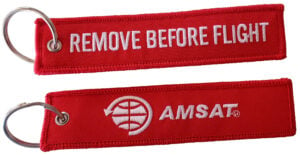
Your $20 Donation Goes to Help Fly a FoxPlus Satellite Includes First Class Postage (Sorry – U.S. Addresses Only) Order Today at https://www.amsat.org/product/amsat-remove-before-flight-keychain
Petition Seeks Amateur Transponder Aboard Bangladesh Satellite-2
The Amateur Radio Society of Bangladesh (ARSB) is seeking support from the worldwide amateur community for its application to Bangladesh Satellite Company Limited (BSCL) requesting the allocation of a dedicated amateur radio transponder payload aboard Bangladesh Satellite-2.
The society notes that such a transponder would provide an important platform for amateur radio communication, technical education, international collaboration, and emergency and disaster communication. The enormous popularity of the QO-100 geostationary transponder has demonstrated what a wide-coverage amateur payload can do for experimentation and training across its footprint, and amateurs across South Asia and beyond would welcome a similar opportunity.
An international petition of support is being circulated, with signatures to be submitted to BSCL solely as evidence of amateur radio community backing for the initiative. By signing, amateurs express their support and their interest in using the proposed transponder for legitimate, non-commercial amateur radio activities, including technical experimentation and emergency communications.
The petition was passed along by Matthias Bopp, DD1US, on behalf of Hasibul Hasan Seyam, S21HMX. A link to the petition may be found in the AMSAT-UK story at https://amsat-uk.org/2026/08/17/petition-for-amateur-transponder-on-bangladesh-satellite-2/
[ANS thanks AMSAT-UK, Matthias Bopp, DD1US, and Hasibul Hasan Seyam, S21HMX, for the above information]
Huntsville Hamfest Hosts ARRL National Convention This Weekend
The Rocket City is the center of the amateur radio universe this weekend, as the Huntsville Hamfest hosts the 2026 ARRL National Convention, August 21-23, in Huntsville, Alabama – the first time the National Convention has come to Huntsville since 2007.
The convention kicked off Friday, August 21, with a series of day-long ARRL Training Tracks and a National Convention Luncheon at the Embassy Suites by Hilton Huntsville, followed by a National Convention Dinner beneath the full-size Saturn V rocket at the U.S. Space & Rocket Center, with proceeds benefiting the ARRL Education & Technology Program.
Known as “The World’s Friendliest Hamfest,” the all-indoor, air-conditioned event continues Saturday, August 22, from 9:00 a.m. to 4:30 p.m. and Sunday, August 23, from 9:00 a.m. to 3:00 p.m. at the Von Braun Center South Hall, connected by sky bridge to the Embassy Suites. Attendees will find a large lineup of commercial exhibitors, notable forum presenters, a flea market, a Youth Lounge with hands-on activities including kit building and foxhunting, and the W1AW America250 Special Event Station.
The weekend was also the presentation of the Bill Pasternak WA6ITF Memorial Amateur Radio Newsline Young Ham of the Year Award. This year’s honoree hits especially close to home for the satellite community. Carsten Glasbrenner, KQ4SJM, of Brooksville, Florida, is an accomplished satellite operator who passed his Technician exam at age 11 and upgraded to General in May 2024, all at just 14 years old today. Carsten credits his father, AMSAT President Drew Glasbrenner, KO4MA, with planting the seeds that grew into an early interest in amateur radio – and specifically in satellites. Presented annually to a licensed amateur age 18 or younger in the United States or Canada who has made significant contributions to the hobby, the award has traditionally been presented at Huntsville, and the satellite community could not be prouder to see one of its own receive the honor this year.
For further details, visit https://www.arrl.org/expo and https://hamfest.org.
[ANS thanks ARRL and the Huntsville Hamfest for the above information]
It’s August! Time is running out for the 2026 President’s Club Coin!
Help Support GOLF and FoxPlus.
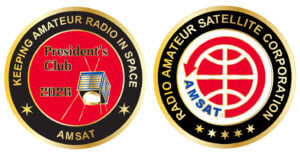
Annual memberships start at only $120
Join the AMSAT President’s Club today and help Keep Amateur Radio in Space! https://www.amsat.org/join-the-amsat-presidents-club/
Radio Amateurs Support Earthquake Communications in Indonesia and Colombia
Radio amateurs have been supporting emergency communications following major earthquakes in Indonesia and Colombia, with International Amateur Radio Union officials asking operators to protect emergency frequencies from interference while relief work continues.
In Indonesia, the IARU Region 3 Disaster Communication Committee reported that a magnitude 7.7 earthquake struck the East Nusa Tenggara region early on August 15. Preliminary reports cited damage to buildings and disruption of normal communications infrastructure in several affected areas.
Ageng Aditya, YB1BTM, Chair of the IARU Region 3 Disaster Communication Committee, asked radio amateurs in Indonesia and throughout the region to keep 7.110 MHz clear for HF emergency communications. The frequency 145.100 MHz has been used for local VHF coordination in affected areas. Operators were asked to give absolute priority to emergency and disaster-relief traffic and to monitor without transmitting unless specifically requested to assist.
The IARU Region 3 Disaster Communication Committee and regional emergency communications coordinators remained on standby to support additional requests for amateur radio assistance.
Radio amateurs have also been heavily involved in communications following the magnitude 7.4 earthquake that struck Colombia on August 10.
Reports relayed by ARRL and IARU Region 2 describe amateur radio clubs working to restore repeaters, maintain regional communications links, and support emergency organizations after cellular and Wi-Fi networks failed in affected areas. In one case, operators in the Coffee Axis region restored an emergency communications system within approximately 15 minutes after repeater power systems failed.
Volunteers from Liga Radio Quindio traveled to Cerro Campanario, a 3,600-meter peak in Colombia’s Central Cordillera, to work on strategically located repeaters serving both amateur radio and government risk-management communications. Solar panels and batteries were being used in efforts to restore service.
Other amateur groups made repeaters and equipment available to emergency agencies. Operators established communications at Red Cross facilities, fire departments, airports, and other locations. According to IARU Region 2 Emergency Coordinator Carlos Alberto Santamaria Gonzalez, CO2JC, amateur radio infrastructure was used when other digital systems became unavailable.
CO2JC asked amateurs to avoid transmitting on the IARU Region 2 emergency frequencies of 3985, 7060, 7240, 7275, 14300, and 21360 kHz. Stations within VHF range of Colombia were also asked to protect 146.520 MHz from unnecessary transmissions.
Because emergency communications requirements can change rapidly, operators should consult the latest IARU and national amateur radio organization reports before using frequencies identified for disaster traffic.
The IARU report on the Indonesian response is available at:
https://www.iaru-r1.org/2026/indonesia-earthquake-15th-august-2026/
ARRL’s reports on the Colombian response are available at:
https://www.arrl.org/news/colombian-emergency-network-activated-following-earthquake
and:
https://www.arrl.org/news/colombian-amateurs-help-in-earthquake-response-clear-frequencies-requested
[ANS thanks Ageng Aditya, YB1BTM, the IARU Region 3 Disaster Communication Committee, Carlos Alberto Santamaria Gonzalez, CO2JC, IARU Region 2, ARRL, and the radio amateurs supporting emergency communications in Indonesia and Colombia for the above information]

AMSAT-UK Announces Colloquium and Gala Dinner Details
The annual AMSAT-UK Colloquium is fast approaching. Once again, it will be held at the Kents Hill Conference Centre in Milton Keynes alongside the RSGB Convention, on Saturday, October 10, and Sunday, October 11, 2026, promising a weekend of all things satellite with lectures from both AMSAT-UK and the RSGB.
One change this year concerns lodging and the social calendar: the Delta by Marriott hotel near Kents Hill is not available for accommodation or for the Gala Dinner, so AMSAT-UK has booked the Woughton House Hotel, Newport Road, Woughton-on-the-Green, Milton Keynes, approximately a five-minute drive from Kents Hill. Details of the hotel and available accommodation may be found at https://hotelwoughtonhouse.co.uk/
The AMSAT-UK Gala Dinner will be held at the Woughton House Hotel on the evening of Saturday, October 10. The three-course meal with tea and coffee is priced at 39 pounds per person. Attendance is restricted this year, and a limited number of tickets are on sale at the AMSAT-UK shop at https://shop.amsat-uk.org/product/amsat-uk-gala-dinner-2026
[ANS thanks AMSAT-UK for the above information]
OrbitDeck for iOS Enters Public Beta; Testers Sought
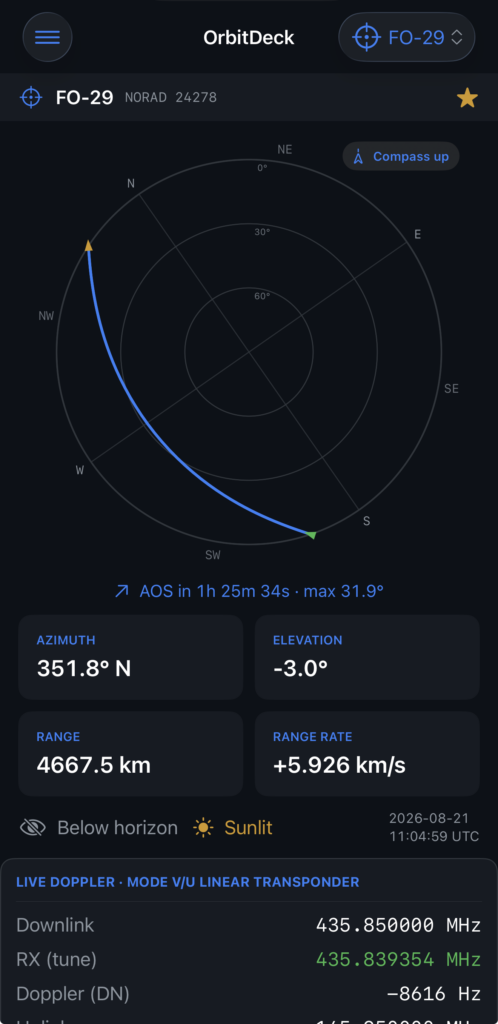
A new amateur-radio satellite tracking app for iPhone and iPad, OrbitDeck for iOS, is now available for public beta testing, and the developer is inviting AMSAT members to try it and share feedback.
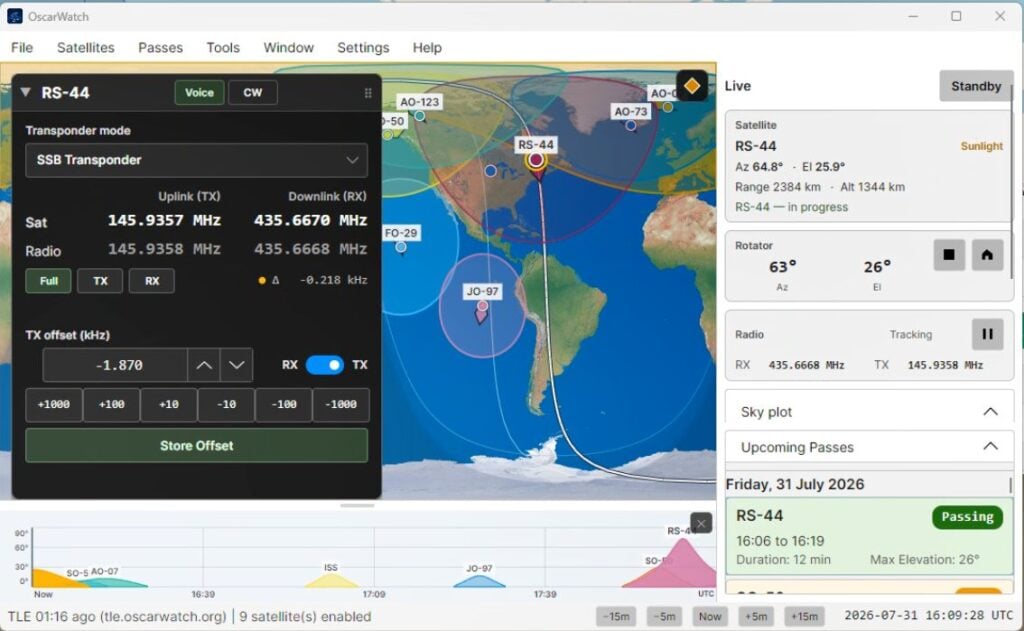
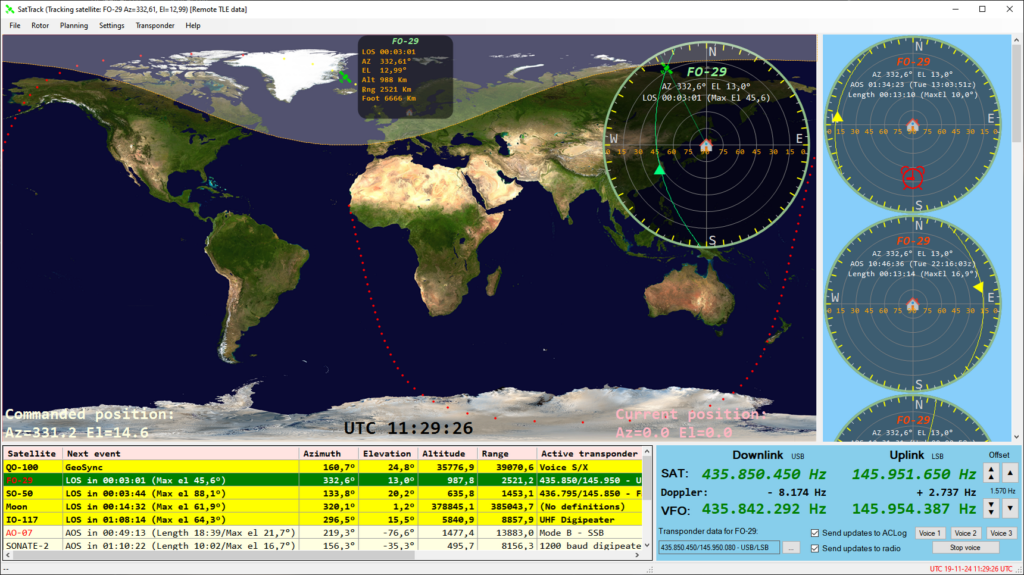
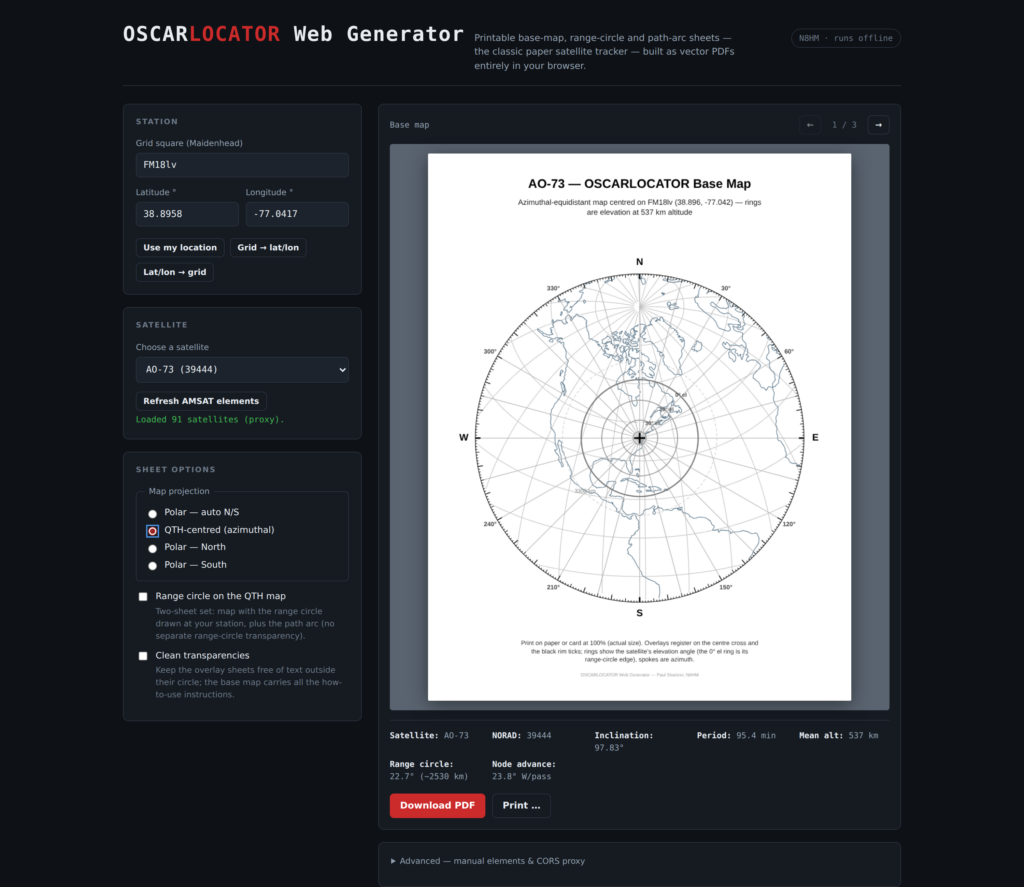
Developed by Paul Stoetzer, N8HM, OrbitDeck is a port of the OrbitDeck desktop application which in turn was a desktop port of many features unique to the CardSat project. It computes passes, Doppler, look angles, footprints, and link budgets from live orbital elements, and adds orbital analysis, live space weather, and the classic OSCARLOCATOR tracking overlays.
Features include live look angles and a real-time polar sky plot; next-pass predictions and a day-by-day schedule of your favorite satellites; a ground-track map, all-sky radar, and an animated 3D globe; four-dial DX Doppler and a single-station Doppler playbook with per-satellite calibration; link budgets; a SatNOGS transponder database; mutual-visibility windows; VUCC grid-line and grid-corner recognition with a live “Grid Finder” to walk you onto a boundary; MUF/HF propagation and NOAA space-weather summaries; and more than 60 bench calculators. Orbital elements come from CelesTrak and AMSAT, and cached data keeps core tracking working offline. OrbitDeck contains no advertising, analytics, or tracking.
Testers can join the beta through Apple’s TestFlight at:
https://testflight.apple.com/join/VEqdpvGN
TestFlight (a free app from Apple) is required, along with an iPhone or iPad running a recent version of iOS or iPadOS. More information, documentation, and the privacy policy are available at https://orbitdeckios.n8hm.radio.
Feedback from operators on real passes — bug reports, feature requests, and usability notes — is especially welcome during the beta.
[ANS thanks Paul Stoetzer, N8HM, AMSAT Executive Vice President, for the above information]
Juan José Ruiz, HK4X, Earns AMSAT Rover Award #95
Make it three weeks in a row – and three countries. Bruce Paige, KK5DO, AMSAT Director of Contests and Awards, has announced that AMSAT Rover Award #95 has been earned by Juan José Ruiz, HK4X, of Colombia, completing an international hat trick that has seen consecutive Rover Awards go to Brazil, the United Kingdom, and now Colombia.
With two of the last three awards landing in South America, the region’s satellite roving scene is clearly picking up speed – welcome news for grid chasers across the hemisphere, for whom activations from Colombia’s grids, many of them draped over Andean terrain that makes portable operation an adventure in itself, are prized catches.
The Rover Award is granted upon accumulating 25 points from satellite operations in grid squares outside the rover’s home grid. Each grid activated earns one point when worked through a single-channel FM transponder, two points through a linear SSB/CW transponder, and three points through a digital transponder, and activating a grid in a state, province, or DX entity other than the rover’s own adds a bonus point. Rovers can add five points by publicizing an activation at least 24 hours in advance – with a public social media post tagging @amsat or #amsat, or via the AMSAT-BB or this bulletin – and five more by posting photos of the operation afterward, while an activation made maritime mobile earns ten points and a /MM endorsement on the certificate.
In announcing the award, Paige offered his congratulations along with his customary encouragement to rovers everywhere to keep on rovin’.
Complete rules and application details for the AMSAT Rover Award are available at https://www.amsat.org/amsat-
Felicitaciones, Juan José!
[ANS thanks Bruce Paige, KK5DO, AMSAT Director of Contests and Awards, for the above information]
Voting Still in Progress for Board of Directors
AMSAT members are reminded that voting remains open in the 2026 AMSAT Board of Directors election. Three seats on the Board are being filled this year. The three candidates receiving the highest number of votes will be elected to the Board, while the candidates receiving the next highest vote totals will be named First Alternate and Second Alternate, respectively.
Voting opened on July 15, 2026, and will conclude on September 15, 2026. Election results will be announced no later than September 30, 2026.
Current AMSAT members may review the official candidate statements and cast their ballots on the AMSAT 2026 Board of Directors Election website at https://launch.amsat.org/2026-BoD-Election
Members are encouraged to take a few minutes to review the candidates’ statements and cast their ballots. Your participation helps shape the future of AMSAT and its mission to Keep Amateur Radio in Space.
[ANS thanks Douglas Tabor, N6UA, AMSAT Secretary, for the above information]
Changes to AMSAT TLE Distribution for July 31, 2026
Two Line Elements or TLEs, often referred to as Keplerian elements or keps in the amateur community, are the inputs to the SGP4 standard mathematical model of spacecraft orbits used by most amateur tracking programs. Weekly updates are completely adequate for most amateur satellites. TLE bulletin files are updated daily in the first hour of the UTC day. New bulletin files will be posted immediately after reliable elements become available for new amateur satellites. More information may be found at https://www.amsat.org/keplerian-elements-resources/.
CO-128 MARMOTSat was incorrectly identified last week, the correct NORAD designation is Cat ID 69912
General Perturbations Data Support
AMSAT is pleased to announce that modern forms of what are called General Perturbations data are being disseminated via modern formats including JSON, XML and KVN at https://newark192.amsat.org/gpdata/current/. The reason this change is being made is that we are running out of 5-digit catalog numbers and the TLE format is not viable for satellites launched after July of this year. See https://celestrak.org/NORAD/documentation/gp-data-formats.php for details.
These data are presently considered in beta test for the next two months while hosted on the test server newark192.amsat.org, and we are very open to community feedback at webmaster at amsat.org. Testers may experience outages and errors while we make improvements. We intend to put this into production on our main web server in July as we expect that satellites launched after this summer will require one of the new formats to accommodate longer object numbers. AMSAT will continue to publish TLE bulletins for satellites launched before July 2026 indefinitely.
[ANS thanks Joe Fitzgerald, KM1P, AMSAT Orbital Elements Manager, for the above information]
Buying from DX Engineering?
Add AMSAT’s Getting Started With Amateur Satellites to your order.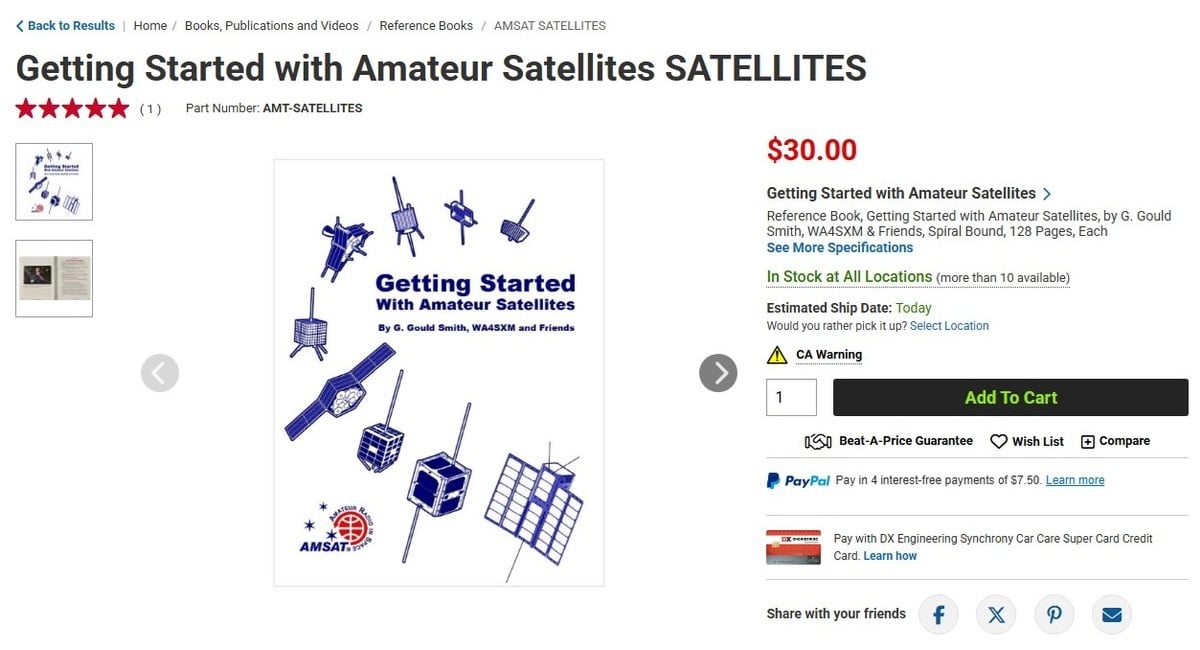 Available for $30 from DX Engineering (free shipping on most orders over $99)
https://www.dxengineering.com/parts/amt-satellites
ARISS News
Amateurs and others around the world may listen in on contacts between amateurs operating in schools and allowing students to interact with astronauts and cosmonauts aboard the International Space Station. The downlink frequency on which to listen is 145.800 MHz worldwide.
Scheduled Contacts
Rockingham Scout Group, Rockingham, Western Australia, Australia, telebridge via ZS6JON
The ISS callsign is presently scheduled to be NA1SS
The scheduled crewmember is Jack Hathaway KJ5NIV
The ARISS mentor is VK4ISS
Contact is go for: Sat 2026-08-29 08:56:33 UTC 86 deg
Many times, a school makes a last-minute decision to do a Livestream or runs into a last-minute glitch requiring a change of the URL, but we at ARISS may not get the URL in time for publication. You can always check https://live.ariss.org/ to see if a school is Livestreaming.
As always, if there is an EVA, a docking, or an undocking; the ARISS radios are turned off as part of the safety protocol.
Schedule of radio power downs and power ups
COL=Columbus module SM=Service Module
Mon 2026-08-24 15:25 UTC COL radio power down
Mon 2026-08-24 15:30 UTC SM radio power down
Tue 2026-08-25 USOS EVA
Egress: 12:35-13:05 UTC
Ingress 18:35-19:05 UTC
Wed 2026-08-26 13:20 UTC COL radio power up
Wed 2026-08-26 13:25 UTC SM radio power up
The crossband repeater remains configured in the Columbus Module (145.990 MHz up {PL 67} & 437.800 MHz down). If a crewmember decides to pick up the microphone and turn up the volume, you may hear them on the air—so keep listening, as you never know when activity might occur.
Kenwood D710GA in the Zvezda Service Module – Call sign RSØISS. Please note we’re still in the process of troubleshooting and testing this radio. APRS is currently active on 437.825 MHz. Feel free to check out status reports at https://ariss-usa.org/ARISS_APRS/.
Ham TV is currently transmitting a test signal at 2395.00 MHz.
Note, all times are approximate. It is recommended that you do your own orbital prediction or start listening about 10 minutes before the listed time.
The latest information on the operation mode can be found at https://www.ariss.org/current-status-of-iss-stations.html
The latest list of frequencies in use can be found at https://www.ariss.org/contact-the-iss.html
[ANS thanks Charlie Sufana, AJ9N, one of the ARISS operation team mentors for the above information]
Want to fly the colors on your own grid expedition? Get an AMSAT car flag and other neat stuff from our Zazzle store!
25% of the purchase price of each product goes towards Keeping Amateur Radio in Space
AMSAT Ambassador Activities
AMSAT Ambassadors provide presentations, demonstrate communicating through amateur satellites, and host information tables at club meetings, hamfests, conventions, maker faires, and other events.
August 28-30, 2026
Wyoming HamCon, ARRL Rocky Mountain Division Convention
Best Western (Downtown)
123 W. E St.
Casper, WY 82601
http://wyohamcon.org/
K0NMR
October 8-11, 2026
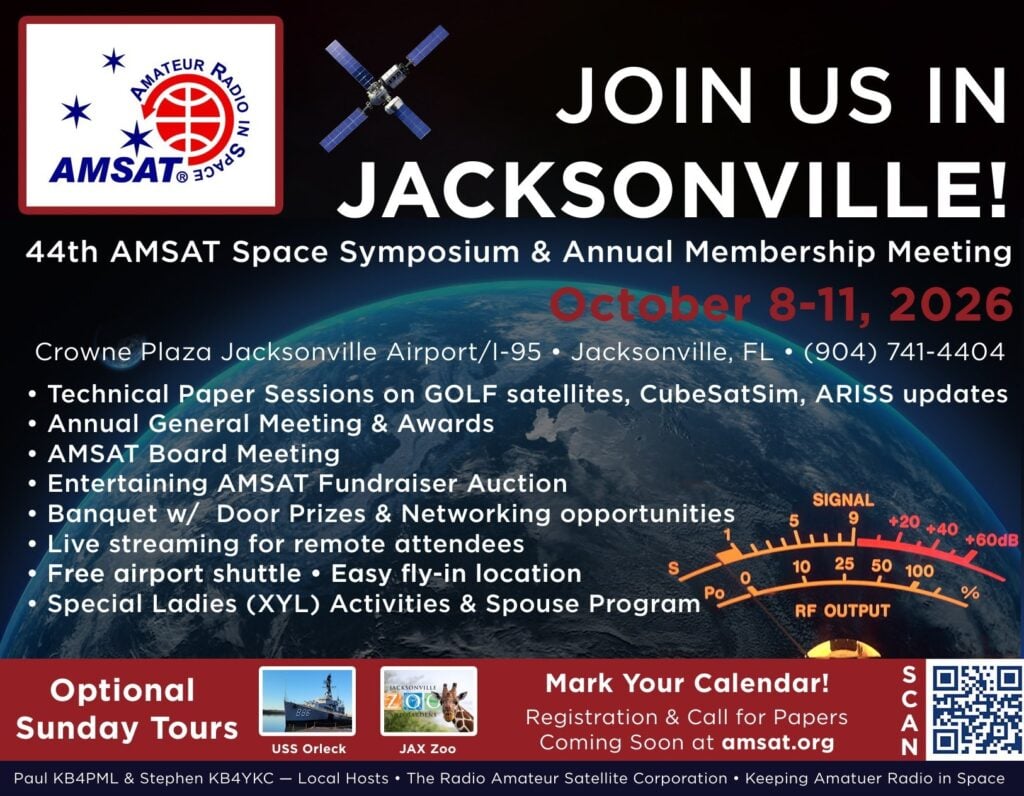
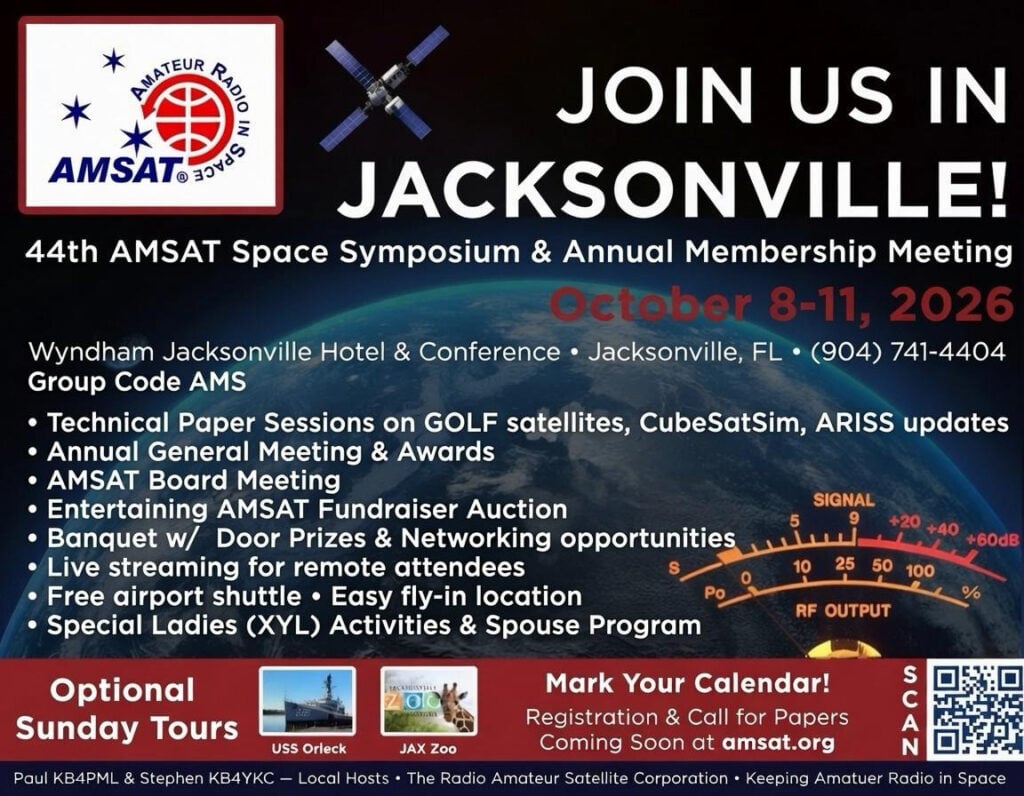
44th AMSAT Space Symposium and Annual Membership Meeting
Crowne Plaza JAX Airport
14670 Duval Road
Jacksonville, FL 32218
Details to follow
Interested in becoming an AMSAT Ambassador? AMSAT Ambassadors provide presentations, demonstrate communicating through amateur satellites, and host information tables at club meetings, hamfests, conventions, maker faires, and other events. For more information go to: https://www.amsat.org/ambassador/
[ANS thanks Bo Lowrey, W4FCL, Director – AMSAT Ambassador Program, for the above information]
REGISTRATION IS NOW OPEN
For the 44th AMSAT Space Symposium and Annual General Meeting, October 8-11, 2026, in Jacksonville!
Register before September 8 and save $20 with early bird pricing.
https://launch.amsat.org/event-6789663
Satellite Shorts from All Over
+ KeplerSet is a new open-source replacement for the classic HalloKepler utility, allowing amateur satellite operators to build custom orbital element sets using the modern Space-Track API. The Windows and macOS application includes a searchable satellite catalog and can export TLE, 3LE, CCSDS OMM XML, KVN, JSON, CSV, and HTML files. Download at https://github.com/prstoetzer/KeplerSet (ANS thanks Paul Stoetzer, N8HM, AMSAT Executive Vice President, for the information)
+ Today is the final day to work C6AUB. Philippe, EA4NF, wraps up his Bahamas satellite DXpedition on Sunday, August 23, after activating grid FL15 (DXCC entity C6, IOTA NA-001) on the FM LEO satellites since August 19 using a portable full-duplex station with Arrow and whip antennas. QSL via LoTW as C6AUB, and watch @EA4NF_SAT for final updates. (ANS thanks Philippe Chateau, EA4NF, for the above information)
+ AMSAT-UK has announced a vacancy for the editor of OSCAR News, the society’s quarterly membership journal packed with amateur satellite information. Members interested in taking on this rewarding volunteer role can find details at https://amsat-uk.org/2026/08/03/oscar-news-editor-vacancy/. (ANS thanks AMSAT-UK for the above information)
+ HamSCI’s Perseids Meteor Scatter QSO Party wrapped up August 12-14, the second event in the 2026 series studying meteor scatter propagation on 6 and 10 meters using MSK144. Participants are encouraged to submit their ADIF logs and WAV recordings of decoded pings to support the research effort. One event remains on the 2026 calendar, coinciding with the Geminids meteor shower December 13-15. Complete details are available at https://hamsci.org/msqp. (ANS thanks HamSCI for the above information)
+ The Alabama Contest Group will once again put K4A, the “9/11 We Do Remember” special event station, on the air September 9-13 – now in its sixth year, and marking 25 years since the September 11, 2001 attacks. Volunteer operators will take shifts making contacts and collecting memories and tributes from amateurs on the air, with a special QSL issued for the event. Those interested in joining the K4A operating crew may contact Bob, WA1FCN, at wa1fcn [at] charter.net. (ANS thanks the Alabama Contest Group and Amateur Radio Daily for the above information)
+ Katalyst Space, the company that built “LINK,” a grappling spacecraft that was trying to boost the orbit of NASA’s Neil Gehrels Swift Observatory before it’s destroyed upon reentry, has jointly called off its mission with NASA, according to an Aug. 20 announcement. The company cited “ongoing attitude control issues” but did not elaborate further. Even with reboosting out of the equation, Link will still perform rendezvous and proximity operations in the vicinity of Swift. (ANS thanks SpaceNews for the above information. Read the full article at https://spacenews.com/katalyst-space-makes-progress-in-restoring-control-of-swift-servicing-spacecraft/?utm_source=ActiveCampaign&utm_medium=email&utm_content=Editor%20s%20Choice%3A%20C-suite%20turnover&utm_campaign=Editor%20s%20Choice%20-%202026-08-19.)
+ During the last three years, an average of 270 orbital rockets have launched from Earth, a more than threefold increase from only a decade ago. By every metric available, the launch industry is crushing it: Prices have never been more competitive, launches never more frequent, and access to space never more rapid. Paradoxically, though, there is a growing crunch in launch availability. With a growing number of constellations big and small, there is a huge and growing demand. The Commercial Space Federation predicts that more than 37,000 satellites will need to be launched between 2023 and 2033, and there may not be enough rockets to carry them. (ANS thanks Ars Technica for the above information. Read the full article at https://arstechnica.com/space/2026/08/theres-a-huge-launch-crunch-right-now-and-it-will-probably-get-worse/)
+ The planned SatNOGS DB version 1.76 release remains delayed while developers wait for an associated SatNOGS Network release. A Libre Space Foundation developer said August 15 that both releases were then estimated for the following week. The DB update will make a breaking change to the satellite API by replacing the current “future,” “alive,” “dead,” and “re-entered” spacecraft status values with “future,” “in-orbit,” “launch failed,” and “re-entered.” Developers of satellite applications using the SatNOGS API should prepare for the change. Version 1.76 will also introduce experimental structured transmitter parameters intended to support more dynamic decoding and flowgraph generation in future SatNOGS software. As of August 19, the public SatNOGS DB still identifies itself as version 1.75. (ANS thanks the Libre Space Foundation and SatNOGS developers for the above information. Details are available at https://community.libre.space/t/upcoming-satnogs-db-release-1-76-breaking-and-notable-changes/14956)
+ A community-maintained TinyGS firmware fork is giving satellite experimenters access to a complete station-side telemetry stream through MQTT while preserving normal participation in the TinyGS network. The AUX_MQTT v0.1.0 release runs a parallel MQTT publisher alongside the normal TinyGS connection, allowing operators to send full packet data and reception metadata to their own Mosquitto broker for processing by COSMOS C3/OpenC3 or other MQTT clients. TinyGS highlighted the project in its August 18 community newsletter. The developer notes that the firmware is a community fork and is not an official TinyGS release. (ANS thanks TinyGS and the AUX_MQTT developer for the above information. See https://tinygs.com/newsletters/2026-08-18-weekly-newsletter/ and https://github.com/sundruid/tinyGS/releases/tag/aux-mqtt-v0.1.0)
+ Ten-year-old Reynaldo Mangual, KM7HFU, of Arizona recently earned his Technician class amateur radio license and received an unexpected head start on building his first station. The Maricopa Amateur Radio Association presented him with a donated Yaesu FT-857D HF/VHF/UHF transceiver, LDG YT-100 automatic antenna tuner, and power supply. Club member Steve Miller, W6DSM, also gave Mangual a restored World War II-era J-38 telegraph key to introduce him to Morse code. Mangual is a member of the Pinal County 4-H Amateur Radio Club and is now the youngest member of the Maricopa Amateur Radio Association. (ANS thanks ARRL for the above information. Read the full article at https://www.arrl.org/news/10-year-old-receives-ham-license-and-more)
Join AMSAT today at https://launch.amsat.org/
In addition to regular membership, AMSAT offers membership to:
- Societies (a recognized group, clubs or organization).
- Students are eligible for FREE membership up to age 25.
- Memberships are available for annual and lifetime terms.
Contact info [at] amsat.org for additional membership information.
73 and remember to help Keep Amateur Radio in Space!
This week’s ANS Editor,
Paul Stoetzer, N8HM
n8hm [at] amsat.org
ANS is a service of AMSAT, the Radio Amateur Satellite Corporation, 712 H Street NE, Suite 1653, Washington, DC 20002. AMSAT is a registered trademark of the Radio Amateur Satellite Corporation.