
AMSAT News Service
ANS-046
February 15, 2026
In this edition:
- AMSAT at Hamcation
- REMINDER: AMSAT Membership Now Includes Getting Started Guide
- New Full-Duplex Satellite Capable HT – The Anytone AT-D890UV
- AMSAT-EA Submits IARU Coordination Request for UNNE-1B (aka HADES-E2)
- Changes to AMSAT TLE Distribution for February 13, 2026
- ARISS News
- AMSAT Ambassador Activities
- Satellite Shorts From All Over
The AMSAT® News Service bulletins are a free, weekly news and information service of AMSAT, The Radio Amateur Satellite Corporation. ANS publishes news related to Amateur Radio in Space including reports on the activities of a worldwide group of Amateur Radio operators who share an active interest in designing, building, launching and communicating through analog and digital Amateur Radio satellites.
The news feed on https://www.amsat.org publishes news of Amateur Radio in Space as soon as our volunteers can post it.
Please send any amateur satellite news or reports to: ans-editor [at] amsat.org
You can sign up for free e-mail delivery of the AMSAT News Service Bulletins via the ANS List; to join this list see: https://mailman.amsat.org/postorius/lists/ans.amsat.org/
AMSAT at Hamcation
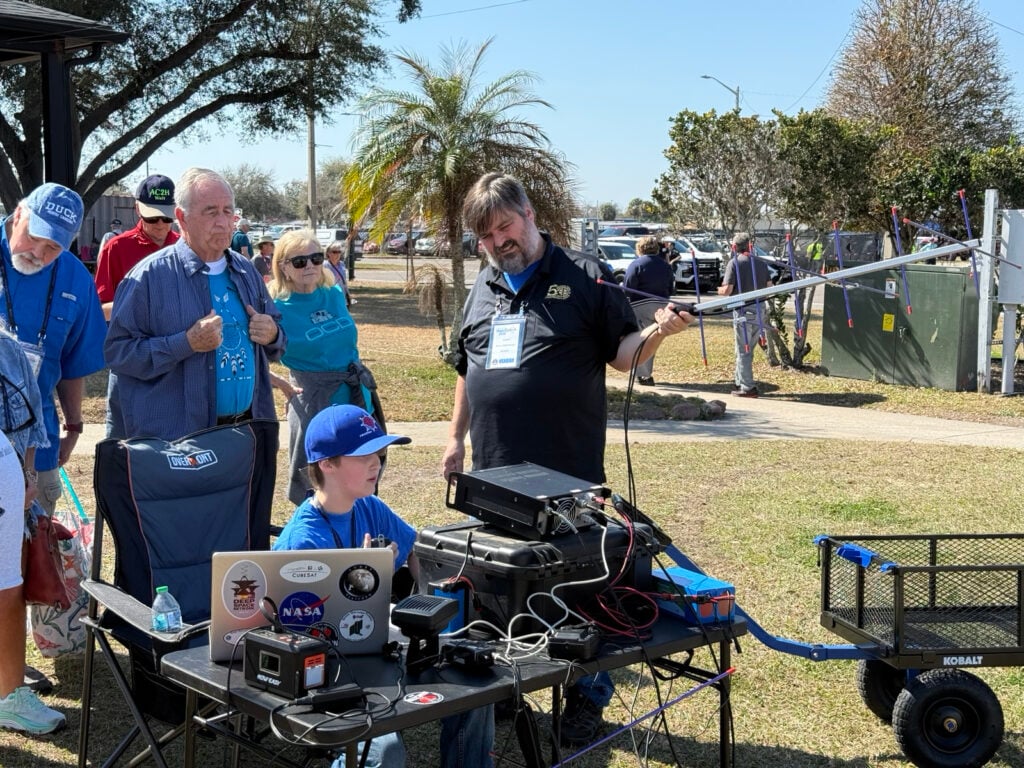
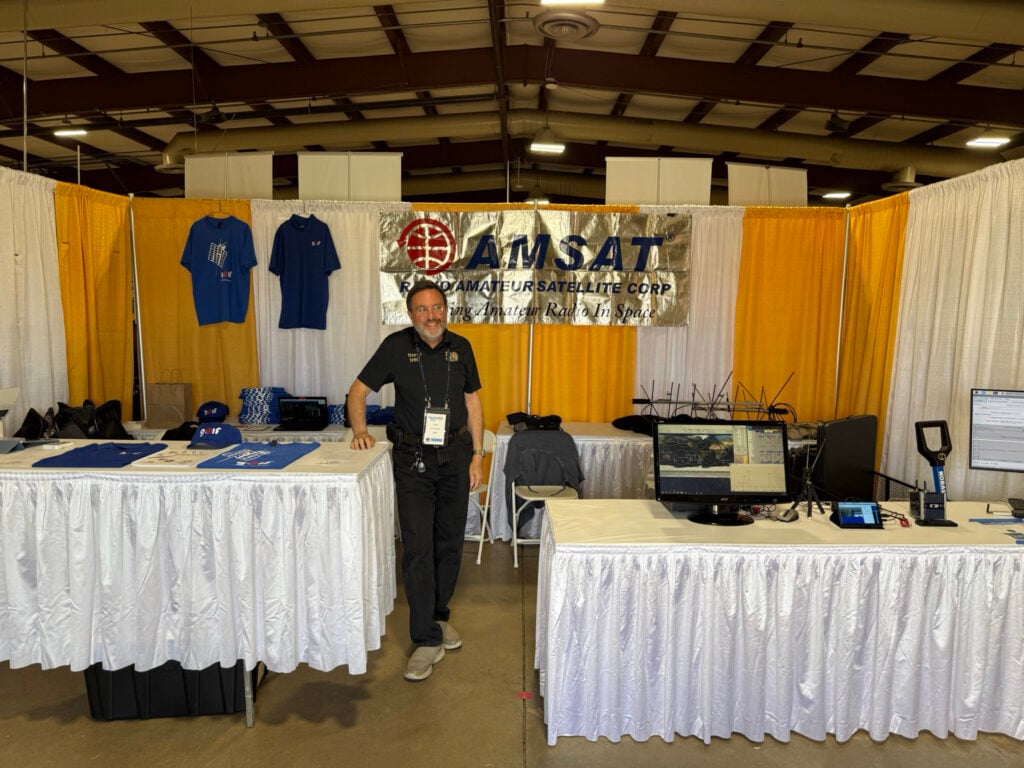
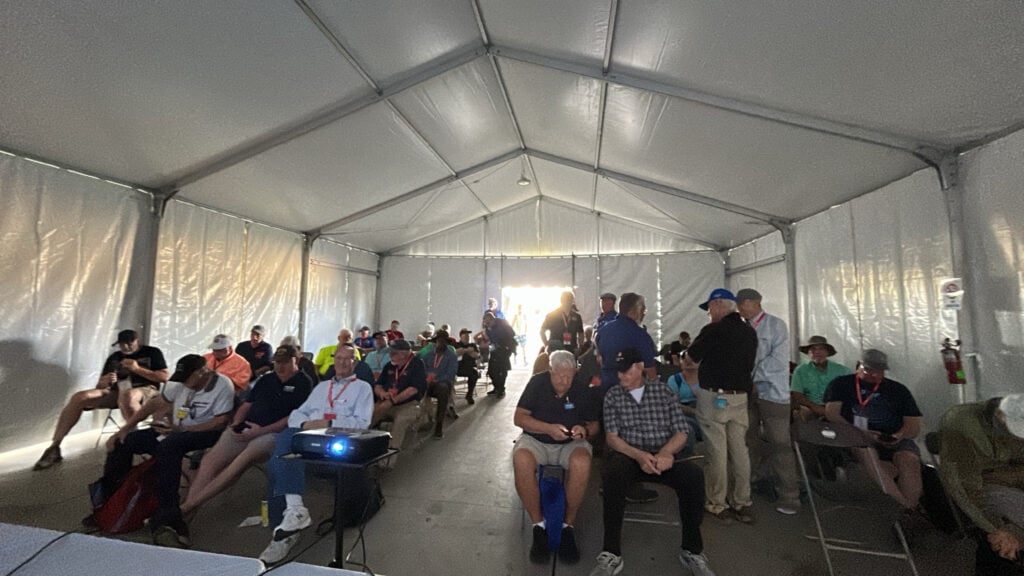
The second largest amateur radio event in the United States takes place this weekend – the Orlando Hamcation. AMSAT had a robust presence with a booth, amateur satellite demos, and a forum that took place on Saturday morning.
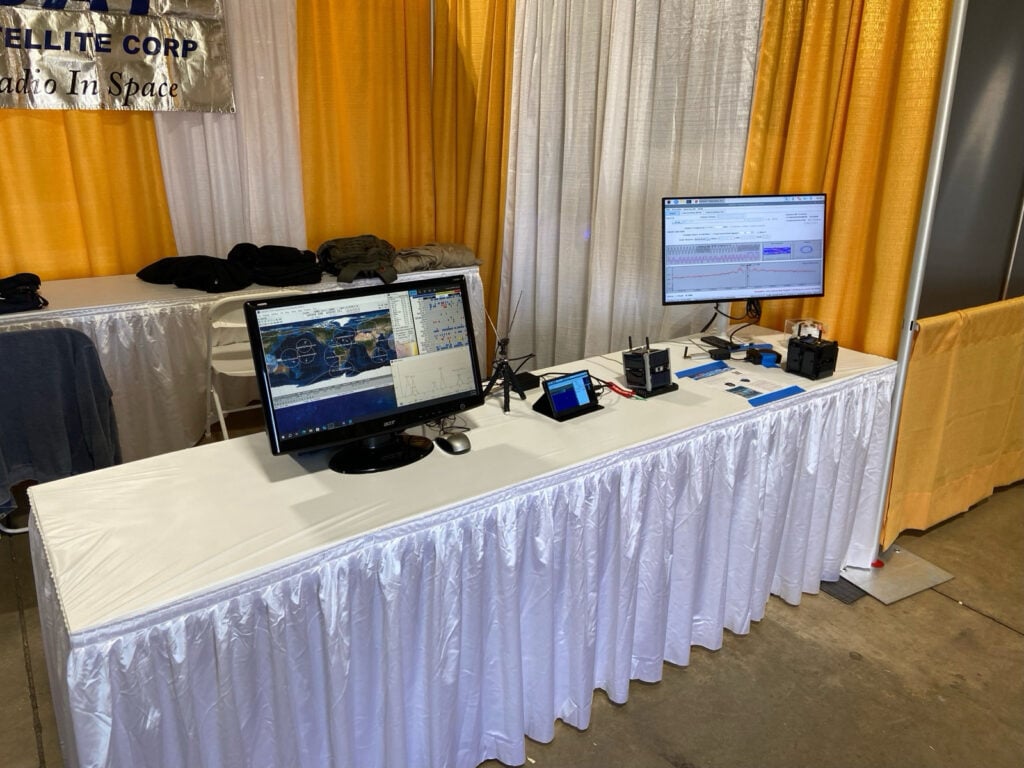
At the AMSAT booth, attendees were able to purchase AMSAT items, join or renew their membership, and see the AMSAT CubeSat Simulator in action.
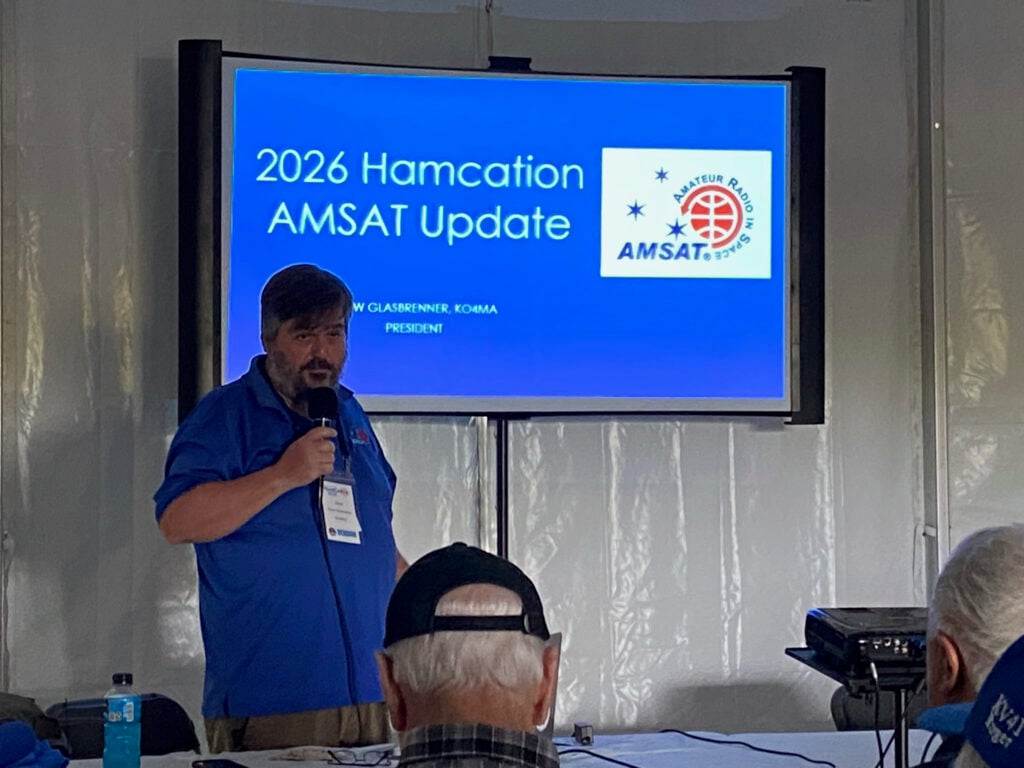
AMSAT President Drew Glasbrenner, KO4MA, along with his son, Carsten, KQ4SJM, conducted amateur satellite demonstrations throughout the weekend.
At the AMSAT forum on Saturday morning, Glasbrenner began with an overview of the amateur satellites that are currently workable, including FM repeaters, linear transponder, digipeaters, and satellites providing SSTV/SSDV image downlinks.
Glasbrenner then described AMSAT’s educational projects, including the AMSAT CubeSat Simulator and the AMSAT Youth Initiative’s free online courses at buzzsat.com. He also discussed AMSAT’s new free satellite coloring book, available for download at buzzsat.com.
After discussing AMSAT’s educational projects, Glasbrenner moved to detailing the current status of AMSAT’s satellite projects. First, AMSAT’s GOLF-TEE satellite is expected to be completed this year. This is an advanced 3U CubeSat with deployable solar panels, attitude control, a V/u transponder, X band high speed downlink, and a radiation tolerant internal housekeeping unit (IHU) While there is still a possiblity of a launch through NASA’s CubeSat Launch Initiative, AMSAT is also investigating possible commercial launch opportunities.
The first AMSAT FoxPlus satellite is also expected to be completed this year. FoxPlus is an updated 1U CubeSat series. The first two are based on ISISpacew hardware with AMSAT radios – the AMSAT LTM-1 and PACSAT. AMSAT is exploring commercial launch opportunities for these spacecraft.
AMSAT’s LTM-1 is a 30 kHz wide V/u linear transponder providing a 1200 bps BPSK telemetry downlink and a command receiver. Previous versions have flown on HO-107, AO-109, and MO-122. These modules are expected to be provided to universities for use in their CubeSat projectsin return for open transponder access and production is currently expanding.
AMSAT’s PACSAT is a V/u digital payload designed for multiuser access with 4 uplink receivers and 1 downlink transmitter. This is a hosted payload expected to be provided to universities for use in their CubeSat projects in return for open access. The first batch of these payloads is in production now.
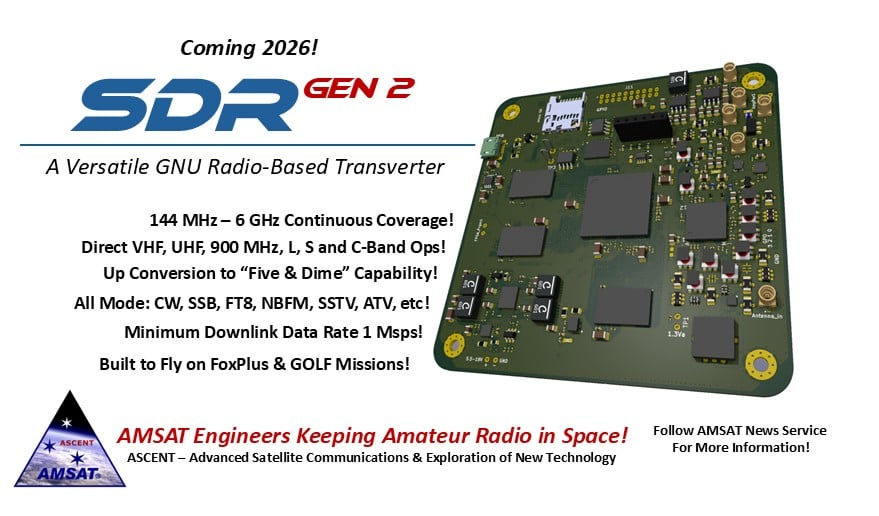
AMSAT’s SDR Gen2 is a versatile GNU Radio based SDR transceiver providing continuous coverage from 144 MHz – 6 GHz along with upconversion to provide a 10 GHz downlink. This transceiver is capable of providing any type of transponder within those frequency ranges and a minimum downlink data rate of 1 Mbps. This transceiver is being built to flew on future FoxPlus and GOLF missions.
Glasbrenner also discussed the European Space Agency (ESA’s) futureGEO project. This is a proposal for a geostationary satellite to serve ESA members and associate members (Canada). The planned location of this satellite in the middle of the Atlantic Ocean would cover most of North America. Initial proposals were submitted last year and AMSAT participated in a planning meeting led by AMSAT-DL last fall. This project has not yet been funded, but AMSAT will continue to participate in this effort.
[ANS thanks the AMSAT Hamcation Team for the above information]
AMSAT Remove Before Flight Key Tags Now Available
Yes, These are the Real Thing!
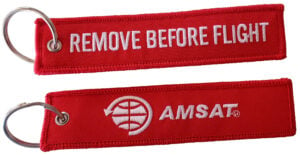
Your $20 Donation Goes to Help Fly a FoxPlus Satellite
Includes First Class Postage (Sorry – U.S. Addresses Only)
Order Today at https://www.amsat.org/product/amsat-remove-before-flight-keychain
REMINDER: AMSAT Membership Now Includes Getting Started Guide
AMSAT is offering a limited-time promotion for new and renewing members that includes a free digital copy of Getting Started with Amateur Satellites. The promotion is being offered as AMSAT begins the 2026 membership year.
Anyone who joins or renews their AMSAT membership during the promotional period will receive a download link for the latest edition of Getting Started with Amateur Satellites in their membership confirmation email. The guide is designed to help radio amateurs understand the fundamentals of satellite operation and serves as a practical reference for both newcomers and operators returning to the hobby. Additional information about AMSAT membership is available at https://launch.amsat.org.

In addition to this limited-time promotion, AMSAT membership includes a subscription to The AMSAT Journal, access to archived issues, discounts on selected items in the AMSAT online store, and opportunities to participate in AMSAT elections, committees, awards programs, and other AMSAT activities and programs. Members may also access archived proceedings from past AMSAT Space Symposiums through the AMSAT member portal.
Beyond these tangible benefits, AMSAT membership supports the development, launch, and operation of amateur radio satellites, along with education and outreach efforts. Joining AMSAT is not just about individual benefits — it is about being part of the community that builds and operates amateur satellites for radio amateurs worldwide. As AMSAT looks ahead to 2026, the promotion helps launch another year of growth and opportunity for amateur radio in space.
[ANS thanks Drew Glasbrenner, KO4MA, AMSAT President for the above information]
The 2026 President’s Club Coin is Now Here!
Help Support GOLF and FoxPlus.
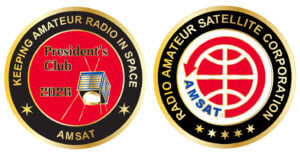
Annual memberships start at only $120
Join the AMSAT President’s Club today and help
Keep Amateur Radio in Space!
https://www.amsat.org/join-the-amsat-presidents-club/
New Full-Duplex Satellite Capable HT – The Anytone AT-D890UV
A recently released HT may be the best full-duplex HT available for FM satellite operations since the discontinuation of the Kenwood TH-D72 – the Anytone AT-D890UV (which is also available as the Bridgecom Maverick and the BTECH DA-7X2).
The Anytone AT-D890UV is a dual-band VHF/UHF DMR digital/analog handheld radio with built-in Bluetooth, GPS, and APRS capability. Features include Air Band AM receive, cross-band repeater mode, and an analog scrambler/compander. It has a 1.77″ color TFT display allows easy access to 4,000 channels and up to 500,000 digital contacts. The radio is powered by a 3100 mAh battery with convenient USB-C charging and upgraded 2G memory capacity. Next Generation Digital Narrowband (NXDN) functionality has also been promised as a future firmware update. A version of the firmware with NXDN support is currently available through unofficial sources.
The AT-D890UV also has the satellite Doppler tracking capability that has been present in previous Anytone radios, but unfortunately this feature does not currently work in full-duplex mode.
The below YouTube video from W8CPT demonstrates it’s full-duplex capability on SO-50, showing no apparent desense while operating in V/u mode.
The Anytone AT-D890UV is available from most amateur radio retailers for $299.99. As of this writing, DX Engineering expects to ship orders on February 23rd while Ham Radio Outlet has limited stock at their Anaheim location.
[ANS thanks AnyTone and W8CPT for the above information]
Need new satellite antennas?
Purchase M2 LEO-Packs from the AMSAT Store.
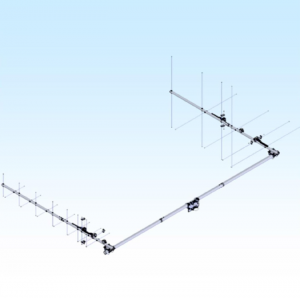
When you purchase through AMSAT, a portion of the proceeds goes towards
Keeping Amateur Radio in Space.
https://amsat.org/product-category/hardware/
AMSAT-EA Submits IARU Coordination Request for UNNE-1B (aka HADES-E2)
UNNE-1B is a 1.5p PocketQube which uses the same satellite hardware and software as the original UNNE-1, but will be launched with SpaceX instead of RFA due to delays in the latter launch. As with UNNE-1, it will offer licensed radio amateurs worldwide the opportunity to relay FM voice and FSK-derived digital modes.
The satellite will also transmit telemetry data reporting its status, a CW beacon, and a CODEC2 digital voice message. All of this will be achieved through the implementation of an SDR-based FM and FSK repeater. The FM/FSK repeater will always be available and will be activated by squelch level, without the need for a subtone.
As an educational payload, a small guessing game is being implemented by students from Universidad de Nebrija (Spain). The satellite will send one clue per week within its telemetry, and radio amateurs will need to solve the mystery by collecting all the clues. Details of the game will be published on the AMSAT-EA and Universidad de Nebrija websites, with all data being public and open.
With this mission, we will replace the SO-124 and SO-125 FM repeaters, as both satellites are expected to decay at the beginning of 2026, and HADES-SA, also scheduled for 2026, supports only digital transmissions. FM voice repeating is a highly demanded service within the community, as it enables long-range communications using simple setups.
The CW beacon and the recorded CODEC2 transmission also represent a small challenge for those wishing to receive them, specially the CODEC2 signal, which requires the use of a computer and dedicated software. This may be particularly appealing to radio amateurs who enjoy exploring the digital side of radio communications.
With this mission, we are also activating the VHF and UHF amateur satellite service bands for use by the amateur space community. Proposing a V/U FM transponder and FSK 50-1200 bps with Telemetry up to 1600 bps customizable by command. There will also be a CW beacon
Launch is expected in June 2026 on the SpaceX Transporter-17 mission. The launch broker is UARX. More info at https://www.amsat-ea.org/proyectos
[ANS thanks AMSAT-EA and the IARU Satellite Coordination Panel for the above information]
Changes to AMSAT TLE Distribution for February 13, 2026
Two Line Elements or TLEs, often referred to as Keplerian elements or keps in the amateur community, are the inputs to the SGP4 standard mathematical model of spacecraft orbits used by most amateur tracking programs. Weekly updates are completely adequate for most amateur satellites. TLE bulletin files are updated daily in the first hour of the UTC day. New bulletin files will be posted immediately after reliable elements become available for new amateur satellites. More information may be found at https://www.amsat.org/keplerian-elements-resources/.
The following satellite has been removed from this week’s AMSAT TLE distribution:
Dragonfly NORAD Cat ID 65729, Decayed from orbit on or aboyu 31 Jan 2026
HYDRA-T NORAD Cat ID 62692, Decayed from orbit on or about 30 Jan 2026
HADES-R (SO-124) NORAD Cat ID62690, Decayed from orbit on or about 30 Jan 2026
[ANS thanks Joe Fitzgerald, KM1P, AMSAT Orbital Elements Manager, for the above information.]
ARISS News
Amateurs and others around the world may listen in on contacts between amateurs operating in schools and allowing students to interact with astronauts and cosmonauts aboard the International Space Station. The downlink frequency on which to listen is 145.800 MHz worldwide.
Scheduled Contacts
The Center for Creativity, Innovation, and Discovery (CCID), Providence, UT direct via W7IVM
The ISS callsign is presently scheduled to be NA1SS
The scheduled crewmember is Chris Williams KJ5GEW and Jack Hathaway KJ5NIV
The ARISS mentor is AJ9N
Contact is go for: Thu 2026-02-19 17:17:29 UTC 77 deg
FIRST x XRP Governors Cup, Washington, DC, telebridge via K6DUE
The ISS callsign is presently scheduled to be TBD
The scheduled crewmember is Chris Williams KJ5GEW and Sophie Adenot KJ5LTN
The ARISS mentor is AJ9N
Contact is go for: Fri 2026-02-20 15:00:05 UTC 68 deg
Many times a school may make a last minute decision to do a Livestream or run into a last minute glitch requiring a change of the URL but we at ARISS may not get the URL in time for publication. You can always check https://live.ariss.org/ to see if a school is Livestreaming.
As always, if there is an EVA, a docking, or an undocking; the ARISS radios are turned off as part of the safety protocol.
The crossband repeater continues to be active (145.990 MHz up {PL 67} & 437.800 MHz down), If any crew member is so inclined, all they have to do is pick up the microphone, raise the volume up, and talk on the crossband repeater. So give a listen, you just never know.
Service Module radio: Not in APRS configuration; only being used for voice contacts at this time. Default mode is for packet operations (145.825 MHz up & down) but occasionally used for SSTV (145.800 MHz down).
Ham TV – Configured. Default mode is for scheduled digital amateur television operations (2395.00 MHz).
Note, all times are approximate. It is recommended that you do your own orbital prediction or start listening about 10 minutes before the listed time.
The latest information on the operation mode can be found at https://www.ariss.org/current-status-of-iss-stations.html
The latest list of frequencies in use can be found at https://www.ariss.org/contact-the-iss.html
[ANS thanks Charlie Sufana, AJ9N, one of the ARISS operation team mentors for the above information.]
Want to fly the colors on your own grid expedition?
Get an AMSAT car flag and other neat stuff from our Zazzle store!
25% of the purchase price of each product goes towards Keeping Amateur Radio in Space
AMSAT Ambassador Activities
AMSAT Ambassadors provide presentations, demonstrate communicating through amateur satellites, and host information tables at club meetings, hamfests, conventions, maker faires, and other events.
March 21, 2026
Midwinter Madness Hamfest
Buffalo Civic Center
1306 County Rd 134
Buffalo Minnesota 55313
KØJM, ADØHJ
Interested in becoming an AMSAT Ambassador? AMSAT Ambassadors provide presentations, demonstrate communicating through amateur satellites, and host information tables at club meetings, hamfests, conventions, maker faires, and other events.
For more information go to: https://www.amsat.org/ambassador/
[ANS thanks Bo Lowrey, W4FCL, Director – AMSAT Ambassador Program, for the above information.]
Satellite Shorts from All Over
+ As of this writing, 3 complete AMSAT CubeSatSim Kits are still available for purchase from the AMSAT store. This kit allows you to build a CubeSat Simulator with no soldering, just assembly. CubeSatSim is a low-cost satellite emulator that runs on solar panels and batteries, transmits UHF radio telemetry, has a 3D printed frame, and can be extended by additional sensors and modules. It is perfect for the classroom or for public demonstrations. The kit can be purchased from the AMSAT store. Sorry, shipping is only available to U.S. addresses. (ANS thanks AMSAT Education for the above information)
+ The AMSAT-X Meetup Net is held weekly on Thursdays at 0300Z (or 0200Z DST – Wednesday evening in North America) on the AMSAT Digital Mode Reflectors. This net is open to anyone that wishes to join with the focus being centered mostly on AMSAT Twitter users involved in grid square roving/chasing activities in North America. Participants are also encouraged to check-in with updates on other satellite activities and projects of interest to the group such as upcoming AMSAT presentations/demonstrations, collection of satellite telemetry, and balloon launches with amateur radio payloads. Currently available linked reflectors are DMR BrandMeister Talkgroup #98006 (AMSAT) and YSF Reflector #11689 (US-AMSAT). An audio feed is normally provided to the *AMSAT* EchoLink Conference Node #101377 but sometimes the bridge is unavailable. AMSAT D-STAR reflectors XLXSAT, XRFSAT, DCSSAT, and REFSAT are not utilized for the AMSAT-Twitter Meetup Net at this time. (ANS thanks AD0HJ and KC3UEP for the above information)
+ For fans of the open source M17 digital voice mode, AMSAT operates M17 reflector M17-SAT that is available for amateur satellite related discussion. If you do not have an M17 capable radio and/or hotspot, the DroidStar app can be used to access M17 reflectors from an Android, iOS, or Windows device.
+ With the Anytone AT-D890UV expected to become popular among amateur satellite operators, perhaps we should spin up an NXDN reflector for AMSAT discussions?
Join AMSAT today at https://launch.amsat.org/
In addition to regular membership, AMSAT offers membership to:
- Societies (a recognized group, clubs or organization).
- Students are eligible for FREE membership up to age 25.
- Memberships are available for annual and lifetime terms.
Contact info [at] amsat.org for additional membership information.
73 and remember to help Keep Amateur Radio in Space!
This week’s ANS Editor,
Paul Stoetzer, N8HM
n8hm [at] amsat.org
ANS is a service of AMSAT, the Radio Amateur Satellite Corporation, 712 H Street NE, Suite 1653, Washington, DC 20002
AMSAT is a registered trademark of the Radio Amateur Satellite Corporation.