AMSAT News Service
ANS-123 May 3, 2026
In this edition:
* Reminder: AMSAT at Hamvention
* FO-29 Update
* FCC Approves Limited Emergency Use of 70cm Band by AST SpaceMobile Satellites Outside the U.S.
* Saudi Amateur Radio Society Sponsors Satthon_2
* Request For Collecting CW Data of ARICA-2
* NASA Completes Nancy Grace Roman Space Telescope
* SpaceX Rocket Debris to Impact The Moon
* Changes to AMSAT-NA TLE Distribution
* Artemis 2 Moon Astronauts Visit the White House
* ARISS News
* AMSAT Ambassador Activities
* Satellite Shorts From All Over
The AMSAT® News Service bulletins are a free, weekly news and information service of AMSAT, The Radio Amateur Satellite Corporation. ANS publishes news related to Amateur Radio in Space including reports on the activities of a worldwide group of Amateur Radio operators who share an active interest in designing, building, launching and communicating through analog and digital Amateur Radio satellites.
The news feed on https://www.amsat.org publishes news of Amateur Radio in Space as soon as our volunteers can post it.
Please send any amateur satellite news or reports to: ans-editor [at] amsat.org
You can sign up for free e-mail delivery of the AMSAT News Service Bulletins via the ANS List; to join this list see: https://mailman.amsat.org/postorius/lists/ans.amsat.org/
Reminder: AMSAT at Hamvention
The 2026 Dayton Hamvention will be held Friday through Sunday, May 15–17, 2026, at the Greene County Fairgrounds in Xenia, Ohio. AMSAT will once again have a strong presence throughout the event, including booth activities, social gatherings, and the annual AMSAT Forum.
The 17th annual TAPR/AMSAT Banquet will be held Friday, May 15 at 6:30 p.m. EDT (18:30 EDT) at the Kohler Presidential Banquet Center, 4548 Presidential Way, Kettering, Ohio 45429, located approximately 20 minutes from the Greene County Fairgrounds. This dinner is a highlight of the TAPR (Tucson Amateur Packet Radio) and AMSAT (Radio Amateur Satellite Corporation) activities during Hamvention.
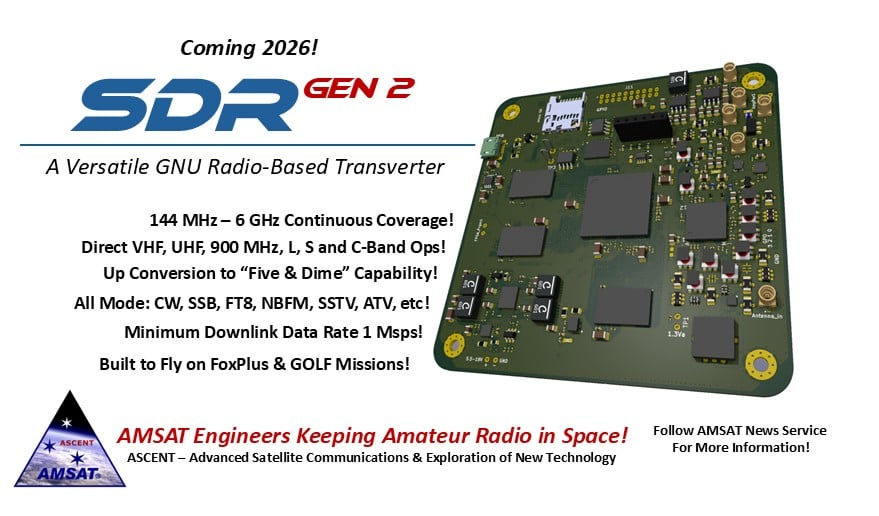
Ray Roberge, WA1CYB, will be the speaker at the 17th annual AMSAT/TAPR Banquet. Roberge, a member of AMSAT’s Engineering team, will speak about progress on AMSAT’s SDR Gen2 project, including what it does and where it can be used.
Tickets are $75 each and may be purchased through the AMSAT store. The deadline to purchase banquet tickets is Monday, May 11 at 17:00 EDT (21:00 UTC). Tickets must be purchased in advance and will not be sold at the AMSAT booth or at the door. There will be no tickets available for pickup at the AMSAT booth. Tickets purchased online will be maintained on a list, with check-in at the door at the banquet center. Seating is limited to the number of meals reserved with the Kohler caterers based on ticket sales by the deadline.  The annual AMSAT “Dinner at Tickets” gathering will take place Thursday, May 14 from 6:00 p.m. to 8:00 p.m. EDT at Tickets Pub & Eatery, 7 W. Main Street, Fairborn, Ohio 45324. Telephone (937) 878-9022. This informal event features no program or speaker, offering an opportunity for conversation and camaraderie. All are welcome, regardless of participation in booth setup or operations. Food may be ordered from the menu, and drinks, including beer, wine, sodas, and iced tea, are available at the bar. No reservations are required.
AMSAT is seeking volunteers to assist at the AMSAT booth, located in Building 1, booths 1007–1010 and 1107–1110. Volunteers are encouraged to contribute as much time as they are able, whether for a few hours or the entire weekend. In 2025, approximately 20 volunteers supported AMSAT’s activities and engagement with attendees.
Those interested in volunteering or requesting additional information may contact Phil Smith, W1EME, AMSAT Hamvention Team Leader, via email at w1eme [at] astrocom.net. Volunteer participation plays an important role in supporting AMSAT’s presence and outreach within the amateur radio community.
The AMSAT Forum will be held Saturday, May 16 from 1:50 p.m. to 3:10 p.m. EDT in Forum Room 2.
[ANS thanks the AMSAT Hamvention team for the above information.]
LIMITED TIME OFFER!!!
AMSAT is offering a limited-time promotion for new and renewing members that includes a free digital copy of Getting Started with Amateur Satellites. The promotion is being offered as AMSAT begins the 2026 membership year.
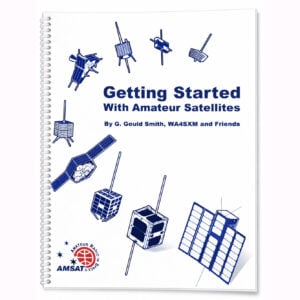
Anyone who joins or renews their AMSAT membership during the promotional period will receive a download link for the latest edition of Getting Started with Amateur Satellites in their membership confirmation email. JOIN TODAY at https://launch.amsat.org/ (Remember! Students join for FREE!)
FO-29 Update
Fuji-OSCAR 29 (FO-29 / JAS-2), the long-lived Japanese amateur radio satellite launched in 1996, continues to operate its V/U inverting analog linear transponder under the control of the Japan Amateur Radio League (JARL). Because the onboard batteries have failed years ago, the satellite depends entirely on solar power and can only function when its solar panels are illuminated.
Current Status (May 2026)
FO-29 entered a full-sunlight orbit in early March 2026 and lasted approximately 40 days. This continuous operation ended around April 21, 2026, after which the satellite entered an eclipse period for about one month.
A second, longer full-sunlight period is expected from approximately May 20 to mid-November 2026, during which continuous operation should resume.
Transponder Details
Mode: V/U inverting linear transponder (SSB and CW only)
Uplink: 145.900 – 146.000 MHz (LSB)
Downlink: 435.800 – 435.900 MHz (USB)
CW Beacon: 435.795 MHz (typically 100 mW)
Digitalker: 435.910 MHz FM (rarely activated)
The digital BBS (1k2/9k6) remains non-operational.
Important Restriction:
Digital modes are generally NOT permitted on the FO-29 linear transponder due to licensing and operational constraints.
Operating Procedure
During eclipse periods (or the transition out of full sunlight), the JARL control team sends specific commands to activate the transponder at designated UTC times. If the transponder does not turn on within about 2 minutes of the command start, the team terminates the attempt.
During confirmed full-sunlight periods, no regular command schedule is needed — the transponder stays active whenever the satellite is in sunlight.
Operators should always check real-time status via AMSAT Live Satellite Status, OSCAR Status pages, or recent community reports, as voltage instability in the aging satellite can occasionally cause unexpected behavior.
The scheduled activations for the eclipse period are:
May
1st 22:56~
2nd 22:00~
3rd 22:51~
4th 21:55~
5th 22:45~
6th 21:50~
7th 22:40~
8th 21:44~
9th 22:35~
15th 22:19~
16th 23:10~
Amateurs are reminded to:
- Use proper Doppler correction.
- Follow linear transponder etiquette (listen before transmitting, keep signals clean).
- Limit uplink power to avoid overloading the transponder (typically no more than a few watts with a modest antenna).
The JARL page provides the detailed historical and upcoming command schedules for eclipse periods across 2025–2026. For the absolute latest status and any updates from the Japanese control team, monitor the official JARL FO-29 page, AMSAT.org, and AMSAT bulletins.
FO-29’s continued operation nearly 30 years after launch remains a testament to robust engineering and the dedication of the JARL team.
[ANS thanks JARL for the above information.]
The 2026 President’s Club Coin is Here! Help Support GOLF and FoxPlus.
Annual memberships start at only $120
Join the AMSAT President’s Club today
and help Keep Amateur Radio in Space!
https://www.amsat.org/join-the-amsat-presidents-club/
FCC Approves Limited Emergency Use of 70cm Band by AST SpaceMobile Satellites Outside the U.S.
The Federal Communications Commission (FCC) has granted AST SpaceMobile limited authorization when not over the United States to use five 50-kHz channels in the 430–440 MHz secondary amateur band for emergency Telemetry, Tracking, and Control (TT&C) operations for its planned satellite constellation (DA-26-391 Docket No. 25-201). The authorization, granted on April 21, 2026, applies only for communication with five specified earth stations, each located well outside of the United States and for which the foreign administration with jurisdiction also must separately authorize the communications.
More than 2,500 comments were filed during the proceeding including filings from ARRL and other member societies of the International Amateur Radio Union (IARU), AMSAT, and individual radio amateurs worldwide.
After considering the filed comments, the FCC narrowed the requested authorization to emergency TT&C only and further provided that:
- Use of these frequencies is permitted only in emergencies when no other spectrum is available
- Each emergency event is limited to no more than 24 hours
- Transmissions are restricted to five specific center frequencies (430.5, 432.3, 434.1, 435.9, and 439.5 MHz), each with no more than 50 kHz bandwidth
In an April 29, 2026 statement, the IARU expressed concern with the FCC’s use of Article 4.4 of the ITU Radio Regulations, which allows administrations to authorize non-standard frequency use under certain conditions. The IARU stated that other frequency bands allocated for satellite TT&C should have been used instead of amateur spectrum and encouraged amateurs to report any interference to their national regulators.
ARRL filed comments (see ARRL News) in July (PDF) and August 2025 (PDF) opposing the application, arguing that:
- The request represented an unprecedented use of secondary amateur spectrum for an unallocated use by a large commercial satellite constellation
- Such operations could cause harmful interference, particularly to amateur satellites in the 435–438 MHz subband
- The FCC should avoid authorizing non-allocated uses that could impact primary allocations for amateur services in other countries
While the FCC ultimately granted the authorization, it imposed the above significant limitations in response to these concerns that reduce the likelihood of interference.
In the U.S., reports of suspected interference to amateur spectrum can be shared with the ARRL Regulatory Information Manager, email [email protected].
ARRL will oppose any similar unallocated uses of spectrum used by amateurs that might cause harmful interference to amateur services and in particular will monitor this situation.
[ANS thanks ARRL News for the above information.]
Saudi Amateur Radio Society Sponsors Satthon_2
The Saudi Amateur Radio Society, in collaboration with AMSAT-HZ, has announced the launch of the second edition of Satthon_2, as part of its national initiatives specialized in satellite communications. The competition aims to develop national talent in satellite communication technologies through hands-on training in receiving, analyzing, and decoding satellite signals across various formats. It also focuses on empowering university students by bridging academic knowledge with real-world application, while fostering innovation and teamwork skills.  The competition will take place from May 8 to 10, 2026, in a team-based format, and includes two categories:
- University Students
- Professionals and Amateur Radio Operators
Cash prizes will be awarded to the top three winners in each category, in addition to participation certificates and volunteer hours. Registration: https://lnkd.in/d2PfhbUh [ANS thanks Samir Khayat, HZ1SK, Saudi Amateur Radio Society, for the above information.]
Need new satellite antennas?
Purchase M2 LEO-Packs from the AMSAT Store.
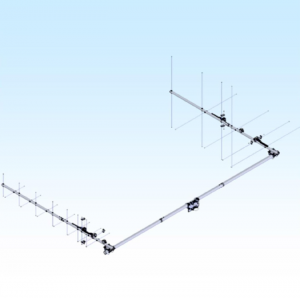
When you purchase through AMSAT, a portion of the proceeds goes towards
Keeping Amateur Radio in Space.
https://amsat.org/product-category/hardware/
Request For Collecting CW Data of ARICA-2
ARICA-2, a 2U cubesat developed by Sakamoto Laboratory at Aoyama Gakuin University in Tokyo, was launched on April 23 by Rocket Lab in New Zealand.
The non-amateur mission goal of ARICA-2 is to demonstrate the real-time alert system of transient astronomical sources, such as gamma-ray bursts, using commercial satellite network services and to collect the images of the earth, and hopefully, aurora with a camera utilizing machine learning capability.
The amateur mission is to provide a “store and forward” capability using a 4k8 GMSK in AX25 format transceiver for communication among amateurs. The alert and housekeeping data are also broadcast through the amateur CW transmitter.
ARICA-2 is operating very stably, with no issues in its batteries or onboard equipment. Thanks to reception reports from amateurs worldwide, the Lab has been able to successfully receive CW signals from ARICA-2 every day, as well as GMSK signals triggered by uplinks from the Aoyama Gakuin university’s ground station.
At present, ARICA-2 is still undergoing satellite checkout procedures, and the amateur mission that will allow communication using GMSK has not yet started. Once the timing is appropriate to begin the amateur mission, the ARICA-2 team will announce it through amsat-bb and on X.
Until then, Sakamoto Laboratory would greatly appreciate the continued cooperation of amateurs in receiving the CW data, which contains housekeeping (HK) information from the satellite.
Here is the info about ARICA-2.
1. Preliminary TLE
ARICA-2 1 99999U 27001A 26113.16829861 .00000000 00000-0 00000-0 0
9999 2 99999 97.5133 263.8390 0010953 206.3608 199.1146 15.08588350 03
2. Frequency: 436.830 MHz (20 wpm CW)
3. The contents of the CW data and transmitting time are described at: https://sakamotolab.phys.aoyama.ac.jp/research/future_space/ARICA-2_en/cw_beacon.
Please also report the received CW data on that page.
Collection of the CW data of ARICA-2 is greatly appreciated!.
[ANS thanks Taka Sakamoto, JA6NWC, Sakamoto Laboratory, for the above information.]
NASA Completes Nancy Grace Roman Space Telescope
NASA has completed assembly of the Nancy Grace Roman Space Telescope, a next-generation observatory designed to map the universe on an unprecedented scale. Engineers at NASA’s Goddard Space Flight Center are finishing prelaunch testing before the spacecraft is shipped to Kennedy Space Center. Launch preparation is underway with a target as early as September, placing the mission ahead of its original schedule. Once deployed, Roman will operate from a distant orbit approximately one million miles from Earth.
The new telescope is designed to complement existing observatories such as the Hubble Space Telescope and the James Webb Space Telescope. While those missions focus on detailed observations of individual targets, Roman will conduct wide-field surveys, capturing images with similar resolution across areas roughly 100 times larger. This capability will allow astronomers to transition from isolated observations to large-scale mapping of cosmic structure. The result is expected to provide a broader context for many of the discoveries made by earlier space telescopes.
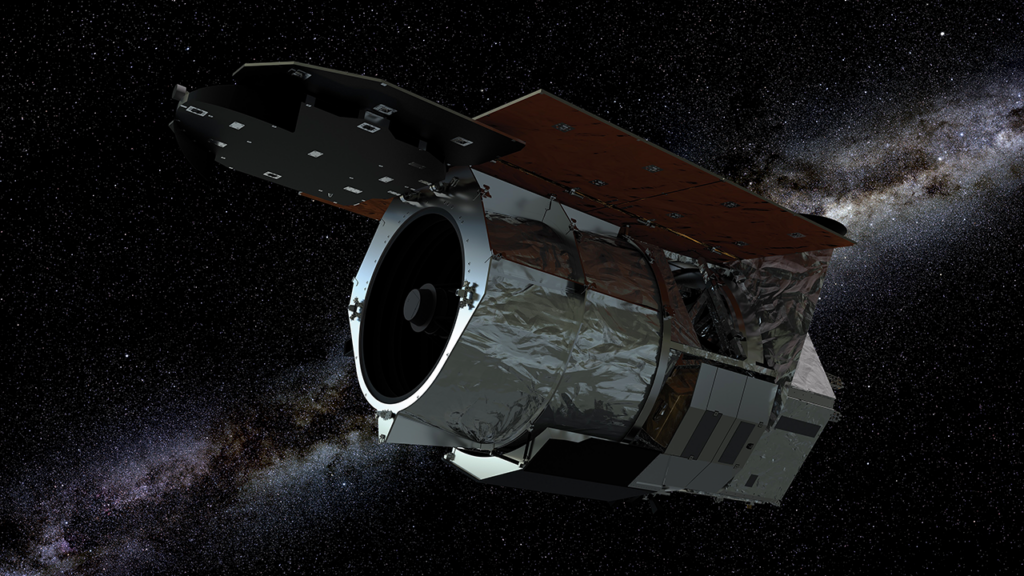 Artist’s rendering of the Nancy Grace Roman Space Telescope. CREDITS: NASA, GSFC
At the core of the mission is an eight-foot primary mirror paired with a powerful infrared imaging system. Roman’s wide field of view allows it to observe large regions of the sky in far fewer pointings than previous telescopes. For example, imaging the Andromeda Galaxy would require hundreds of individual exposures with Hubble but only a handful with Roman. This efficiency makes the observatory particularly well suited for large survey missions and time-domain astronomy.
One of Roman’s primary science goals is to study dark matter and dark energy, which together make up the majority of the universe. By mapping hundreds of millions of galaxies and measuring subtle distortions in their shapes, scientists can trace how invisible mass influences the structure of the cosmos. Observations of Type Ia supernovae will also help refine measurements of cosmic expansion. These combined datasets are expected to improve our understanding of the universe’s evolution and underlying physical laws.
The telescope will also expand the search for exoplanets using gravitational microlensing techniques. By monitoring dense star fields in the Milky Way’s central region, Roman can detect planets that orbit far from their host stars, including free-floating worlds. This approach complements earlier missions that focused on planets closer to their stars. In addition, Roman will test advanced coronagraph technology capable of blocking starlight to directly observe faint planetary companions.
Roman’s wide-field imaging capability will also support time-domain astronomy by repeatedly scanning large areas of the sky. These observations will capture transient events such as supernovae, black hole activity, and other short-lived phenomena. The resulting datasets will serve as a long-term reference for future discoveries, enabling astronomers to compare “before” and “after” views of dynamic regions of space.
Read the full article at: https://www.msn.com/en-us/news/technology/nasas-incredible-new-telescope-will-offer-an-atlas-of-the-universe/ar-AA21skN5
[ANS thanks Elisha Sauers, Mashable.com and NASA for the above information.]
SpaceX Rocket Debris to Impact The Moon
Earth’s moon is to be on the receiving end of a spent rocket stage in early August – the leftovers from a SpaceX Falcon 9 launch last year.
Firefly’s Blue Ghost Mission 1, named Ghost Riders in the Sky, launched on Jan. 15, 2025 and performed the first fully successful commercial lunar landing on March 2 at the moon’s Mare Crisium. That lander went on to mark the longest commercial operation on the moon to date.
Meanwhile, the Falcon 9’s leftover upper stage, labeled 2025-010D, that lobbed the two private spacecraft into space, is now headed for a run in with the moon. “We’ve been tracking it since launch. The orbit has changed a bit over the last year or so, and is now headed for a lunar impact,” said Bill Gray of Project Pluto.
Project Pluto provides software tools useful for astronomers to identify satellites in their data, and has published a page of data about the Falcon 9 upper stage.
He recalls that NASA’s Lunar Crater Observation and Sensing Satellite (LCROSS) mission back years ago did something very similar.
“We now have another upper stage due to hit the moon, this one on Aug. 5 and (just barely) on the near side of the moon,” Gray said.
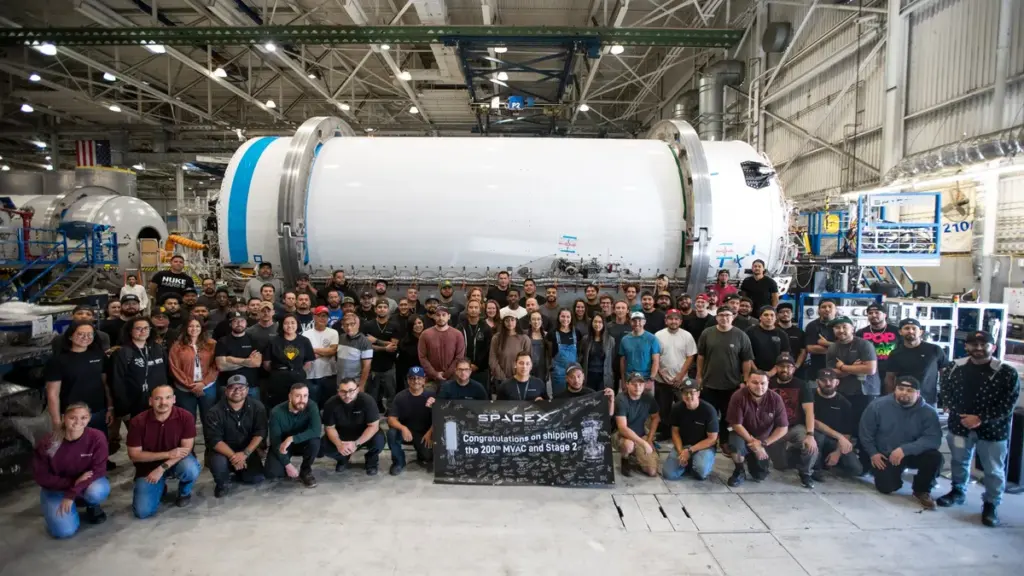 A SpaceX photo of one of the company’s Falcon 9 second stages, taken in 2022. (Image credit: SpaceX)
Gray said he doesn’t expect this particular object to cause any trouble.
“It doesn’t present any danger to anyone,” said Gray, “though it does highlight a certain carelessness about how leftover space hardware is disposed of.”
The chance that rubble kicked up by the impact would hit a moon-circling spacecraft is quite small, said Gray, but he would factor that into any planned maneuvers.
“In a few years, things may be different,” Gray said, given humans tromping about on the lunar surface.
“That raises the stakes considerably. If I were sending an upper stage to high orbit, I would think about where it was going,” said Gray. You might launch an upper stage today, and then years later see a real problem, he said.
[ANS thanks Space.com for the above information. Read the full article at https://www.space.com/space-exploration/launches-spacecraft/a-stray-spacex-rocket-stage-could-slam-into-the-moon-this-august-amateur-astronomer-says]
Changes to AMSAT TLE Distribution for May 1, 2026
Two Line Elements or TLEs, often referred to as Keplerian elements or keps in the amateur community, are the inputs to the SGP4 standard mathematical model of spacecraft orbits used by most amateur tracking programs. Weekly updates are completely adequate for most amateur satellites. TLE bulletin files are updated daily in the first hour of the UTC day. New bulletin files will be posted immediately after reliable elements become available for new amateur satellites. More information may be found at https://www.amsat.org/keplerian-elements-resources/.
The following satellites have been added to this week’s AMSAT TLE Distribution:
MAGNARO-II-Piscis is object 68798 (2026-088G). Frequency: 436.326 MHz.
ARICA 2 is object 68796 (2026-088E). Frequency: 436.830 MHz.
FSI-SAT 2 is object 68792 (2026-088A). Frequency: 437.176 MHz.
WASEDA-SAT-ZERO-II is object 68797 (2026-088F). Frequency: 437.205 MHz.
OrigamiSat 2 is object 68795 (2026-088D). Frequency: 437.506 MHz.
General Perturbations Data Support
AMSAT is pleased to announce that modern forms of what are called General Perturbations data are being disseminated via modern formats including JSON, XML and KVN at https://newark192.amsat.org/gpdata/current/. The reason this change is being made is that we are running out of 5-digit catalog numbers and the TLE format is not viable for satellites launched after July of this year. See https://celestrak.org/NORAD/documentation/gp-data-formats.php for details.
These data are presently considered in beta test for the next two months while hosted on the test server newark192.amsat.org, and we are very open to community feedback at [email protected]. Testers may experience outages and errors while we make improvements. We intend to put this into production on our main web server in July as we expect that satellites launched after this summer will require one of the new formats to accommodate longer object numbers. AMSAT will continue to publish TLE bulletins for satellites launched before July 2026 indefinitely.
[ANS thanks Joe Fitzgerald, KM1P, AMSAT Orbital Elements Manager, for the above information.]
AMSAT Remove Before Flight Key Tags Now Available
Yes, These are the Real Thing!
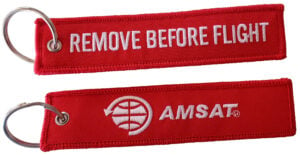
Your $20 Donation Goes to Help Fly a Fox-Plus Satellite
Includes First Class Postage (Sorry – U.S. Addresses Only)
Order Today at https://www.amsat.org/product/amsat-remove-before-flight-keychain
Artemis 2 Moon Astronauts Visit the White House
President Trump invited the Artemis 2 quartet and NASA Administrator Jared Isaacman to the Oval Office today (April 29), for a livestreamed press event that the White House described as a “greeting.”
“It takes people like this to make our country great,” Trump said of the crew. “We’re very proud of these people. They have unbelievable courage.”
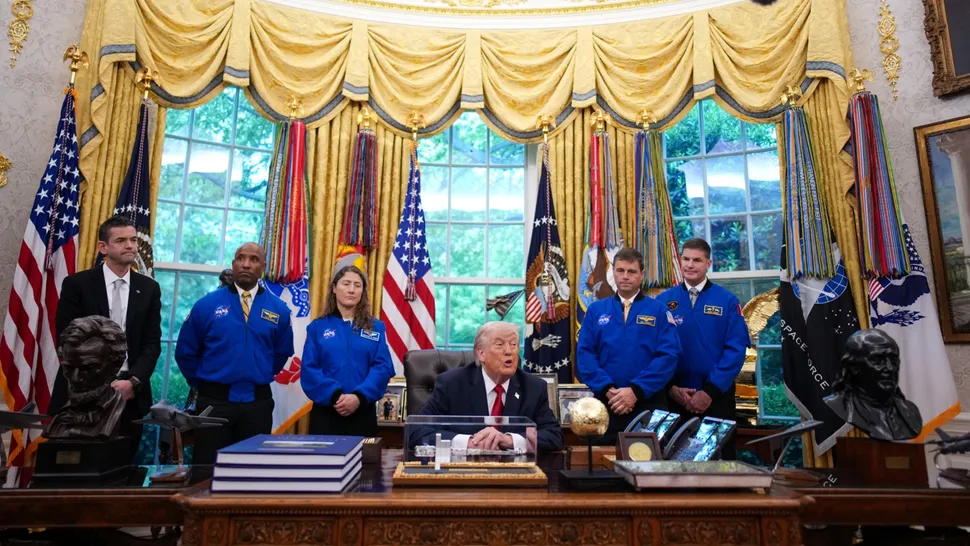 President Donald Trump welcomed the four Artemis 2 astronauts (in blue flight suits) and NASA Administrator Jared Isaacman (in dark suit, in front of American flag) to the Oval Office on April 29, 2026. (Image credit: Andrew Harnik/Getty Images)
Artemis 2 launched on April 1 and returned to Earth on April 10. The mission sent Reid Wiseman, KF5LKT, Victor Glover, KI5BKC, Christina Hammock Koch, and Canadian astronaut Jeremy Hansen, KF5LKU, on an epic journey around the moon and back. They were the first people to leave Earth orbit since the Apollo 17 astronauts in 1972, and they got farther from their home planet than anyone ever has before, breaking the record set by Apollo 13 in 1970.
[ANS thanks Space.com for the above information. Read the full article at https://www.space.com/space-exploration/artemis/trump-invited-the-artemis-2-moon-astronauts-to-the-oval-office-heres-what-happened]
ARISS News
Amateurs and others around the world may listen in on contacts between amateurs operating in schools and allowing students to interact with astronauts and cosmonauts aboard the International Space Station. The downlink frequency on which to listen is 145.800 MHz worldwide.
RECENTLY COMPLETED
Scouts Australia, Victorian Branch, Wodonga Scouts Groups – Wireless Institute of Australia AGM and Technical Expo event 2026, The Albury Wodonga ARC, NSW, Australia and Wireless Institute of Australia, Thurgoona, New South Wales, Australia, telebridge via VK6MJ
The ISS callsign was NA1SS
The scheduled crewmember was Chris Williams, KJ5GEW
The ARISS mentor was VK4KHZ
Contact was successful: Sat 2026-05-02 10:43:04 UTC 73 degrees maximum elevation.
UPCOMING
Universidad Tecnologica Nacional Facultad Regional San Rafael, San Rafael, Argentina, direct via LU9MAB
The ISS callsign is presently scheduled to be NA1SS
The scheduled crewmember is Sophie Adenot, KJ5LTN
The ARISS mentor is VE6JBJ
Contact is go for: Tue 2026-05-05 14:12:15 UTC 50 degrees maximum elevation.
NANO-Potsdam NANO Wissenschaft begreifen, Potsdam, Germany, telebridge via ZS6JON
The ISS callsign is presently scheduled to be NA1SS
The scheduled crewmember is Chris Williams, KJ5GEW
The ARISS mentor is IN3GHZ
Contact is go for: Thu 2026-05-07 14:36:13 UTC 50 degrees maximum elevation.
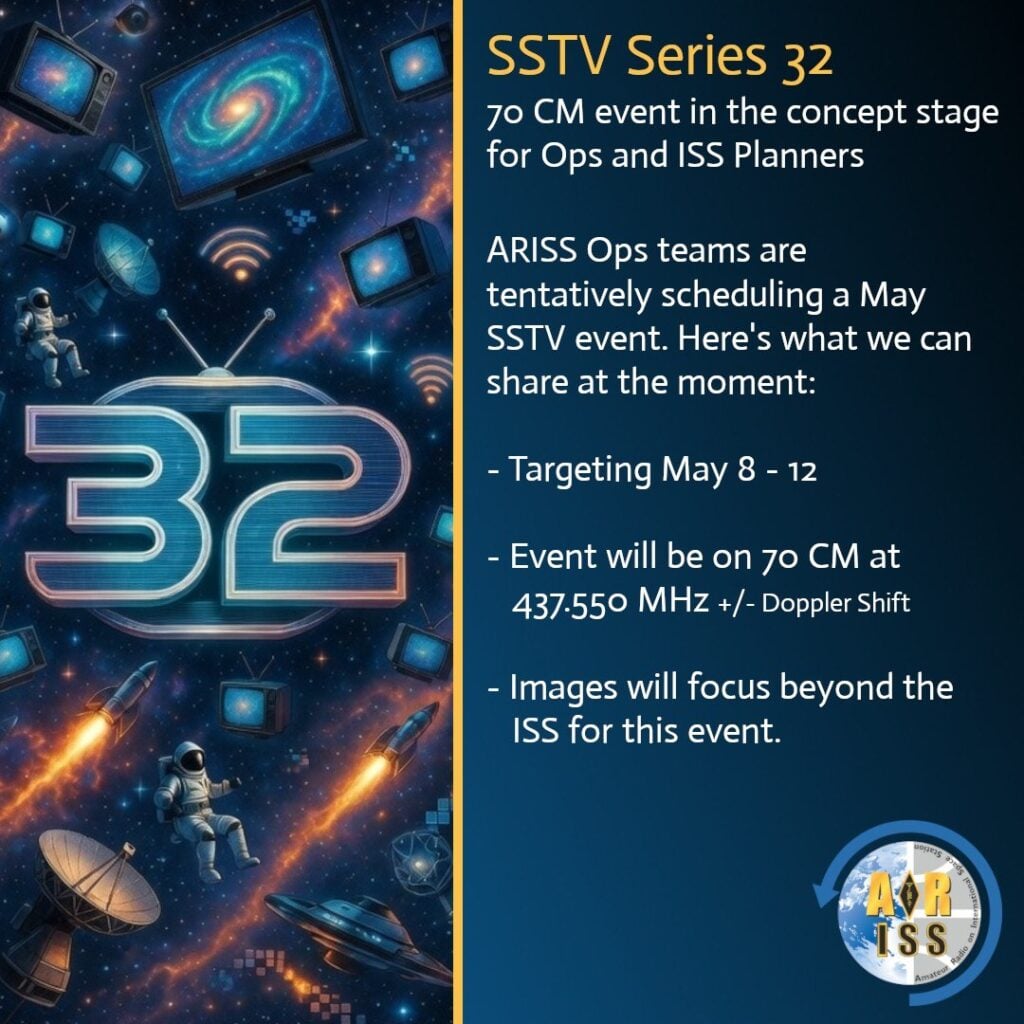 Many times a school may make a last minute decision to do a Livestream or run into a last minute glitch requiring a change of the URL but we at ARISS may not get the URL in time for publication. You can always check https://live.ariss.org/ to see if a school is Livestreaming.
As always, if there is an EVA, a docking, or an undocking; all ARISS radios are turned off as part of the safety protocol.
The crossband repeater continues to be active (145.990 MHz up {PL 67} & 437.800 MHz down). If any crewmember is so inclined, all they have to do is pick up the microphone, raise the volume up, and talk on the crossband repeater. So give a listen, you just never know.
APRS is currently active on 145.825 MHz. Please note that ARISS is still in the process of troubleshooting and testing the Kenwood D710GA radio in the Zvezda Service Module – Call sign RSØISS. Feel free to check out status reports here.
Ham TV in the Columbus European Laboratory is currently transmitting a test signal at 2395.00 MHz. For more information, visit the ARISS Ham TV Live site here.
Note, all times are approximate. It is recommended that you do your own orbital prediction or start listening about 10 minutes before the listed time.
The latest information on the operation mode can be found at https://www.ariss.org/current-status-of-iss-stations.html
The latest list of frequencies in use can be found at https://www.ariss.org/contact-the-iss.html
[ANS thanks Charlie Sufana, AJ9N, one of the ARISS operation team mentors for the above information.]
Want to fly the colors on your own grid expedition? Get an AMSAT car flag and other neat stuff from our Zazzle store!
25% of the purchase price of each product goes towards
Keeping Amateur Radio in Space
AMSAT Ambassador Activities
AMSAT Ambassadors provide presentations, demonstrate communicating through amateur satellites, and host information tables at club meetings, hamfests, conventions, maker faires, and other events.
May 15-17, 2026
Dayton Hamvention
Greene County Fair and Expo Center
210 Fairground Road Xenia 45385
https://hamvention.org/
October 8-11, 2026
44th AMSAT Space Symposium and Annual Membership Meeting
Crowne Plaza JAX Airport
14670 Duval Road
Jacksonville, FL 32218
Interested in becoming an AMSAT Ambassador? AMSAT Ambassadors provide presentations, demonstrate communicating through amateur satellites, and host information tables at club meetings, hamfests, conventions, maker faires, and other events. For more information go to: https://www.amsat.org/ambassador/
[ANS thanks Bo Lowrey, W4FCL, Director – AMSAT Ambassador Program, for the above information.]
Satellite Shorts from All Over
+ The Iowa State University Campus Amateur Radio Club (WØISU) will be launching a 10 kHz wide non-inverting linear transponder on May 2nd at 1300z on a high altitude balloon. All info for this flight can be found at this website: https://stuorgs.engineering.iastate.edu/carc/balloon-lauch/. The transponder will have a 10m uplink and a 2m downlink. NOTE: There is always a chance that the balloon launch may be cancelled due to weather. The backup launch day will be Sunday, May 3rd. Please see the linked website for updates regarding cancellation of the launch. Please contact me if you have any questions. (ANS thanks Kees Van Oosbree, WØAAE, for the above information.)
+ The hatches are open between the International Space Station and the new Progress 95 cargo spacecraft following the delivery of about three tons of food, fuel, and supplies on Monday. Expedition 74 commander Sergey Kud-Sverchkov and flight engineer Sergei Mikaev, both from Roscosmos, finalized leak and pressure checks between Progress 95 and the Zvezda service module’s rear port on Tuesday. Afterward, the duo installed air ducts and began unpacking the spacecraft beginning seven months of cargo activities in the resupply ship. (ANS thanks NASA for the above information.)
+ AST SpaceMobile has received the green light to operate satellite-to-phone services in the US, setting the stage for the company to compete against SpaceX’s Starlink Mobile. On April 21, AST secured FCC approval to operate the entirety of its 248-satellite constellation and offer “supplemental coverage from space,” including outside the U.S. (ANS thanks PC Magazine for the above information. Read the full article at https://www.pcmag.com/news/ast-spacemobile-secures-fcc-nod-to-compete-with-starlink-mobile)
+ SpaceX’s most powerful operational rocket, the Falcon Heavy, lifted off Wednesday carrying a massive communications satellite on its 12th flight since 2018. The 27 Merlin engines of the three Falcon boosters roared to life at 1413 UTC and the 70-meter-tall (229.6 ft) rocket thundered away from Launch Complex 39A propelled by 5 million pounds of thrust. Deployment of the satellite came at nearly five hours after liftoff. The upper stage featured an additional thermal protection layer to ensure the fuel, a rocket-grade kerosene, does not freeze during the roughly four-hour coasting phase between the second and third engine ignitions. The ViaSat-3 F3 satellite is the second in the series to be launched onboard a SpaceX Falcon Heavy rocket and the third and final member of this constellation. The first satellite, ViaSat-3 Americas, launched on a Falcon Heavy rocket in 2023. (ANS thanks Spaceflight Now for the above information. Read the full article at https://spaceflightnow.com/2026/04/29/spacex-launches-6-ton-viasat-3-f3-satellite-on-falcon-heavy-rocket/)
Join AMSAT today at https://launch.amsat.org/
In addition to regular membership, AMSAT offers membership to:
- Societies (a recognized group, clubs or organization).
- Students are eligible for FREE membership up to age 25.
- Memberships are available for annual and lifetime terms.
Contact info [at] amsat.org for additional membership information.
73 and remember to help Keep Amateur Radio in Space!
This week’s ANS Editor, Mark Johns, KØJM
mjohns [at] amsat.org
ANS is a service of AMSAT, the Radio Amateur Satellite Corporation, 712 H Street NE, Suite 1653, Washington, DC 20002
AMSAT is a registered trademark of the Radio Amateur Satellite Corporation.