AMSAT News Service
ANS-011
January 11, 2026
In this edition:
* NASA Ends Crew 11 Mission Due To ‘Medical Concern’ With An Astronaut
* REMINDER: AMSAT Membership Now Includes “Getting Started” Guide
* NASA Marks 50 Years Of GOES Satellites
* VUCC Satellite Standings for January, 2026
* DXCC Satellite Standings for January, 2026
* Changes to AMSAT-NA TLE Distribution
* Two U.S. Schools/Organizations Moved Forward in ARISS Selection Process
* ARISS News
* AMSAT Ambassador Activities
* Satellite Shorts From All Over
The AMSAT® News Service bulletins are a free, weekly news and information service of AMSAT, The Radio Amateur Satellite Corporation. ANS publishes news related to Amateur Radio in Space including reports on the activities of a worldwide group of Amateur Radio operators who share an active interest in designing, building, launching and communicating through analog and digital Amateur Radio satellites.
The news feed on https://www.amsat.org publishes news of Amateur Radio in Space as soon as our volunteers can post it.
Please send any amateur satellite news or reports to: ans-editor [at] amsat.org
You can sign up for free e-mail delivery of the AMSAT News Service Bulletins via the ANS List; to join this list see: https://mailman.amsat.org/postorius/lists/ans.amsat.org/
NASA Ends Crew 11 Mission Due To ‘Medical Concern’ With An Astronaut
NASA is bringing some of the crew aboard the International Space Station (ISS) back to Earth early due to medical concerns with one the astronauts.
NASA officials announced on Wednesday, January 7, that they had decided to cancel an upcoming spacewalk due to a medical issue with an undisclosed crew member. Hours later, the agency indicated that it wasn’t ruling out an early end to Crew-11’s mission, and confirmed that the unnamed crew member was in a stable, non-emergency condition. NASA officials finalized the decision to bring the astronauts home in an announcement on Thursday, January 8.
Mike Fincke, KE5AIT, and Zena Cardman, KJ5CMN, had been scheduled to step outside the International Space Station (ISS) on Thursday at about 13:00 UTC, kicking off a roughly 6.5-hour extravehicular activity (EVA). But that spacewalk was postponed.
A follow-up statement from NASA said, “Safely conducting our missions is our highest priority, and we are actively evaluating all options, including the possibility of an earlier end to Crew-11’s mission.” That crew includes both Cardman and Fincke, as well as Japanese astronaut Kimiya Yui, KG5BPH, and Russian cosmonaut Oleg Platonov. The crew was launched on August 1, 2025 and was not scheduled for return until mid-February, following the arrival of Crew-12.

The crew of NASA’s SpaceX Crew-11 mission pose for a photo during a training session on July 3, 2025 at SpaceX facilities in Florida.
From left: Oleg Platonov, Mike Fincke, KE5AIT, Zena Cardman, KJ5CMN, and Kimiya Yui, KG5BPH. (Credit: SpaceX)
The early return of Crew-11 shouldn’t cause any delays in the preparations to rollout and launch the agency’s Space Launch System (SLS) rocket for Artemis 2 — the first crewed mission to the moon in over 50 years — NASA Administrator Jared Isaacman said on Thursday, January 8. Artemis 2 is slated to roll to the launchpad for a liftoff no earlier than February 5.
[ANS thanks Space.com for the above information. Read the full story at https://www.space.com/space-exploration/international-space-station/iss-astronaut-evacuation-shouldnt-interfere-with-upcoming-artemis-2-moon-mission-nasa-chief-says.]
AMSAT Remove Before Flight Key Tags Now Available
Yes, These are the Real Thing!
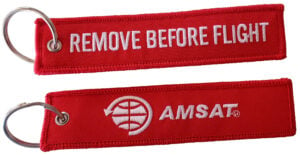
Your $20 Donation Goes to Help Fly a Fox-Plus Satellite
Includes First Class Postage (Sorry – U.S. Addresses Only)
Order Today at https://www.amsat.org/product/amsat-remove-before-flight-keychain
REMINDER: AMSAT Membership Now Includes “Getting Started” Guide
AMSAT is offering a limited-time promotion for new and renewing members that includes a free digital copy of Getting Started with Amateur Satellites. The promotion is being offered as AMSAT begins the 2026 membership year.
Anyone who joins or renews their AMSAT membership during the promotional period will receive a download link for the latest edition of Getting Started with Amateur Satellites in their membership confirmation email. The guide is designed to help radio amateurs understand the fundamentals of satellite operation and serves as a practical reference for both newcomers and operators returning to the hobby. Additional information about AMSAT membership is available at https://launch.amsat.org.

In addition to this limited-time promotion, AMSAT membership includes a subscription to The AMSAT Journal, access to archived issues, discounts on selected items in the AMSAT online store, and opportunities to participate in AMSAT elections, committees, awards programs, and other AMSAT activities and programs. Members may also access archived proceedings from past AMSAT Space Symposiums through the AMSAT member portal.
Beyond these tangible benefits, AMSAT membership supports the development, launch, and operation of amateur radio satellites, along with education and outreach efforts. Joining AMSAT is not just about individual benefits — it is about being part of the community that builds and operates amateur satellites for radio amateurs worldwide. As AMSAT looks ahead to 2026, the promotion helps launch another year of growth and opportunity for amateur radio in space.
[ANS thanks Drew Glasbrenner, KO4MA, AMSAT President for the above information.]
The 2026 President’s Club Coin is Now Here!
Help Support GOLF and FoxPlus.
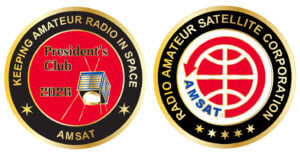
Annual memberships start at only $120
Join the AMSAT President’s Club today and help
Keep Amateur Radio in Space!
https://www.amsat.org/join-the-amsat-presidents-club/
NASA Marks 50 Years Of GOES Satellites
NOAA’s Geostationary Operational Environmental Satellites, or GOES programme started a revolution in meteorology and weather forecasting. With GOES-1, satellite-sourced weather data could be sourced without waiting for the satellite to pass overhead. Previous satellites could only provide data at the times they were passing overhead.
The first three GOES satellites carried an instrument called Visible and Infrared Spin-Scan Radiometer (VISSR). This instrument enabled meteorologists to collect a wider range of data as well as a fuller set of data than ever before. GOES-1 went up in 1974, with the next two arriving in the next five years
The second generation of GOES satellites added important weather observation instruments. With these, our understanding of phenomena such as El Niño and tropical storms improved greatly. Furthermore, beginning with GOES-7, an RF receiver was added as part of the Search and Rescue Satellite-Aided Tracking (SARSAT) system.
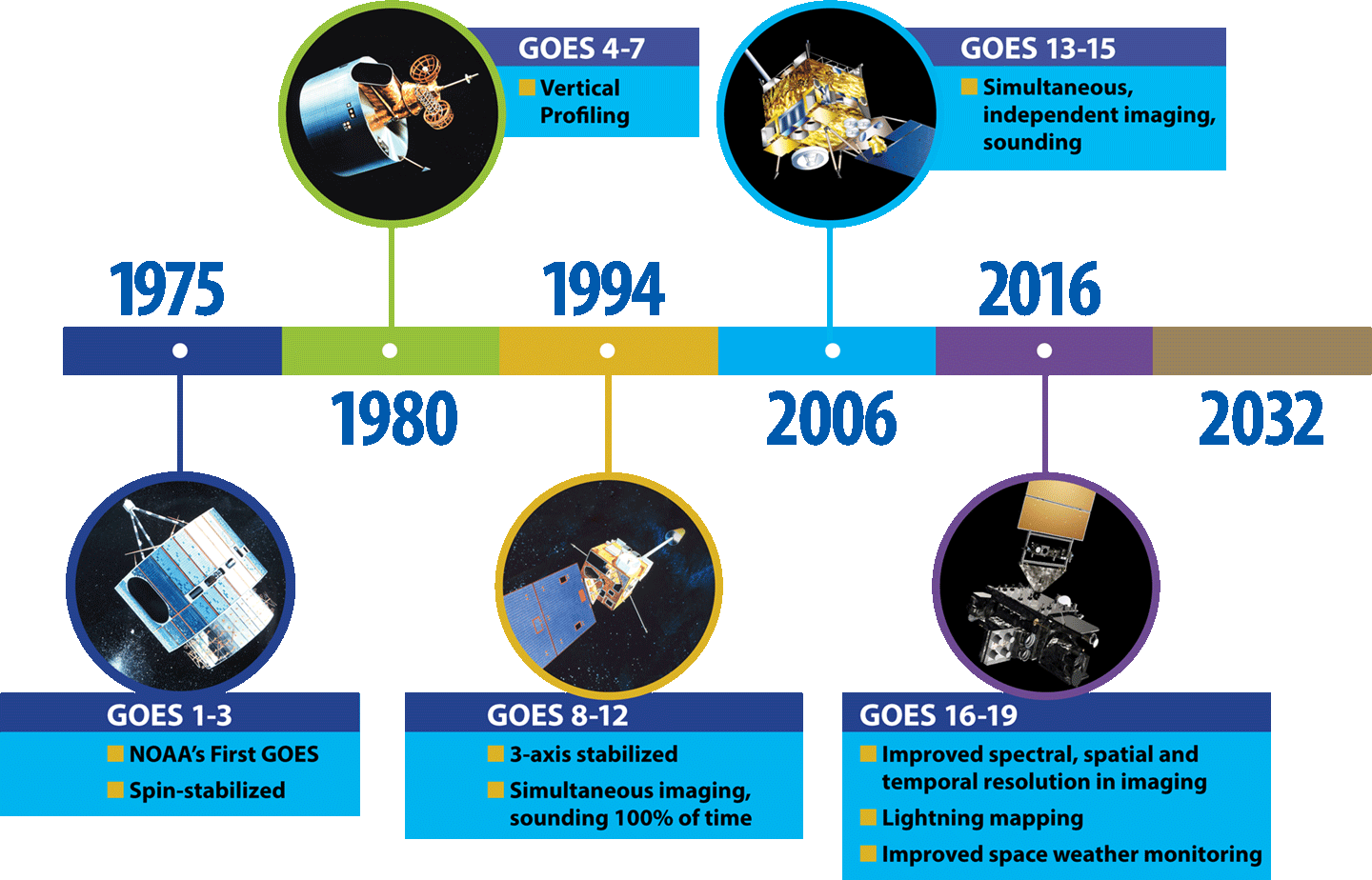
Timeline of GOES launches including key technological developments associated with each “generation” of satellites. (Figure credit: NOAA/NASA)
From 1994-2001, the third generation GOES satellites reached orbit. Innovations included the ability to narrow the area under observation to better understand local weather events. GOES-12 also included the Solar X-ray Imager (SXI) instrument, which added full-disk X-ray observations of the Sun to the toolkit of space weather watchers.
Gen 4 satellites, called GOES-N, ushered in improvements to positioning with star-tracker instruments. With these, the location of weather events could be more precisely determined. The Extreme Ultraviolet Sensor added to space weather observations. Scan rates were quickened to one-minute scans, which aided in understanding severe weather outbreaks and issuing warnings.
The current generation of GOES satellites, known as GOES-R, added a variety of capabilities. These satellites feature the ability to narrow in and zoom out from local to global views with a choice of scan rates. Fire-detection instruments were added for the first time ever on a geostationary satellite. Many hobbyists enjoy receiving direct L-band downlinks from these satellites.
[ANS thanks Orbital Today for the above information. See the full article at https://orbitaltoday.com/2025/12/26/nasa-marks-50-years-of-goes-satellites/.]
Need new satellite antennas?
Purchase M2 LEO-Packs from the AMSAT Store.
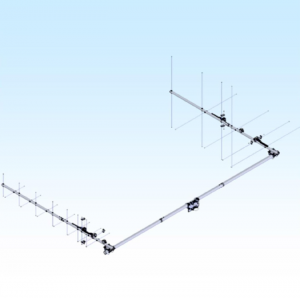
When you purchase through AMSAT, a portion of the proceeds goes towards
Keeping Amateur Radio in Space.
https://amsat.org/product-category/hardware/
VUCC Satellite Standings for January, 2026
VUCC Satellite Award/Endorsement Change Summary for December 01, 2025 to January 01, 2026.
| Callsign | Dec | Jan |
|---|---|---|
| PY2PIM | New | 1200 |
| RA3DNC | 599 | 824 |
| N8MR | 801 | 809 |
| AC9DX | 682 | 725 |
| HB9GWJ | 631 | 651 |
| VE4MM | 561 | 577 |
| N7UJJ | 462 | 509 |
| K5WO | 326 | 350 |
| N9XG | 310 | 312 |
| SV8CKM | 273 | 285 |
| PU5DDC | 241 | 254 |
| G4BWP | 150 | 200 |
| WD9EWK(DM42) | 189 | 194 |
| E75AA | New | 191 |
| WB5TX | 156 | 160 |
| IK2XRL | New | 140 |
| BY1QH | New | 126 |
| PT2VM | 100 | 126 |
| PU4ELT | New | 100 |
| PY3YO | New | 100 |
Congratulations to the new VUCC Satellite holders.
PY2PIM
E75AA
IK2XRL
BY1QH
PU4ELT
PY3YO
PY3YO is first VUCC Satellite holder from GG32
PY2PIM is first VUCC Satellite holder from GG67
PU4ELT is first VUCC Satellite holder from GH70
[ANS thanks Jon Goering, N7AZ, for the above information.]
DXCC Satellite Standings for January, 2026
DXCC Satellite Award/Endorsement Change Summary for December 01, 2025 to January 01, 2026.
| Call | Nov | Dec |
|---|---|---|
| HB9RYZ | 166 | 169 |
| IK4CIE | 146 | 157 |
| G8BCG | 135 | 154 |
| PA7RA | 148 | 154 |
| DL9RAN | 125 | 150 |
| IU0LFQ | 121 | 150 |
| IK1GPG | 100 | 144 |
| DL8GAM | 125 | 136 |
| LA0FA | 128 | 133 |
| ON6AA | 114 | 131 |
| W2GDJ | 122 | 123 |
| LA7XK | 110 | 118 |
| JK2XXK | New | 106 |
| I1YDT | New | 100 |
| YB5QZ | New | 100 |
Congratulations to the new DXCC Satellite holders.
YV5NEA
EA7Z
YV5NEA is first DXCC Satellite holder from Venezuela and FK60
EA7Z is first DXCC Satellite holder from IM67
[ANS thanks Jon Goering, N7AZ, for the above information.]

Changes to AMSAT TLE Distribution for January 9, 2026
Two Line Elements or TLEs, often referred to as Keplerian elements or keps in the amateur community, are the inputs to the SGP4 standard mathematical model of spacecraft orbits used by most amateur tracking programs. Weekly updates are completely adequate for most amateur satellites. TLE bulletin files are updated daily in the first hour of the UTC day. New bulletin files will be posted immediately after reliable elements become available for new amateur satellites. More information may be found at https://www.amsat.org/keplerian-elements-resources/.
The following satellite has been removed from this week’s AMSAT TLE distribution:
IO-86 NORAD Cat ID 40931. No new elements released for more than 180 days.
[ANS thanks Joe Fitzgerald, KM1P, AMSAT Orbital Elements Manager, for the above information.]
Two U.S. Schools/Organizations Moved Forward in ARISS Selection Process
Amateur Radio on the International Space Station (ARISS) is pleased to announce the U.S. schools/host organizations newly selected for 2026 ARISS contacts. A total of two of the submitted proposals during the recent proposal window have been accepted to move forward in the processes of planning to host a scheduled amateur radio contact with crew on the ISS. The primary goal of the ARISS program is to engage young people in Science, Technology, Engineering, Arts and Math (STEAM) activities and raise their awareness of space communications, radio communications, space exploration, and related areas of study and career possibilities.
The ARISS program anticipates that NASA will be able to provide scheduling opportunities for the two U.S. host organizations during the July – December 2026 period. They are now at work starting to implement their 4–6-month education plan which was outlined in their proposal. These STEAM based educational activities help prepare students for their contact as well as create an on-going exploration and interest in aerospace and amateur radio topics. They are also completing an acceptable equipment plan that demonstrates their ability to execute the ham radio contact. Once their equipment plan is approved by ARISS, the final selected schools/organizations will be scheduled as their availability and flexibility match up with the scheduling opportunities offered by NASA.
The school and host organization are:
- YOTA Summer Camp in Huntsville, AL seeking a contact date between June 14 – 19, 2026.
- University Heights School of Medical Arts in Jonesboro, AR seeking a contact date between July and December 2026.
Amateur Radio on the International Space Station (ARISS) is a cooperative venture of international amateur radio societies and the space agencies that support the ISS. In the United States, sponsors are the American Radio Relay League (ARRL), Amateur Radio Digital Communications (ARDC), Radio Amateur Satellite Corporation (AMSAT), NASA’s Space Communications and Navigation program (SCaN) and the ISS National Lab—Space Station Explorers. The primary goal of ARISS is to promote exploration of science, technology, engineering, the arts, and mathematics topics. ARISS does this by organizing scheduled contacts via amateur radio between crew members aboard the ISS and students. Before and during these radio contacts, students, educators, parents, and communities take part in hands-on learning activities tied to space, space technologies, and amateur radio. For more information, see http://www.ariss.org.
[ANS thanks Dave Jordan, AA4KN, ARISS PR, for the above information.]
ARISS News
Amateurs and others around the world may listen in on contacts between amateurs operating in schools and allowing students to interact with astronauts and cosmonauts aboard the International Space Station. The downlink frequency on which to listen is 145.800 MHz worldwide.
Scheduled Contacts
None scheduled for the coming week.
Many times a school may make a last minute decision to do a Livestream or run into a last minute glitch requiring a change of the URL but we at ARISS may not get the URL in time for publication. You can always check https://live.ariss.org/ to see if a school is Livestreaming.
As always, if there is an EVA, a docking, or an undocking; the ARISS radios are turned off as part of the safety protocol.
The crossband repeater continues to be active (145.990 MHz up {PL 67} & 437.800 MHz down), If any crew member is so inclined, all they have to do is pick up the microphone, raise the volume up, and talk on the crossband repeater. So give a listen, you just never know.
Service Module radio: Not in APRS configuration; only being used for voice contacts at this time. Default mode is for packet operations (145.825 MHz up & down) but occasionally used for SSTV (145.800 MHz down).
Ham TV – Configured. Default mode is for scheduled digital amateur television operations (2395.00 MHz).
Note, all times are approximate. It is recommended that you do your own orbital prediction or start listening about 10 minutes before the listed time.
The latest information on the operation mode can be found at https://www.ariss.org/current-status-of-iss-stations.html
The latest list of frequencies in use can be found at https://www.ariss.org/contact-the-iss.html
[ANS thanks Charlie Sufana, AJ9N, one of the ARISS operation team mentors for the above information.]
Want to fly the colors on your own grid expedition?
Get an AMSAT car flag and other neat stuff from our Zazzle store!
25% of the purchase price of each product goes towards Keeping Amateur Radio in Space
AMSAT Ambassador Activities
AMSAT Ambassadors provide presentations, demonstrate communicating through amateur satellites, and host information tables at club meetings, hamfests, conventions, maker faires, and other events.
February 13-15, 2026
HamCation
Central Florida Fairgrounds and Expo Park
4603 West Colonial Drive
Orlando, Florida 32808
AA4KN
March 21, 2026
Midwinter Madness Hamfest
Buffalo Civic Center
1306 County Rd 134
Buffalo Minnesota 55313
KØJM, ADØHJ
Interested in becoming an AMSAT Ambassador? AMSAT Ambassadors provide presentations, demonstrate communicating through amateur satellites, and host information tables at club meetings, hamfests, conventions, maker faires, and other events.
For more information go to: https://www.amsat.org/ambassador/
[ANS thanks Bo Lowrey, W4FCL, Director – AMSAT Ambassador Program, for the above information.]
Satellite Shorts from All Over
+ LACHIT-1 (Live Amateur Communication Hub for Innovative Technologies – One), the first satellite developed Assam Don Bosco University (ADBU) in Northeast India, is scheduled for launch aboard Indian Space Research Organisation’s (ISRO) PSLV-C62 rocket on January 12. The LACHIT-1 mission is a student-led initiative involving more than 50 students and faculty members drawn from across the Northeast, including Assam, Meghalaya, Nagaland, Arunachal Pradesh and Manipur states. The satellite will carry a UHF downlink using 2-FSK modulation at up to 9k6 kb with store and forward capability and a CW beacon. Frequencies for a telemetry and data downlink on 436.175 MHz and for the beacon on 435.360 MHz have been coordinated by the International Amateur Radio Union (IARU). (ANS thanks Northeast News and IARU for the above information.)
+ A live Satellite Communication Demonstration with the International Space Station (ISS) was successfully conducted in Pransla village, Gujarat (India) on 29 December 2025 with more than 12,000 students assembled. The live science and space outreach program was conducted with the active support of AMSAT-INDIA and Upagraha Amateur Radio Club (UpARC) at Indian Space Research Organisation’s U R Rao Satellite Centre. Basic concepts like ham radio, satellite communication, uplink & downlink, azimuth, elevation, frequencies, etc., and satellite tracking were explained so students could understand the upcoming live ISS pass. Three confirmed two-way contacts were made during the single ISS pass before what may be one of the largest crowds ever assembled for a satellite demonstration. (ANS thanks Rajesh Vagadia, VU2EXP, Regional Coordinator – AMSAT-INDIA, for the above information.)
+ 2025 was a banner year for shattering launch records worldwide. The 324 orbital launch attempts in 2025 represented a 25% increase from 2024’s previous record of 259. Almost 60% of all launch attempts came from the U.S., with SpaceX conducting 170 of the 193 American launches. China was second with 92 launches during the year. (ANS thanks SpaceNews for the above information.)
+ SpaceX is lowering orbits of 4,400 Starlink satellites to 480km throughout 2026, reducing ballistic decay time by 80% and preventing orbital debris accumulation risks. Lower altitude decreases collision risk in increasingly crowded low Earth orbit. Deorbiting faster prevents long-term orbital contamination. Massive orbital reconfiguration represents proactive response to congestion challenges. Nearly half of Starlink’s 9,400 operational satellites will require altitude adjustment. The current 550-kilometer orbit sits within crowded debris-prone region. The proposed 480-kilometer altitude places satellites in a less congested orbital band. (ANS thanks NASA Space News for the above information. Read the full story at https://nasaspacenews.com/2026/01/spacex-lowering-orbits/.)
+ AMSAT-UK are pleased to announce they will be holding a webinar to advise European amateurs regarding the ESA / CCSDS sponsored outreach competition to develop reference protocols at 16:00 UTC on Wednesday 14th January. The webinar will be via Zoom and the event will be recorded. NOTE: this competition is for European and UK hams only. For information and registration see https://amsat-uk.org/2026/01/06/webinar-for-ccsds-competition/. (ANS thanks AMSAT-UK for the above information.)
Join AMSAT today at https://launch.amsat.org/
In addition to regular membership, AMSAT offers membership to:
- Societies (a recognized group, clubs or organization).
- Students are eligible for FREE membership up to age 25.
- Memberships are available for annual and lifetime terms.
Contact info [at] amsat.org for additional membership information.
73 and remember to help Keep Amateur Radio in Space!
This week’s ANS Editor,
Mark Johns, KØJM
mjohns [at] amsat.org
ANS is a service of AMSAT, the Radio Amateur Satellite Corporation, 712 H Street NE, Suite 1653, Washington, DC 20002
AMSAT is a registered trademark of the Radio Amateur Satellite Corporation.