AMSAT News Service
ANS-341
December 7, 2025
In this edition:
* KSLV-II Mission Deploys 13 Satellites, Including New Amateur Radio Payloads
* ISS Deployment Added Five New Education-Focused Amateur Radio Missions
* ARISS Moves Series 30 SSTV Transmissions to RS-38S After Equipment Issue
* GridMasterMap Satellite Top 100 Rovers December 2025 Rankings
* Changes to AMSAT-NA TLE Distribution for December 5, 2025
* ARISS News
* AMSAT Ambassador Activities
* Satellite Shorts From All Over
The AMSAT® News Service bulletins are a free, weekly news and information service of AMSAT, The Radio Amateur Satellite Corporation. ANS publishes news related to Amateur Radio in Space including reports on the activities of a worldwide group of Amateur Radio operators who share an active interest in designing, building, launching and communicating through analog and digital Amateur Radio satellites.
The news feed on https://www.amsat.org publishes news of Amateur Radio in Space as soon as our volunteers can post it.
Please send any amateur satellite news or reports to: ans-editor [at] amsat.org
You can sign up for free e-mail delivery of the AMSAT News Service Bulletins via the ANS List; to join this list see: https://mailman.amsat.org/postorius/lists/ans.amsat.org/
KSLV-II Mission Deploys 13 Satellites, Including New Amateur Radio Payloads
South Korea recorded another significant achievement in its growing domestic space program with the successful nighttime launch of the Korea Space Launch Vehicle-II (KSLV-II), also known as Nuri, from the Naro Space Center in Goheung, South Korea. Liftoff occurred at 16:13 UTC on 26 November 2025 after a brief delay caused by an abnormal pressure-sensor signal in the rocket’s umbilical system. After the anomaly was resolved, Nuri ascended smoothly and became South Korea’s first orbital launch conducted during nighttime operations.
The vehicle performed nominally throughout ascent, completing stage separations on schedule and surpassing the 500 km mark roughly seven minutes after liftoff. Orbit insertion occurred approximately twelve minutes into the flight, followed one minute later by the deployment of CAS500-3, a 500-kilogram scientific satellite designed for highly light-sensitive Earth-observation missions. Korea Aerospace Administration (KASA) officials confirmed multiple ground-station contacts with CAS500-3 during its first day on orbit, including passes over the King Sejong Station in Antarctica.
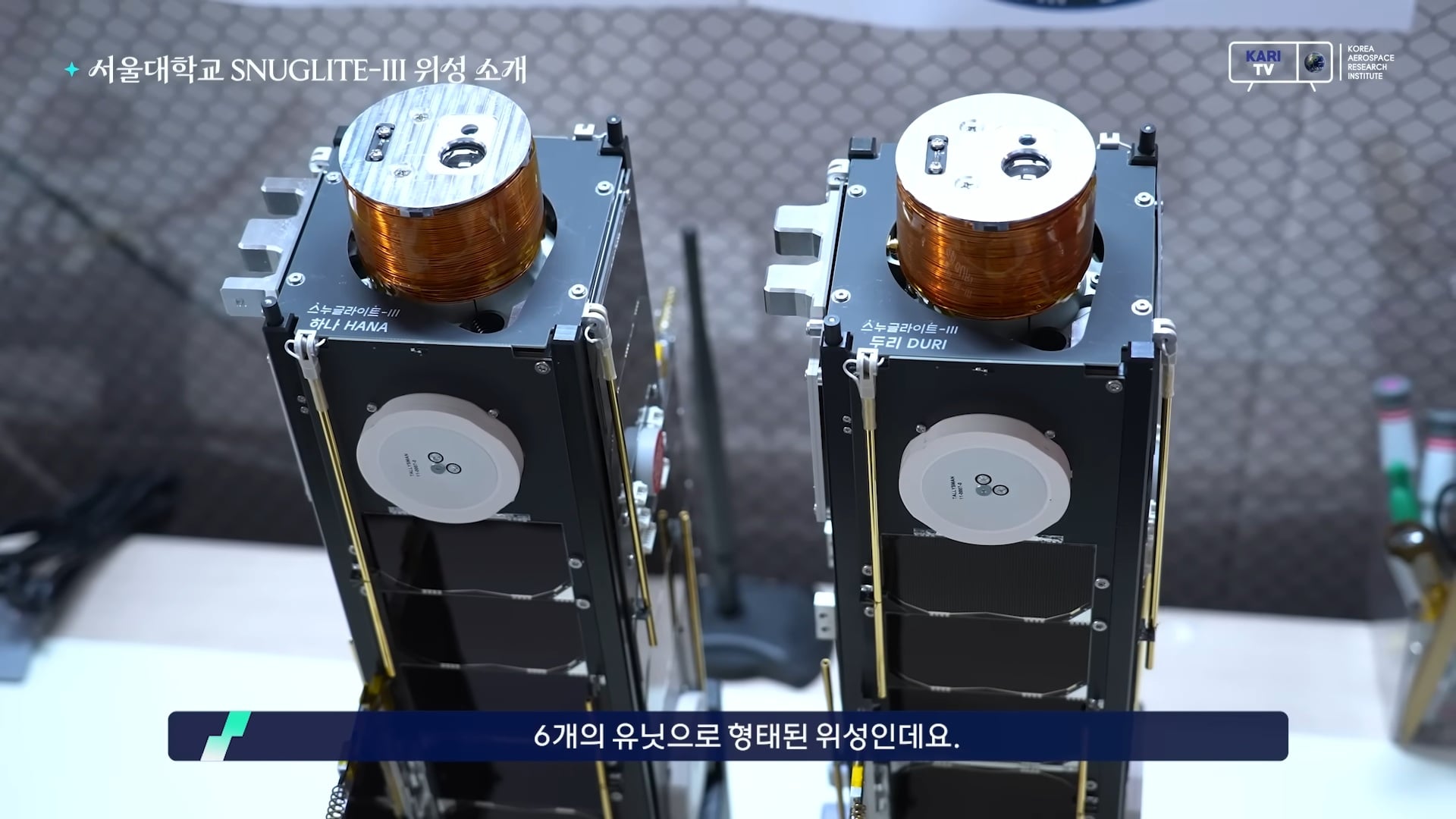
Following the primary payload, Nuri deployed twelve CubeSats, nine of which operate in the amateur UHF bands. Of these, three satellites were fully IARU-coordinated. The twin SNUGLITE-III CubeSats—HANA (436.460 MHz) and DURI (436.788 MHz)—developed by Seoul National University, each carry a 9600-bps GMSK AX.25 digipeater, UHF beacons, and an S-band imaging payload at 2405.000 MHz. These spacecraft support amateur-radio training, GPS-RO technology demonstrations, and formation-flying experiments. The third coordinated payload, SPIRONE (436.650 MHz / 2425.100 MHz) from Sejong University, combines an environmental mission to detect marine plastic with a GMSK beacon and an S-band transponder intended for amateur-radio experimentation.
This launch also reflects South Korea’s broader strategy of strengthening its commercial aerospace ecosystem. For the first time, primary launch-operation responsibility was handled by Hanwha Aerospace, marking a transition toward greater private-sector involvement in national space access. Despite a two-and-a-half-year gap since the previous Nuri flight, Hanwha and its partners maintained launch readiness and executed the mission successfully—an encouraging sign for Korea’s long-term space-industry development.
KASA plans at least two additional Nuri launches through 2027, with the goal of supporting annual flights thereafter and ultimately developing a next-generation booster capable of heavier payloads and deep-space missions. For the amateur-satellite community worldwide, the KSLV-II program’s demonstrated ability to deploy large numbers of small spacecraft—including coordinated amateur payloads—is a promising development, expanding future rideshare opportunities and adding new signals to monitor across UHF and S-band.
Read the full article at: https://www.koreaherald.com/article/10624440 and Libre Space discussion at: https://community.libre.space/t/kslv-2-cas500-3-mission-2025-11-26-16-13-utc/14043
[ANS thanks Kan Hyeong-woo, The Korea Herald, and the Libre Space community, for the above information]
ISS Deployment Added Five New Education-Focused Amateur Radio Missions
Seven satellites were deployed from the International Space Station on December 2, 2025, with release times spanning 08:10 UTC to 09:50 UTC in three batches using the Voyager Space NanoRacks CubeSat Deployer (NRCSD) system. Five of the deployed spacecraft—SilverSat, RHOK-SAT, Content-Cube, EagleSat-2, and Foras Promineo—operate on amateur radio frequencies and represent a broad collection of university, student-led, and educational missions. SatNOGS stations scheduled more than 700 observations during the first 24 hours as the satellites drifted away from the ISS to form their initial orbits, requiring careful Doppler evaluation and coordinated tracking during the early identification phase.
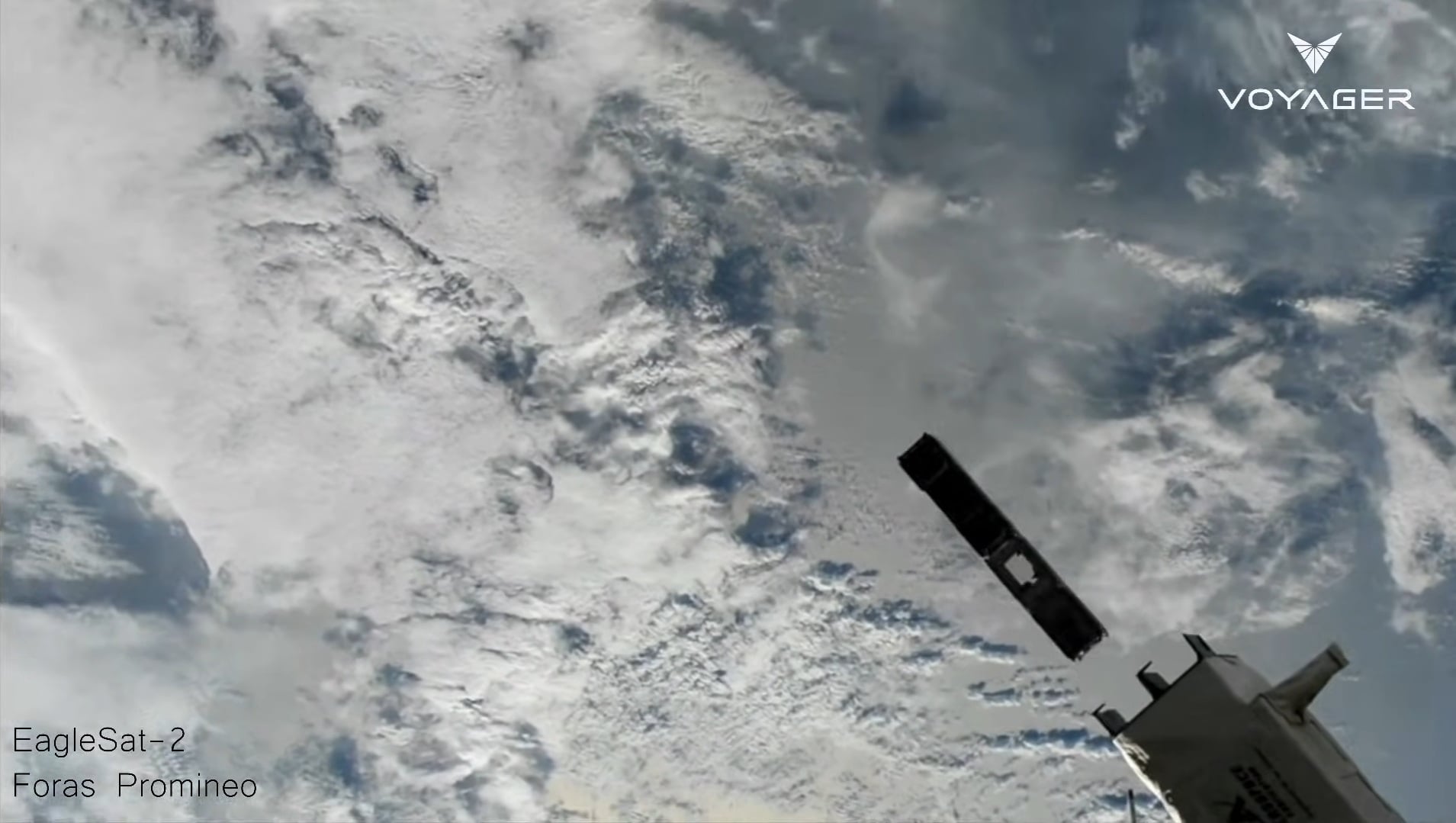
The first release at 08:10 UTC deployed the 6U DUPLEX satellite, which does not carry an amateur-radio payload. A second deployment window at 08:20 UTC released four 1U spacecraft: SilverSat, RHOK-SAT, Content-Cube, and CU-Alpha. Of these, CU-Alpha operates outside the amateur bands using LoRa at 915 MHz. The final release at 09:50 UTC deployed the two 3U amateur missions, EagleSat-2 and Foras Promineo, completing the NRCSD-29 sequence.
SilverSat, a 1U open-source CubeSat designed to inspire student interest in space science and engineering, was the first amateur satellite from NRCSD-29 to be positively heard on orbit. The spacecraft automatically relays images and telemetry to its ground network, which posts them to social-media platforms whenever a pass is received. European stations reported early carrier traces shortly after deployment, and the first confirmed CW beacon—sent at 16 WPM under the callsign “WP2XGW”—was received at approximately 14:46 UTC. SilverSat uses a UHF turnstile antenna oriented perpendicular to its magnetically stabilized axis, producing LHCP reception for most northern observers.
The 08:20 UTC deployment batch also included RHOK-SAT, Content-Cube, and a 1U CubeSat from Cornell University carrying a brief-duration light-sail experiment designed by students at the Space Systems Design Studio. The sail will be released during a later activation sequence following the CubeSat’s deployment and carries several ChipSat flight computers intended to transmit LoRa telemetry in the 70 cm amateur band during a short operational period. Because the timing of the sail’s release depends on mission conditions, additional details about the project and its ChipSat technology are available at alphacubesat.cornell.edu. Telemetry downlinks for this group include 435.425 MHz for RHOK-SAT (9600 FSK), 437.020 MHz for Content-Cube (9600 GMSK), and 437.400 MHz for the ChipSats, which may remain active only for hours to a few days before re-entry.
The two 3U satellites, EagleSat-2 and Foras Promineo, completed the deployments at 09:50 UTC. EagleSat-2, developed by undergraduate students at Embry-Riddle Aeronautical University, carries two scientific experiments: the Cosmic Ray Payload, designed to track high-energy particle interactions across three observation phases, and the Memory Degradation Experiment, which compares radiation-induced error rates in several CMOS memory technologies. EagleSat-2 transmits on 437.165 MHz using 19k2 2-GFSK. Foras Promineo supports a public-outreach mission based on an interactive robotic-arm game that operates autonomously or under real-time command during ground passes, transmitting LoRa telemetry on 437.400 MHz.
As of the first day of operations, SatNOGS contributors reported active tracking of all five amateur satellites using preliminary TLEs derived from ISS deployment vectors. With the objects initially clustered closely together, early identification required coordinated Doppler measurements and community-supported observation campaigns. As tracking continues to refine and the satellites separate further, operators can expect more reliable beacon reception and additional opportunities for amateur participation as the missions begin their operational phases.
Read the NRCSD29 ISS Satellites Deployment Libre Space discussion at: https://community.libre.space/t/nrcsd29-iss-satellites-deployment-2025-12-02-08-28-utc/14045
[ANS thanks AMSAT-Francophone and the Libre Space community for the above information]
Only 3 Weeks Left to Get Your Coin!
Celebrate the 40th Anniversary of Amateur Radio on Human Spaceflight
Help Support GOLF and FoxPlus.
Annual memberships start at only $120
Join the AMSAT President’s Club today and help
Keep Amateur Radio in Space!
https://www.amsat.org/join-the-amsat-presidents-club/
ARISS Moves Series 30 SSTV Transmissions to RS-38S After Equipment Issue
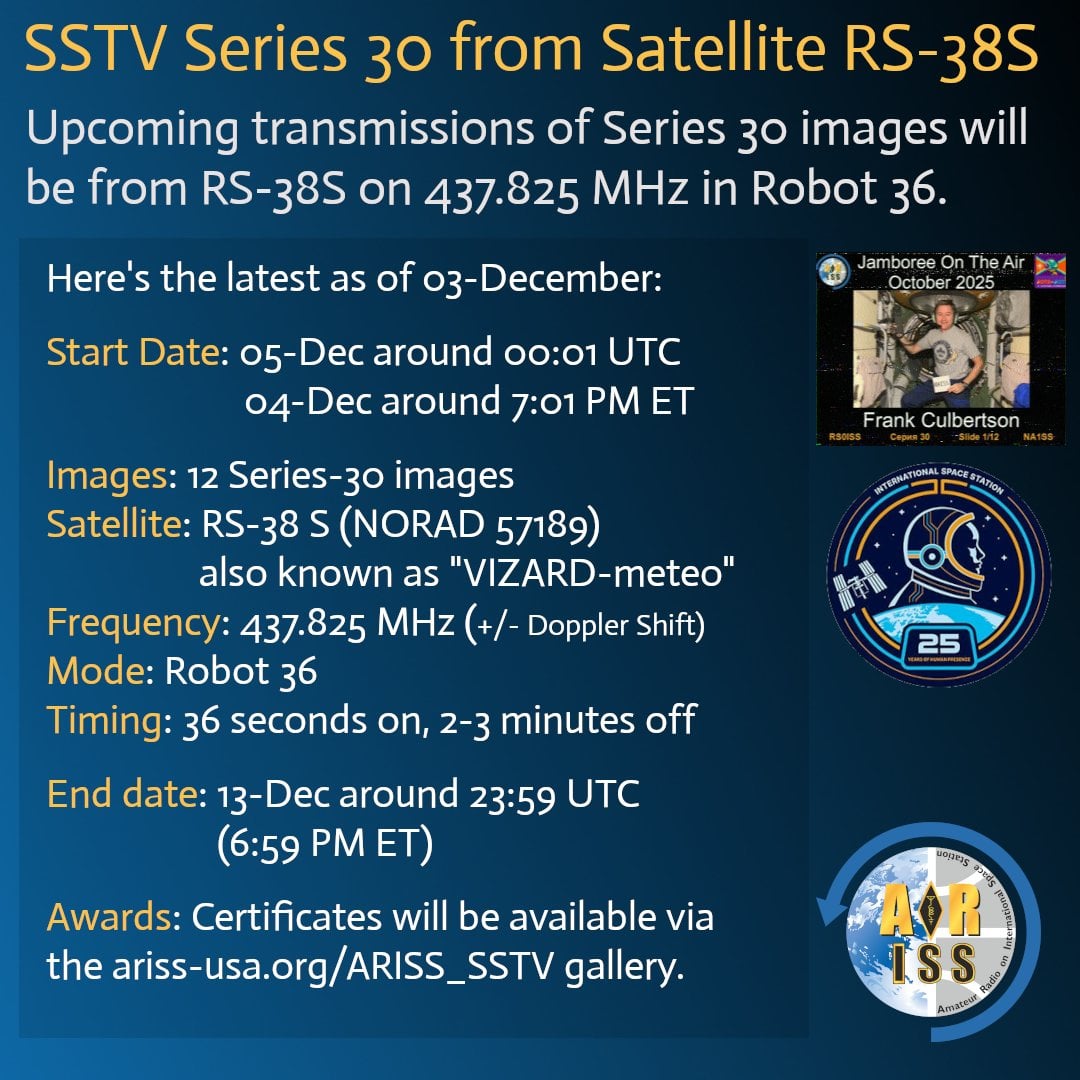
Amateur Radio on the International Space Station (ARISS) has released final scheduling details for the Series 30 Slow-Scan Television retransmission event, which will take place using the RS-38S satellite rather than the ISS. Transmissions are scheduled to begin on 5 December at 00:01 UTC (4 December at 7:01 PM ET) and continue through 13 December at 23:59 UTC. The images will be broadcast from RS-38S, also known as VIZARD-meteo and listed under NORAD 57189, on a downlink of 437.825 MHz with normal Doppler adjustments. Each image will be sent in Robot 36 mode for approximately 36 seconds, followed by a silence period of two to three minutes. Operators may upload their received images to the ARISS SSTV gallery to obtain a new Series 30-1 certificate tailored for the RS-38S event. The satellite can be monitored on amsat.org/status under its VIZARD-meteo entry, and pass-prediction tools are available at amsat.org/pass-prediction for those planning reception attempts.
The RS-38S retransmission provides amateurs an opportunity to receive all 12 Series 30 images after the ISS-based event in November was interrupted by a hardware issue. ARISS announced on 29 November that the RS-38S spacecraft would transmit the same Series 30 imagery during the period of 5–13 December, offering a complete replacement opportunity. This announcement was well received by participants who were unable to capture images during the short ISS transmission window on 12 November. As with previous SSTV events, stations may submit their best frames to the ARISS gallery and request corresponding certificates. The retransmission preserves the commemorative nature of Series 30 while operating entirely independent of ISS hardware. ARISS encourages operators worldwide to monitor its official channels for updates throughout the event period.
The satellite-based activity follows a series of technical difficulties that prevented completion of the original Series 30 event aboard the International Space Station. The ISS transmissions began on 12 November with approximately two hours of successful downlink activity, during which several stations worldwide decoded and uploaded clean images. Soon afterward, SSTV activity on 145.800 MHz FM abruptly stopped, prompting ARISS to acknowledge the outage and begin checking the system status with operations teams on the ground. Crew schedules and limited immediate access to the Service Module hardware initially slowed the troubleshooting process. Operators monitored the downlink throughout the day, but no additional frames were received. ARISS provided real-time updates confirming the outage and advising listeners that further checks were underway.
By 15 November, ARISS reported that the SSTV system had remained offline since the initial interruption and that ongoing solar activity added complexity to assessments of the Service Module equipment. U.S. teams awaited additional information, and only the early decodes from the opening hours of the event appeared in the official SSTV gallery. ARISS thanked operators for their continued patience and reminded them that certificates would still be issued for the initial images. Amateur radio stations worldwide continued to submit signal reports and monitor each ISS pass in hopes of renewed activity. Despite broad interest, no additional transmissions were detected. ARISS stated it would continue providing updates as new information became available.
On 16 November, after three days of analysis, ARISS confirmed that the ISS-based Series 30 event could not continue. The Kenwood D710GA transceiver in the Zvezda Service Module, which supports SSTV operations, appeared to have failed and was taken offline for further review. ARISS reported that the radio functioned normally for approximately two hours before the issue occurred, ending downlink activity for the remainder of the planned 12–20 November window. Operators who received images early in the event were encouraged to upload their frames before the submission deadline to qualify for Series 30 certificates. ARISS emphasized that those certificates would still be honored despite the shortened schedule. No additional transmissions were expected until testing of the affected hardware could be completed.
A follow-on update on 21 November clarified the status of the Service Module radio system. ARISS reported that the faulty Kenwood D710GA had been replaced with the onboard spare Kenwood D710E, which is now supporting scheduled Russian school contacts and required backup communications. Additional in-orbit testing of the original D710GA is planned to determine the cause of the failure and evaluate when APRS or SSTV capabilities might be restored. ARISS also confirmed that the Columbus module radio systems, including the cross-band FM repeater and HamTV equipment, continue to operate normally. Restoration of SSTV service from the ISS will depend on the results of continued hardware assessments. Until those evaluations are complete, ISS-based SSTV remains offline, and the RS-38S retransmission provides the primary means for operators to receive the full Series 30 imagery.
[ANS thanks Amateur Radio on the International Space Station (ARISS) for the above information]
GridMasterMap Satellite Top 100 Rovers December 2025 Rankings
The December 2025 rankings for the Top 100 Rovers (Mixed LEO/MEO/GEO) in satellite operations, as determined by @GridMasterMap on Twitter, has been released. The ranking is determined by the number of grids and DXCC entities activated, taking into account only those grids where a minimum number of QSOs logged on the gridmaster.fr website have been validated by a third party. Grid numbers do not directly reflect the exact number of activations. Satellite operators are encouraged to upload their LoTW satellite contacts to https://gridmaster.fr in order to provide more accurate data.
Updated: 2025-12-02
| 1 | ND9M | 26 | KX9X | 51 | KE0PBR | 76 | SP5XSD |
| 2 | NJ7H | 27 | KG5CCI | 52 | WD5GRW | 77 | DL4EA |
| 3 | UT1FG | 28 | DJ8MS | 53 | XE3DX | 78 | N6UTC |
| 4 | JA9KRO | 29 | N5BO | 54 | W7WGC | 79 | N4UFO |
| 5 | N5UC | 30 | ON4AUC | 55 | LU4JVE | 80 | VE7PTN |
| 6 | F5VMJ | 31 | K8BL | 56 | JK2XXK | 81 | PT2AP |
| 7 | DL6AP | 32 | KE4AL | 57 | PR8KW | 82 | VE1VOX |
| 8 | WI7P | 33 | KB5FHK | 58 | EB1AO | 83 | AA8CH |
| 9 | K5ZM | 34 | AC0RA | 59 | XE1ET | 84 | KB2YSI |
| 10 | DP0POL | 35 | PA3GAN | 60 | EA4NF | 85 | KI7UXT |
| 11 | OE3SEU | 36 | KI0KB | 61 | N6DNM | 86 | AF5CC |
| 12 | WY7AA | 37 | F4BKV | 62 | W8LR | 87 | KJ7NDY |
| 13 | N6UA | 38 | KI7UNJ | 63 | W1AW | 88 | BI1MHK |
| 14 | HA3FOK | 39 | VA3VGR | 64 | KI7QEK | 89 | PT9BM |
| 15 | LU5ILA | 40 | JO2ASQ | 65 | SM3NRY | 90 | FG8OJ |
| 16 | W5PFG | 41 | VE3HLS | 66 | KE9AJ | 91 | YU0W |
| 17 | AK8CW | 42 | BG7QIW | 67 | F4DXV | 92 | BG5CZD |
| 18 | N9IP | 43 | HJ5LVR | 68 | VE1CWJ | 93 | PU4CEB |
| 19 | AD0DX | 44 | LA9XGA | 69 | AA5PK | 94 | W8MTB |
| 20 | AD0HJ | 45 | VK5DG | 70 | AD7DB | 95 | N4DCW |
| 21 | DL2GRC | 46 | N7AGF | 71 | KM4LAO | 96 | WA9JBQ |
| 22 | N4AKV | 47 | K7TAB | 72 | M1DDD | 97 | BA8AFK |
| 23 | ND0C | 48 | DF2ET | 73 | HB9GWJ | 98 | VE3GOP |
| 24 | WD9EWK | 49 | JL3RNZ | 74 | VA7LM | 99 | JM1CAX |
| 25 | BA1PK | 50 | KE0WPA | 75 | N8RO | 100 | PS8BR |
[ANS thanks @GridMasterMap for the above information]
AMSAT Remove Before Flight Key Tags Now Available
Yes, These are the Real Thing!
Your $20 Donation Goes to Help Fly a Fox-Plus Satellite
Includes First Class Postage (Sorry – U.S. Addresses Only)
Order Today at https://www.amsat.org/product/amsat-remove-before-flight-keychain
Changes to AMSAT TLE Distribution for December 5, 2025
Two Line Elements or TLEs, often referred to as Keplerian elements or keps in the amateur community, are the inputs to the SGP4 standard mathematical model of spacecraft orbits used by most amateur tracking programs. Weekly updates are completely adequate for most amateur satellites. TLE bulletin files are updated daily in the first hour of the UTC day. New bulletin files will be posted immediately after reliable elements become available for new amateur satellites. More information may be found at https://www.amsat.org/keplerian-elements-resources/.
The following satellites have been added to this week’s AMSAT TLE Bulletin:
SPIRONE NORAD Cat ID 66657
K-HERO NORAD Cat ID 66660
[ANS thanks Joe Fitzgerald, KM1P, AMSAT Orbital Elements Manager, for the above information.]
ARISS News
Amateurs and others around the world may listen in on contacts between amateurs operating in schools and allowing students to interact with astronauts and cosmonauts aboard the International Space Station. The downlink frequency on which to listen is 145.800 MHz worldwide.
Scheduled Contacts
+ Recently Completed
Istituto Di Istruzione Superiore “Il Tagliamento” Di Spilimbergo / Istituto Comprensivo “G. Mazzini”, Spilimbergo, Italy, telebridge via IK1SLD
The ISS callsign was OR4ISS
The scheduled crewmember was Zena Cardman KJ5CMN
The ARISS mentors were IZ2GOJ and IKØWGF
Contact was successful: Fri 2025-11-28 11:40:17 UTC
Congratulations to the Istituto Di Istruzione Superiore “Il Tagliamento” Di Spilimbergo (Pn) and Istituto Comprensivo “G. Mazzini” students, Zena, mentors IZ2GOJ and IKØWGF, and telebridge via IK1SLD!
Watch the Livestream at https://www.ariotti.com/ and https://www.youtube.com/live/MgG7kcYvxWM
Russian State Agrarian University – Moscow Agricultural Academy named after K.A. Timiryazev, Moscow, Russia, direct via TBD
The ISS callsign was RSØISS
The scheduled crewmember was Sergey Kud-Sverchkov
The ARISS mentor was RV3DR
Contact was successful: Fri 2025-12-05 11:00 UTC
Congratulations to the students of the Russian State Agrarian University – Moscow Agricultural Academy, Sergey Kud-Sverchkov, and mentor RV3DR on a successful contact!
Lincoln Magnet School, Springfield, Illinois, direct via K9OK
The ISS callsign was NA1SS
The scheduled crewmember was Jonathan (Jonny) Kim KJ5HKP
The ARISS mentor was AJ9N
Contact was successful: Fri 2025-12-05 15:29:41 UTC
Congratulations to the students of Lincoln Magnet School, Jonathan (Jonny) Kim KJ5HKP, and mentor AJ9N on a successful contact!
+ Upcoming Contacts
None currently scheduled
Many times a school may make a last-minute decision to do a Livestream or run into a last-minute glitch requiring a change of the URL but we at ARISS may not get the URL in time for publication. You can always check https://live.ariss.org/ to see if a school is Livestreaming.
As always, if there is an EVA, a docking, or an undocking; the ARISS radios are turned off as part of the safety protocol.
The crossband repeater remains configured in the Columbus Module (145.990 MHz up {PL 67} & 437.800 MHz down). If a crewmember decides to pick up the microphone and turn up the volume, you may hear them on the air—so keep listening, as you never know when activity might occur.
The service module IORS is not currently in APRS configuration and is being used only for voice contacts at this time. HamTV in the Columbus Module is configured for scheduled digital amateur television operations on 2395.00 MHz.
Note, all times are approximate. It is recommended that you do your own orbital prediction or start listening about 10 minutes before the listed time.
The latest information on the operation mode can be found at https://www.ariss.org/current-status-of-iss-stations.html
The latest list of frequencies in use can be found at https://www.ariss.org/contact-the-iss.html
[ANS thanks Charlie Sufana, AJ9N, one of the ARISS operation team mentors for the above information.]
AMSAT Ambassador Activities
AMSAT Ambassadors provide presentations, demonstrate communicating through amateur satellites, and host information tables at club meetings, hamfests, conventions, maker faires, and other events.
AMSAT Ambassador Clint Bradford, K6LCS, says,
“Think a 75-minute presentation on “working the easy satellites” would be appropriate for your club or event? Let me know by emailing me at k6lcsclint (at) gmail (dot) com or calling me at 909-999-SATS (7287)!”
Clint has NEVER given the exact same show twice: EACH of the 150+ presentations so far has been customized/tailored to their audiences.
Scheduled Events
None currently scheduled.
For more information go to: https://www.amsat.org/ambassador/
[ANS thanks Bo Lowrey, W4FCL, Director – AMSAT Ambassador Program, for the above information.]
Want to fly the colors on your own grid expedition?
Get an AMSAT car flag and other neat stuff from our Zazzle store!
25% of the purchase price of each product goes towards Keeping Amateur Radio in Space
Satellite Shorts from All Over
+ For the first time in its 25-year history, the International Space Station had all eight docking ports occupied following the reinstallation of Northrop Grumman’s Cygnus XL cargo spacecraft on the Unity module. The visiting spacecraft complement included two SpaceX Dragons, JAXA’s HTV-X1, Cygnus XL, two Soyuz crew vehicles, and the Progress 92 and 93 cargo ships. The Cygnus relocation was coordinated by NASA, Northrop Grumman, and Roscosmos to provide proper clearance for the Soyuz MS-28 spacecraft, which arrived last week. Cygnus XL will remain attached until no earlier than March 2026, when it is scheduled to depart with approximately 11,000 pounds of trash for a destructive re-entry. Meanwhile, the Expedition 73 crew continued a full schedule of research activities as the newly arrived Soyuz MS-28 crew members began long-duration studies focused on human physiology in microgravity. The station is expected to transition to Expedition 74 on December 8 when three MS-27 crew members—NASA astronaut Jonny Kim and Roscosmos cosmonauts Sergey Ryzhikov and Alexey Zubritsky—undock for their return to Earth. (ANS thanks NASA for the above information)
+ Ham Satting, a new multi-platform satellite-tracking and logging application developed by Yousuf Al Balushi, A46UNX, has officially launched on the Apple App Store, bringing a consolidated suite of real-time visualization, pass-prediction, and operating tools to amateur satellite enthusiasts. The app tracks the ISS and more than 20 amateur satellites using an interactive live map with dynamic icons, integrated N2YO data, and improved reliability features introduced in recent updates. Pass-prediction capabilities include precise AOS/LOS times, duration, azimuth, elevation, and quality indicators, complemented by a timeline view that organizes multiple satellite passes into clear, easy-to-read tables for mission planning. Operators can log QSOs locally, filter and export entries, map both home and mobile QTH locations, and track grid squares for VUCC award progress through built-in location-mapping tools. Additional utilities include smart notifications for upcoming passes, calendar integration, customizable satellite lists, and interface refinements aimed at streamlining portable operating and roving. While iOS marks the first full public release, beta versions are already available for Android, Windows, and macOS, with a Linux edition planned soon via unixeer.com. (ANS thanks Yousuf AL Balushi, A46UNX, for the above information)
+ NASA is once again offering the public a chance to “fly” around the Moon by submitting their names for inclusion on a digital boarding pass that will travel aboard Artemis II. The names will be stored on an SD card inside the Orion spacecraft when four astronauts—Reid Wiseman, Victor Glover, Christina Koch, and Canada’s Jeremy Hansen—undertake the first crewed flight of the Artemis program in 2026. Participants can sign up by providing a first name, last name, and a 4- to 7-digit PIN, which is needed later to retrieve the boarding pass. Artemis II will be a roughly 10-day mission launching from Kennedy Space Center, first performing system checkouts before sending the crew on a looping figure-eight trajectory around the far side of the Moon. The flight will evaluate Orion’s performance, carry research payloads on radiation and human health, and help prepare for future lunar surface missions. Sign-ups and details are available at https://www3.nasa.gov/send-your-name-with-artemis/. (ANS thanks NASA for the above information)
+ Time on Mars runs slightly faster than on Earth, according to new calculations by NIST researchers Neil Ashby and Bijunath Patla, who found that clocks on the Martian surface gain about 477 microseconds per day relative to terrestrial time. The difference arises from Mars’ weaker surface gravity, highly elliptical orbit, and changing distance from the Sun and the Earth–Moon system, all of which alter the rate at which clocks tick under general relativity. Although the offset amounts to less than a millisecond per day, modern navigation and communication systems—such as GPS and future Mars-based networks—require timing precision far tighter than a microsecond. The effect is also not constant: depending on Mars’ orbital position, the daily time gain can vary by as much as 226 microseconds. As planning advances for autonomous rover operations, relay satellites, and eventual crewed missions, engineers will need to incorporate these relativistic corrections to prevent timing drift and data inconsistencies. Ashby and Patla’s work, published December 1 in The Astronomical Journal, represents an early step toward establishing accurate and stable time standards for interplanetary operations. (ANS thanks Space.com for the above information)
Join AMSAT today at https://launch.amsat.org/
In addition to regular membership, AMSAT offers membership to:
- Societies (a recognized group, clubs or organization).
- Students enrolled in at least half-time status are eligible for free membership to age 25.
- Memberships are available for annual and lifetime terms.
Contact info [at] amsat.org for additional membership information.
73 and remember to help Keep Amateur Radio in Space!
This week’s ANS Editor,
Mitch Ahrenstorff, ADØHJ
mahrenstorff [at] amsat.org
ANS is a service of AMSAT, the Radio Amateur Satellite Corporation, 712 H Street NE, Suite 1653, Washington, DC 20002
AMSAT is a registered trademark of the Radio Amateur Satellite Corporation.