
AMSAT News Service
ANS-081 March 22, 2026
In this edition:
* Digital Modes on FO-29 Not Permitted per Licensing Restrictions
* Ten-Koh 2 Satellite With Linear Transponder Update
* Catsat Request for Activation
* SpaceX Plan For 1 Million Centers Poses Dangerous Risk
* Changes to AMSAT-NA TLE Distribution
* Astronauts Complete Prep For New ISS Solar Array
* ARISS News
* AMSAT Ambassador Activities
* Satellite Shorts From All Over
The AMSAT® News Service bulletins are a free, weekly news and information service of AMSAT, The Radio Amateur Satellite Corporation. ANS publishes news related to Amateur Radio in Space including reports on the activities of a worldwide group of Amateur Radio operators who share an active interest in designing, building, launching and communicating through analog and digital Amateur Radio satellites.
The news feed on https://www.amsat.org publishes news of Amateur Radio in Space as soon as our volunteers can post it.
Please send any amateur satellite news or reports to: ans-editor [at] amsat.org
You can sign up for free e-mail delivery of the AMSAT News Service Bulletins via the ANS List; to join this list see: https://mailman.amsat.org/postorius/lists/ans.amsat.org/
Digital Modes on FO-29 Not Permitted per Licensing Restrictions
Fuji-OSCAR 29 (FO-29 / JAS-2), the Japanese amateur radio satellite launched in August 1996, has entered a period of full sunlight, resulting in renewed and more frequent transponder activity. The inverting analog transponder operates with an uplink passband of 145.900–146.000 MHz (LSB) and a downlink of 435.800–435.900 MHz (USB), along with a CW beacon at 435.795 MHz. The satellite’s 1-watt PEP output is shared across the 100 kHz bandwidth, making careful power management essential for all users.
Although the FO-29 linear transponder is technically capable of passing narrowband digital signals such as FT8, FT4, PSK31, or Olivia, such operations are not permitted under the satellite’s original licensing from Japanese authorities. The transponder is explicitly licensed for SSB and CW modes only. This restriction stems from the satellite’s operational permit issued by Japan’s Ministry of Internal Affairs and Communications (MIC), which does not authorize digital emissions on the linear transponder frequencies.
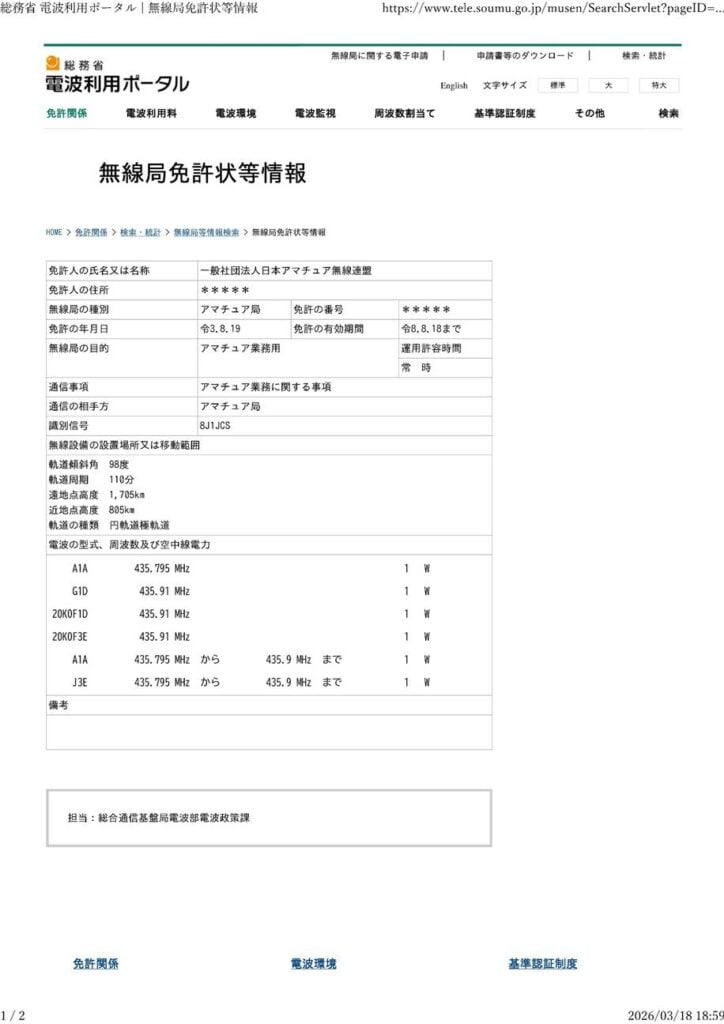
Japanese license information indicating emission modes A1A (CW) and J3E (SSB)
are the only modulations permitted in the linear transponder downlink.
Operators attempting digital modes risk non-compliance with international amateur radio etiquette and could contribute to transponder overload, distortion, or temporary shutdowns—issues exacerbated by the high-duty-cycle nature of many digital signals.
AMSAT urges all users to limit their operations on FO-29 to SSB and CW and to practice good satellite etiquette:
- Use the minimum power necessary to produce a readable downlink signal.
- Ensure your downlink signal strength does not exceed the CW beacon level.
- Monitor the transponder before and during your transmission; if the beacon weakens or the passband becomes noisy, reduce power immediately.
- Keep signals clean and within the passband.
Share the limited resource responsibly so that the maximum number of amateurs worldwide can enjoy FO-29 while it remains active.
With the satellite now enjoying extended full-sunlight operation in 2026, this is an excellent time to explore its capabilities through permitted modes. Experimentation with unauthorized modes is discouraged to preserve the satellite’s health and comply with licensing.
[ANS thanks AMSAT, JARL, and JK2XXK for the above information.]
LIMITED TIME OFFER!!!
AMSAT is offering a limited-time promotion for new and renewing members
that includes a free digital copy of Getting Started with Amateur Satellites.
The promotion is being offered as AMSAT begins the 2026 membership year.
Anyone who joins or renews their AMSAT membership
during the promotional period will receive a download link
for the latest edition of Getting Started with Amateur Satellites
in their membership confirmation email. JOIN TODAY at
https://launch.amsat.org/
(Remember! Students join for FREE!)
Ten-Koh 2 Satellite With Linear Transponder Update
The 6U CubeSat Ten-Koh 2 (also written as Tenkoh-2 or てんこう2) from Japan’s Nihon University was successfully deployed into orbit on March 11, 2026, at approximately 09:34 UTC. The satellite was released from JAXA’s new HTV-X1 cargo spacecraft using the HTV-X Small Satellite Orbital Deployer (H-SSOD) after the vehicle departed the International Space Station (ISS) on March 6 and raised its altitude to around 500 km. This marks the first use of the H-SSOD mechanism for satellite deployment from HTV-X.
Developed by the Okuyama Laboratory in the Department of Aerospace Engineering at Nihon University’s College of Science and Technology, Ten-Koh 2 builds on the legacy of its predecessor, Ten-Koh (launched in 2018). The mission focuses on low-Earth orbit environmental observations to gather data for future space development, alongside in-orbit demonstrations of next-generation communication technologies. Key goals include evaluating high-speed data transmission and enabling global access for amateur radio operators to collect telemetry and experiment with the payloads.
The satellite carries an amateur radio payload coordinated by the International Amateur Radio Union (IARU) and supported by JAMSAT (Japan Amateur Satellite Association):
V/U Linear Transponder (inverting, 40 kHz bandwidth):
Uplink (LSB): 145.895–145.935 MHz
Downlink (USB): 435.875–435.915 MHz
Additional Downlinks/Experiments:
CW beacon, Digitalker, AFSK 1.2 kbps, GMSK up to 19.2 kbps on 435.860 MHz
High-speed experiments (GMSK 4.8–19.2 kbps, 4FSK 38.4 kbps) and photo/picture downlinks on 435.895 MHz
5.839 GHz CW beacon for microwave-band communication demos (SHF experimenters take note—this provides a great target for testing dishes, feeds, and LNAs)
The transponder is expected to operate on a scheduled basis (initially two days per week, with details forthcoming from the team). Operations began shortly after deployment, with the university’s ground station confirming reception of the CW beacon for basic telemetry (voltage, temperature, etc.).
Post-deployment updates from the Okuyama Lab indicate the signal level is currently weaker than anticipated, prompting ongoing monitoring and appeals for reception reports via networks like SatNOGS to aid diagnostics and performance assessment. Early passes over Japan and other regions have yielded mixed results, with some operators reporting no signals yet. Ten-Koh 2 currently only transmits very weak CW data on 435.860 MHz.
Ten-Koh 2 Keplerian data (TLE) are now available in the regular satellite catalog under catalog number 68261.
[ANS thanks the Okuyama Laboratory at Nihon University and Nico Janssen, PA0DLO, for the above information.]
The 2026 Coins Are Here! Help Support GOLF-TEE and FoxPlus.
Annual memberships start at only $120
Join the AMSAT President’s Club today and help Keep Amateur Radio in Space!
https://www.amsat.org/join-the-amsat-presidents-club/
CatSat Request for Activation
For those who might be getting ready to try and track the Catsats’ 10 GHz beacon, be advised that it is not always on.
The University of Arizona team has a web page setup to allow requests for activation of either the beacon (10.47 GHz) or linear transponder (C/x 5.663/10.47 GHz). The link is here:
Once you have submitted your request, if it’s possible, you can see it scheduled on their calendar page located here:
https://catsat.arizona.edu/calendar
[ANS thanks Mike Seguin, N1JEZ, for the above information.]
Need new satellite antennas?
Purchase M2 LEO-Packs from the AMSAT Store.
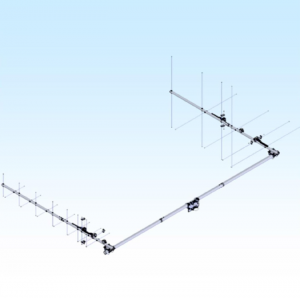
When you purchase through AMSAT,
a portion of the proceeds goes towards
Keeping Amateur Radio in Space.
https://amsat.org/product-category/hardware/
SpaceX Plan For 1 Million Centers Poses Dangerous Risk
A SpaceX plan for 1 million orbital data centers proposes a massive constellation of sunlit objects that could severely impair ground-based astronomy and increase atmospheric pollution through frequent reentries in the upper atmosphere.
Astronomers warn that these 100-meter-long structures will remain illuminated even at midnight. This constant visibility threatens observations at ground-based observatories, such as the Vera Rubin Observatory and the Extremely Large Telescope currently under construction in Chile.
These orbital data centers, potentially 100 meters long, create persistent light streaks that obstruct astronomical research. Positioned in high-inclination orbits at 500-2,000 km, they remain illuminated by sunlight even at midnight, significantly outshining traditional broadband satellites.
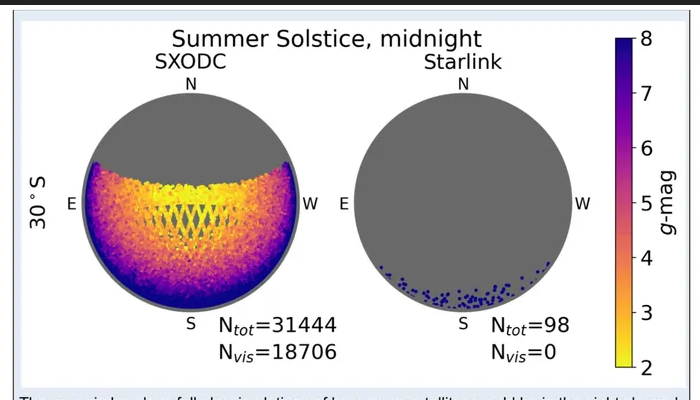
Comparison of Starlink satellite visibility and that of SpaceX’s proposed data center constellation. (Credit: nasaspacenews)
Astronomers have filed formal objections with the FCC regarding the January 30 application. This new constellation poses a challenge unlike any encountered in the commercial space era, undermining years of progress.
Further, this much hardware results in one spacecraft burning up in the atmosphere every three minutes. This mass incineration releases dangerous concentrations of aluminum oxide and lithium, potentially depleting the protective ozone layer and altering global temperatures.
Environmental experts highlight risks, but the FCC’s fast-track approval process bypasses standard environmental reviews, placing the burden of proof on the scientific community to prevent damage.
[ANS thanks nasaspacenews for the above information. Read the full article at https://nasaspacenews.com/2026/03/spacex-plan-for-1-million/.]

Changes to AMSAT TLE Distribution for March 20, 2026
Two Line Elements or TLEs, often referred to as Keplerian elements or keps in the amateur community, are the inputs to the SGP4 standard mathematical model of spacecraft orbits used by most amateur tracking programs. Weekly updates are completely adequate for most amateur satellites. TLE bulletin files are updated daily in the first hour of the UTC day. New bulletin files will be posted immediately after reliable elements become available for new amateur satellites. More information may be found at https://www.amsat.org/keplerian-elements-resources/.
Ten-Koh 2 has been added under its own NORAD Cat ID 68261
[ANS thanks Joe Fitzgerald, KM1P, AMSAT Orbital Elements Manager, for the above information.]
AMSAT Remove Before Flight Key Tags Now Available
Yes, These are the Real Thing!

Your $20 Donation Goes to Help Fly a Fox-Plus Satellite
Includes First Class Postage (Sorry – U.S. Addresses Only)
Order Today at https://www.amsat.org/product/amsat-remove-before-flight-keychain
Astronauts Complete Prep For New ISS Solar Array
Two NASA astronauts prepared the International Space Station (ISS) for the addition of a new solar array on the first U.S. spacewalk in almost a year.
Expedition 74 crewmates Jessica Meir and Chris Williams, KJ5GEW, ventured outside of the space station’s Quest airlock at 1252 UTC on Wednesday, March 18 to install a mount for an advanced power-producing solar panel. The pair worked on the left (or port) side of the space station’s backbone truss, where they first assembled and then attached the bracket structure that will support an ISS Roll-Out Array (iROSA), to be installed on a future spacewalk.
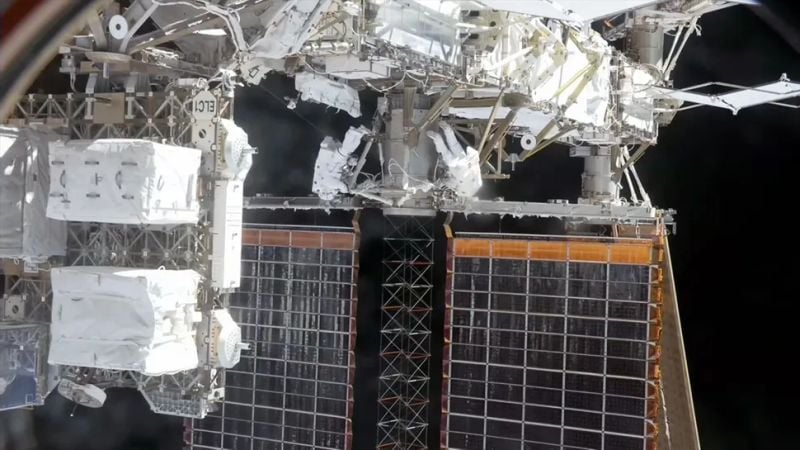
NASA astronauts Jessica Meir (at left) and Chris Williams prepare the
International Space Station for the addition a new solar array during
a spacewalk on Wednesday, March 18, 2026. (Image credit: NASA)
NASA had scheduled for the iROSA kit to be installed during a spacewalk in January, but one of the then-assigned spacewalkers, Mike Fincke, KE5AIT, had an undisclosed medical issue that required the excursion to be canceled and he and his crewmates to return to Earth a month early.
The space station’s original solar arrays have degraded, having exceeded their 15-year service life. When all of them are in place, the new iROSAs will increase the orbiting lab’s electricity supply by 20% to 30%. The additional power on the ISS will help support expanded commercial activities and the upcoming transition from the ISS to commercially operated space stations.
Wednesday’s spacewalk ended at 19:54 UTC, 7 hours and 2 minutes after it began.
[ANS thanks Space.com for the above information. Read the full article at https://www.space.com/space-exploration/international-space-station/astronauts-complete-prep-for-new-iss-solar-array-on-1st-nasa-spacewalk-in-10-months.]
ARISS News
Amateurs and others around the world may listen in on contacts between amateurs operating in schools and allowing students to interact with astronauts and cosmonauts aboard the International Space Station. The downlink frequency on which to listen is 145.800 MHz worldwide.

RECENTLY COMPLETED
Lewis Center for Educational Research, Apple Valley, CA, telebridge via IK1SLD
The ISS callsign was OR4ISS
The scheduled crewmember was Sophie Adenot KJ5LTN
The ARISS mentor was AA6TB
Contact was successful: Thu 2026-03-19 17:15:13 UTC 48 degrees max. elevation
Congratulations to the Lewis Center for Educational Research students, Sophie, mentor AA6TB, and telebridge station IK1SLD!
Watch for Livestream at https://live.ariss.org/
UPCOMING
Vauban, Ecole et Lycée français de Luxembourg, Luxembourg City, Luxembourg, direct via LX26LV
The ISS callsign is presently scheduled to be OR4ISS
The scheduled crewmember is Sophie Adenot KJ5LTN
The ARISS mentor is ON6TI
Contact is go for: Wed 2026-03-25 15:47:34 UTC 73 degrees max. elevation
Amur State University, Blagoveshchensk, Russia, direct via TBD
The ISS callsign is presently scheduled to be RSØISS
The scheduled crewmember is Andrey Fedyaev
The ARISS mentor is RV3DR
Contact is go for Thu 2026-03-26 08:50 UTC
MOBU, Ufa, Republic of Bashkortostan, Russia, direct via TBD
The ISS callsign is presently scheduled to be RSØISS
The scheduled crewmember is Sergey Kud-Sverchkov
The ARISS mentor is RV3DR
Contact is go for Thu 2026-03-26 13:30 UTC
Immanuel Kant Baltic Federal University, Kaliningrad, Russia, direct via TBD
The ISS callsign is presently scheduled to be RSØISS
The scheduled crewmember is Sergey Mikaev
The ARISS mentor is RV3DR
Contact is go for 2026-03-27 15:50 UTC
Aznakaevsky District, Republic of Tatarstan, Russia, direct via TBD
The ISS callsign is presently scheduled to be RSØISS
The scheduled crewmember is Andrey Fedyaev
The ARISS mentor is RV3DR
Contact is go for 2026-03-30 11:55 UTC
POIC at Marshall Space Flight Center, Huntsville, AL, telebridge via IK1SLD
The ISS callsign is presently scheduled to be OR4ISS
The scheduled crewmember is Chris Williams KJ5GEW
The ARISS mentor is KI5SDP
Contact is go for: Fri 2026-03-27 19:05:04 UTC 40 degrees max. elevation
The crossband repeater continues to be active (145.990 MHz up {PL 67} & 437.800 MHz down). If any crewmember is so inclined, all they have to do is pick up the microphone, raise the volume up, and talk on the crossband repeater. So give a listen, you just never know.
The packet system is still in the process of troubleshooting and testing (145.825 MHz up & down).
Ham TV is currently transmitting a test signal at 2395.00 MHz.
As always, if there is an EVA, a docking, or an undocking; the ARISS radios are turned off as part of the safety protocol.
Supporting Progress vehicle activities:
Powering down March 24 at 08:45 UTC
Powering back up March 24 at 18:30 UTC
*times subject to shift or change.
Note, all times are approximate. It is recommended that you do your own orbital prediction or start listening about 10 minutes before the listed time.
The latest information on the operation mode can be found at https://www.ariss.org/current-status-of-iss-stations.html
The latest list of frequencies in use can be found at https://www.ariss.org/contact-the-iss.html
[ANS thanks Charlie Sufana, AJ9N, one of the ARISS operation team mentors for the above information.]
Want to fly the colors on your own grid expedition?
Get an AMSAT car flag and other neat stuff from our Zazzle store!
25% of the purchase price of each product goes towards
Keeping Amateur Radio in Space
https://www.zazzle.com/amsat_gear
AMSAT Ambassador Activities
AMSAT Ambassadors provide presentations, demonstrate communicating through amateur satellites, and host information tables at club meetings, hamfests, conventions, maker faires, and other events.
April 11, 2026
Tucson Area Spring Hamfest
Radio Society of Tucson
Calvary Tucson Church
8711 East Speedway
Tucson, AZ 85710
https://k7rst.club/
N1UW
Interested in becoming an AMSAT Ambassador? For more information go to: https://www.amsat.org/ambassador/
[ANS thanks Bo Lowrey, W4FCL, Director – AMSAT Ambassador Program, for the above information.]
Satellite Shorts from All Over
+ SilverSat’s SSDV schedule can be found at http://operations.silversat.org/ssdv (ANS thanks the SilverSat team for the information.)
+ NASA’s Moon rocket returned to the launch pad after repairs inside the Vehicle Assembly Building at the Kennedy Space Center. The rocket’s rollout to pad 39B was completed at noon local time on March 20 and sets up a launch attempt for the Artemis 2 mission no earlier than April 1. (ANS thanks Spaceflight Now for the above informatin. Read the full article at https://spaceflightnow.com/2026/03/19/live-coverage-nasa-to-roll-its-sls-rocket-back-to-the-launch-pad-ahead-of-planned-april-flight-of-artemis-2/.)
+ Prime Minister Mark Carney has announced that the Canadian government is investing $200 million towards Canada’s first launch pad. The site is owned by Maritime Launch Services, a Canadian commercial space company founded in 2016 and headquartered in Halifax, Nova Scotia. The funds will be put toward a 10-year lease on the launch pad, located near Canso, N.S., which is expected to finish construction by 2028. (ANS thanks Universe Today for the above information. Read the full article at https://www.universetoday.com/articles/canada-allocates-200-million-towards-the-creation-of-nations-first-spaceport.)
+ The Germany-wide Space Day will take place on Saturday, March 28, 2026. AMSAT-DL and the Bochum Observatory will participate with a varied program of interesting short talks and presentations on the topics of space travel, astronomy, STEM education and amateur radio. At the same time, an ESERO family day will take place on this day from 11 am to 5 pm in and around the radome of Bochum Observatory under the motto “Adventure Space”: Fun & interesting facts for young and old await visitors; they can embark on a journey of discovery and immerse themselves in the world of astronomy and space travel. For a complete schedule see https://amsat-dl.org/en/bochum-space-day-march-28-2026-space-day/ (ANS thanks AMSAT-DL for the above information.)
+ The JAMSAT Symposium is being held this weekend, March 21-22, at the Japan Museum of the Future Science and Technology in Tokyo. The program began with a hands-on activity for children and continues with technical presentations and demonstrations. (ANS thanks JAMSAT for the above information.)
Join AMSAT today at https://launch.amsat.org/
In addition to regular membership, AMSAT offers membership to:
- Societies (a recognized group, clubs or organization).
- Students are eligible for FREE membership up to age 25.
- Memberships are available for annual and lifetime terms.
Contact info [at] amsat.org for additional membership information.
73 and remember to help Keep Amateur Radio in Space!
This week’s ANS Editor, Mark Johns, KØJM
mjohns [at] amsat.org
ANS is a service of AMSAT, the Radio Amateur Satellite Corporation, 712 H Street NE, Suite 1653, Washington, DC 20002
AMSAT is a registered trademark of the Radio Amateur Satellite Corporation.