
AMSAT News Service
ANS-039
February 8, 2026
In this edition:
* FO-29 Approaches Full Sunlight
* Gridmaster Top 100 Rovers for February 2026
* VUCC Satellite Standing February 2026
* DXCC Satellite Standing for February 2026
* SpaceX Grounds its Falcon 9 Rocket
* Declassifying JUMPSEAT: An American Pioneer in Space
* Changes to AMSAT-NA TLE Distribution
* Kenya to Represent Africa in ARISS Program 2026
* ARISS News
* AMSAT Ambassador Activities
* Satellite Shorts From All Over
The AMSAT® News Service bulletins are a free, weekly news and information service of AMSAT, The Radio Amateur Satellite Corporation. ANS publishes news related to Amateur Radio in Space including reports on the activities of a worldwide group of Amateur Radio operators who share an active interest in designing, building, launching and communicating through analog and digital Amateur Radio satellites.
The news feed on https://www.amsat.org publishes news of Amateur Radio in Space as soon as our volunteers can post it.
Please send any amateur satellite news or reports to: ans-editor [at] amsat.org
You can sign up for free e-mail delivery of the AMSAT News Service Bulletins via the ANS List; to join this list see: https://mailman.amsat.org/postorius/lists/ans.amsat.org/
FO-29 Approaches Full Sunlight
Fuji-OSCAR 29 (JAS 2) will soon enter a season of orbits in full sunlight, making it once again available for worldwide use.
JAS-2 was successfully launched on August 17, 1996. It orbits the Earth in a polar orbit at 1300 km altitude in a time of 112 minutes. The inclination is 98°. The transmission power of the beacon is 100 mW, the transponder 1 watt. The linear transponder downlink is from 435.800 MHz – 435.900 MHz (USB, CW), with uplink from 145.900 MHz – 146.00 MHz (LSB, CW). CW beacon frequency is 435.795 MHz.
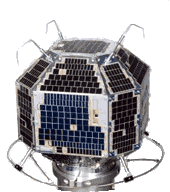
Fuji-OSCAR 29 (JAS 2) Credit: JAMSAT
Designated as Fuji-OSCAR 29 after achieving orbit, JAS 2 has long been one of the most popular and most useful linear satellites available to amateurs. However, as the satellite approaches 30 years of age, its batteries have long-since failed. It only continues to operate while the sun is illuminating its solar panels.
On March 9, FO-29 will begin orbiting in full sunlight, without periodic eclipses.
In mid-February, the duration of the shadow decreases from about 20 minutes to about 1 minute per day. Therefore, FO-29’s transmitter may suddenly come to life unexpectedly. Amateurs are encouraged to monitor the satellite and to update its activity on the AMSAT OSCAR Satellite Status page, https://www.amsat.org/status/.
Please enjoy using FO-29 while it remains available!
[ANS thanks Akira Kaneko, JA1OGZ, of JAMSAT for the above information.]
AMSAT Remove Before Flight Key Tags Now Available
Yes, These are the Real Thing!
Your $20 Donation Goes to Help Fly a Fox-Plus Satellite
Includes First Class Postage (Sorry – U.S. Addresses Only)
Order Today at https://www.amsat.org/product/amsat-remove-before-flight-keychain
Gridmaster Top 100 Rovers for February 2026
The February 2026 rankings for the Top 100 Rovers (Mixed LEO/MEO/GEO) in satellite operations, as determined by @GridMasterMap on Twitter, has been released. The ranking is determined by the number of grids and DXCC entities activated, taking into account only those grids where a minimum number of QSOs logged on the gridmaster.fr website have been validated by a third party. Grid numbers do not directly reflect the exact number of activations. Satellite operators are encouraged to upload their LoTW satellite contacts to https://gridmaster.fr in order to provide more accurate data.
| 1 | ND9M | 26 | BA1PK | 51 | KE0WPA | 76 | HB9GWJ |
| 2 | NJ7H | 27 | KX9X | 52 | WD5GRW | 77 | VA7LM |
| 3 | UT1FG | 28 | KG5CCI | 53 | KE0PBR | 78 | DL4EA |
| 4 | JA9KRO | 29 | DJ8MS | 54 | XE3DX | 79 | N8RO |
| 5 | N5UC | 30 | N5BO | 55 | BA8AFK | 80 | SP5XSD |
| 6 | F5VMJ | 31 | ON4AUC | 56 | LU4JVE | 81 | N6UTC |
| 7 | DL6AP | 32 | K8BL | 57 | W7WGC | 82 | N4UFO |
| 8 | DP0POL | 33 | KE4AL | 58 | PR8KW | 83 | VE7PTN |
| 9 | WI7P | 34 | KB5FHK | 59 | JK2XXK | 84 | PT2AP |
| 10 | K5ZM | 35 | AC0RA | 60 | EA4NF | 85 | VE1VOX |
| 11 | OE3SEU | 36 | PA3GAN | 61 | EB1AO | 86 | AA8CH |
| 12 | WY7AA | 37 | F4BKV | 62 | XE1ET | 87 | KB2YSI |
| 13 | LU5ILA | 38 | KI0KB | 63 | N6DNM | 88 | KI7UXT |
| 14 | N6UA | 39 | JO2ASQ | 64 | W8LR | 89 | AF5CC |
| 15 | HA3FOK | 40 | KI7UNJ | 65 | W1AW | 90 | KJ7NDY |
| 16 | OH2UDS | 41 | VA3VGR | 66 | KI7QEK | 91 | BI1MHK |
| 17 | W5PFG | 42 | VE3HLS | 67 | SM3NRY | 92 | PT9BM |
| 18 | AK8CW | 43 | BG7QIW | 68 | KE9AJ | 93 | FG8OJ |
| 19 | N9IP | 44 | LA9XGA | 69 | F4DXV | 94 | BG5CZD |
| 20 | AD0DX | 45 | HJ5LVR | 70 | VE1CWJ | 95 | YU0W |
| 21 | AD0HJ | 46 | VK5DG | 71 | AA5PK | 96 | PU4CEB |
| 22 | DL2GRC | 47 | N7AGF | 72 | AD7DB | 97 | W8MTB |
| 23 | N4AKV | 48 | DF2ET | 73 | KM4LAO | 98 | N4DCW |
| 24 | ND0C | 49 | K7TAB | 74 | PU6JBN | 99 | WA9JBQ |
| 25 | WD9EWK | 50 | JL3RNZ | 75 | M1DDD | 100 | PS8BR |
[ANS thanks Gridmaster.fr for the above information.]
The 2026 President’s Club Coin is Now Available!
Help Support GOLF and FoxPlus.
Annual memberships start at only $120
Join the AMSAT President’s Club today and help
Keep Amateur Radio in Space!
https://www.amsat.org/join-the-amsat-presidents-club/
VUCC Satellite Standing February 2026
VUCC Satellite Award/Endorsement Change Summary for January 01, 2026 to February 01, 2026.
| Call | Jan | Feb |
|---|---|---|
| DF2ET | 1700 | 1801 |
| DG7RO | 1504 | 1600 |
| PS8ET | 1000 | 1216 |
| EA2AA | 1135 | 1170 |
| JL1SAM | 905 | 1008 |
| JS1LQI | 808 | 825 |
| PA7RA | 534 | 604 |
| XE2YWH | 595 | 600 |
| HB9BIN | 356 | 460 |
| WO3T | 437 | 450 |
| OH3DP | 352 | 401 |
| IK8YTA | 300 | 332 |
| PU5DDC | 254 | 258 |
| EA4DEI | 200 | 250 |
| XE1R | 105 | 237 |
| G4BWP | 200 | 220 |
| I2OIM | 155 | 206 |
| WB5TX | 160 | 165 |
| W1AW | 103 | 134 |
| PU4FAR | New | 100 |
| YB0OSU | New | 100 |
Congratulations to the new VUCC Satellite holders.
PU4FAR
YB0OSU
PU4FAR is first VUCC Satellite holder from GH83
[ANS thanks Jon Goering, N7AZ, for the above information.]
Need new satellite antennas?
Purchase M2 LEO-Packs from the AMSAT Store.
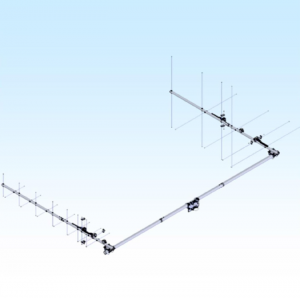
When you purchase through AMSAT, a portion of the proceeds goes towards
Keeping Amateur Radio in Space.
https://amsat.org/product-category/hardware/
DXCC Satellite Standing for February 2026
DXCC Satellite Award/Endorsement Change Summary for January 01, 2026 to February 01, 2026.
| Call | Jan | Feb |
|---|---|---|
| HB9BZA | 196 | 204 |
| PY2RN | 166 | 192 |
| YO2CMI | 185 | 186 |
| VU2LBW | 166 | 174 |
| ON4AOI | 156 | 167 |
| HB9GWJ | 150 | 154 |
| EA3GP | 103 | 153 |
| LA7XK | 118 | 119 |
| IK8YTA | 107 | 118 |
| K6FW | 102 | 104 |
[ANS thanks Jon Goering, N7AZ, for the above information.]

SpaceX Grounds its Falcon 9 Rocket
SpaceX has temporarily grounded its workhorse Falcon 9 rocket, which is slated to launch four astronauts next week.
A Falcon 9 delivered 25 of SpaceX’s Starlink satellites into low Earth orbit (LEO) as planned on Monday (Feb. 2). But, after deploying the payloads, the rocket’s upper stage failed to perform its deorbit burn, which was designed to bring it down for controlled destruction in Earth’s atmosphere.
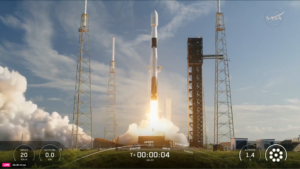
Northrop Grumman’s Cygnus XL cargo craft lifts off atop SpaceX Falcon 9 rocket from Florida’s Cape Canaveral Space Force Station
to the International Space Station in September, 2025. Credit: NASA+
The Falcon 9 is the world’s busiest rocket by far. It launched a record-breaking 165 times in 2025 and already has 14 liftoffs until its belt this year.
The rocket is incredibly reliable, too. All of last year’s missions were successful, and just a single one — a Starlink launch on March 3 — experienced a significant anomaly.
It’s unclear how long this new launch hiatus will last. But both SpaceX and NASA doubtless hope the issue is resolved soon, for a very high-profile Falcon 9 launch is coming up — that of the Crew-12 astronaut mission to the International Space Station (ISS).
Crew-12 is scheduled to include NASA astronauts Jack Hathaway, KJ5NIV, and Jessica Meir, as well as French astronaut Sophie Adenot, KJ5LTN, and Russian cosmonaut Oleg Artemyev. Their SpaceX Dragon capsule has been scheduled for launch atop a Falcon 9 rocket on February 11.
[ANS thanks Space.com for the above information. See the full article at https://www.space.com/space-exploration/launches-spacecraft/spacex-grounds-its-falcon-9-rocket-after-a-problem-with-its-upper-stage-will-the-crew-12-astronaut-mission-be-affected]
Declassifying JUMPSEAT: An American Pioneer in Space
The director of the National Reconnaissance Office (NRO) recently declassified the existence of JUMPSEAT: the United States’ first-generation, highly elliptical orbit (HEO) signals-collection satellite.
Launched from 1971 to 1987 under mission numbers 7701 to 7708, JUMPSEAT was the product of the United States Air Force’s (USAF) program at the NRO. Developed under a program called “Project EARPOP,” JUMPSEAT offered the U.S. a way of collecting intelligence during unprecedented geopolitical change and Cold War tensions that lasted until the early 1990s.
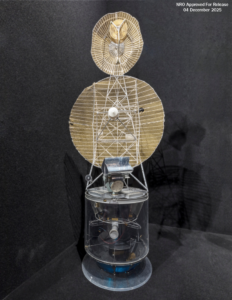
JUMPSEAT Model_2_1 Credit: NRO
The NRO and USAF, collaborating as a part of NRO’s “Program A,” were tasked with developing a foundational HEO signals collection satellite to bolster the U.S. government’s space intelligence portfolio. Named JUMPSEAT, the new satellite would be capable of operating in a highly ellipical, or Molniya, orbit. [Editor’s Note: These orbits are very similar to those that were used by amateur radio satellites AO-10, AO-13, and AO-40 in the 1980s and -90s.]
Together, the NRO and the USAF launched the first JUMPSEAT mission in 1971 from Vandenberg Air Force Base (now Vandenberg Space Force Base) in California. Once in orbit, JUMPSEAT successfully collected electronic emissions and signals, communication intelligence, and foreign instrumentation intelligence: invaluable information that was downlinked to ground processing facilities within the U.S. From there, the data was provided to the Department of Defense, the National Security Agency, and other national security elements.
Over the decades, JUMPSEAT satellites continued to prove their worth to signals intelligence, finally operating in transponder mode until they were taken out of service in 2006.
[ANS thanks the National Reconnaissance Office for the above information. Read the full article at https://www.nro.gov/news-media-featured-stories/news-media-archive/News-Article/Article/4392223/declassifying-jumpseat-an-american-pioneer-in-space/]
Changes to AMSAT TLE Distribution for February 6
Two Line Elements or TLEs, often referred to as Keplerian elements or keps in the amateur community, are the inputs to the SGP4 standard mathematical model of spacecraft orbits used by most amateur tracking programs. Weekly updates are completely adequate for most amateur satellites. TLE bulletin files are updated daily in the first hour of the UTC day. New bulletin files will be posted immediately after reliable elements become available for new amateur satellites. More information may be found at https://www.amsat.org/keplerian-elements-resources/.
This week there are no additions or deletions to the AMSAT TLE distribution.
[ANS thanks Joe Fitzgerald, KM1P, AMSAT Orbital Elements Manager, for the above information.]
Kenya to Represent Africa in ARISS Program 2026
Kenya is set to make history in 2026 after being selected to host the Amateur Radio on the International Space Station (ARISS) program, a global initiative that enables the public to communicate live with astronauts aboard the International Space Station (ISS).
The Kenya Space Agency announced the selection, positioning the country at the heart of an international effort to advance space education and public engagement in science. Kenya is the only African nation chosen for the 2026 ARISS cycle, a milestone expected to spark interest in science, technology, engineering and mathematics (STEM) and inspire innovation across the country.
According to the agency, the hosting window will run between July and December 2026. During this period, Kenyan students, professionals and members of the public will take part in live radio sessions with astronauts on the ISS. Participants will have the opportunity to ask questions and receive real-time answers about daily life in orbit, scientific research conducted on board and the realities of living and working in space.
The Kenya Space Agency will oversee preparations for the event in collaboration with Pan-African Citizen Science e-Laboratory mentor and agency liaison Harold Safary. Planning efforts will include technical coordination, public outreach and the selection of participants, with an open call to be issued for interested individuals and institutions wishing to take part in the live ISS contacts.
The 2026 ARISS program will offer Kenyans a rare opportunity to speak directly with astronauts aboard the ISS, marking a significant step in the country’s engagement with global space initiatives and space education.
[ANS thanks Satellite Pro Middle East for the above information. Read the full article at https://satelliteprome.com/news/kenya-to-represent-africa-in-iss-ariss-programme-2026/]
ARISS News
Amateurs and others around the world may listen in on contacts between amateurs operating in schools and allowing students to interact with astronauts and cosmonauts aboard the International Space Station. The downlink frequency on which to listen is 145.800 MHz worldwide.
RECENTLY COMPLETED
School No. 4, Semenov, Nizhny Novgorod Region, Russia, direct via UB3TBX
The ISS callsign was scheduled to be RSØISS
The scheduled crewmember was Sergey Kud-Sverchkov
The ARISS mentor was RV3DR
Contact was successful for Thu 2026-02-05 09:14 UTC
Congratulations to the School No. 4 students, Sergey, mentor RV3DR, and ground station UB3TBX!
FBU Im. I. Kant, Kaliningrad, Russia, direct via R2FDB
The ISS callsign was scheduled to be RSØISS
The scheduled crewmember was Sergey Mikaev
The ARISS mentor was RV3DR
Contact was successful for Thu 2026-02-05 10:49 UTC
Congratulations to the FBU Im. I. Kant students, Sergey, mentor RV3DR, and ground station R2FDB!
Klimop Tongeren, Tongeren-Borgloon, Belgium, telebridge via ON4ISS
The ISS callsign was scheduled to be OR4ISS
The scheduled crewmember was Chris Williams, KJ5GEW
The ARISS mentor was ON6TI
Contact was successful for: Thu 2026-02-05 12:21:51 UTC 82 degrees maximum elevation
Congratulations to the Klimop Tongeren students, Chris, mentor ON6TI, and telebridge station ON4ISS!
UPCOMING
Hilltop Elementary, Canfield, OH, telebridge via K6DUE
The ISS callsign is presently scheduled to be NA1SS
The scheduled crewmember is Chris Williams, KJ5GEW
The ARISS mentor is KD8COJ
Contact is go for Mon 2026-02-09 18:44:58 UTC 57 deg
Watch for Livestream at https://www.youtube.com/@ARISSlive/videos and https://live.ariss.org/
Many times a school may make a last minute decision to do a Livestream or run into a last minute glitch requiring a change of the URL but we at ARISS may not get the URL in time for publication. You can always check https://live.ariss.org/ to see if a school is Livestreaming.
As always, if there is an EVA, a docking, or an undocking; the ARISS radios are turned off as part of the safety protocol.
The crossband repeater continues to be active (145.990 MHz up {PL 67} & 437.800 MHz down), If any crewmember is so inclined, all they have to do is pick up the microphone, raise the volume up, and talk on the crossband repeater. So give a listen, you just never know.
The packet system (145.825 MHz up & down) was scheduled for repair on February 5.
Ham TV (2395.00 MHz) is configured for scheduled digital amateur television operations.
Note, all times are approximate. It is recommended that you do your own orbital prediction or start listening about 10 minutes before the listed time.
The latest information on the operation mode can be found at https://www.ariss.org/current-status-of-iss-stations.html
The latest list of frequencies in use can be found at https://www.ariss.org/contact-the-iss.html
[ANS thanks Charlie Sufana, AJ9N, one of the ARISS operation team mentors for the above information.]
Want to fly the colors on your own grid expedition?
Get an AMSAT car flag and other neat stuff from our Zazzle store!
25% of the purchase price of each product goes towards Keeping Amateur Radio in Space
AMSAT Ambassador Activities
AMSAT Ambassadors provide presentations, demonstrate communicating through amateur satellites, and host information tables at club meetings, hamfests, conventions, maker faires, and other events.
February 13-15, 2026
Hamcation 2026
Central Florida Fairgrounds and Expo Park
Colonial Drive
Orlando, Florida
AMSAT will have a table and many items available for purchase
Contact Dave Jordan, AA4KN to volunteer n4csitwo [at] bellsouth.net
March 21, 2026
Midwinter Madness Hamfest 2026
Maple Grove Radio Club
Buffalo Civic Center
1306 County Rd 134
Buffalo, Minnesota 55313
https://k0ltc.org/midwinter-madness/
KØJM, ADØHJ, KEØPBR
Interested in becoming an AMSAT Ambassador? AMSAT Ambassadors provide presentations, demonstrate communicating through amateur satellites, and host information tables at club meetings, hamfests, conventions, maker faires, and other events.
For more information go to: https://www.amsat.org/ambassador/
[ANS thanks Bo Lowrey, W4FCL, Director – AMSAT Ambassador Program, for the above information.]
Satellite Shorts from All Over
+ In September 2025, AMSAT-DL and the Bochum Observatory jointly organized the “Bochum Space Days 2025” conference in the radome under the 20-metre antenna. The Radom was all about satellite and space research. A varied and informative program was offered, aimed at AMSAT members as well as all space enthusiasts and makers. The presentations are now available on the AMSAT-DL YouTube channel. The language of the presentation is mixed German/English and subtitles can also be optionally activated in the respective translation. Begin at https://www.youtube.com/watch?v=IW384KY6lBo&list=PLbIhjH2wj12GfMJGRwbYPFEjU7ECtjzzO (ANS thanks AMSAT-DL for the above information.)
+ The National Oceanic and Atmospheric Administration (NOAA) Space Weather Follow On – Lagrange 1 (SWFO-L1) satellite has reached its final destination—nearly one million miles away from Earth toward the sun and has been renamed SOLAR-1. The observatory is expected to begin space weather operations in Spring 2026. Read more at http://bit.ly/4bUIY1K. (ANS thanks NOAA for the above information.)
+ Edge of Space Sciences, a ham radio club in Englewood, Colorado, has been monitoring three amateur radio pico balloons as they continue to circumnavigate the globe. Two balloons were released at HamCon Colorado on October 25, 2025. EOSSP-3 has completed 5 circumnavigations and is currently lost somewhere “up north.” No signal has been heard for 4 days. EOSSP-4 has completed 7 circumnavigations and is currently approaching India. Meanwhile, EOSSP-2, launched September 18, completed its 10th circumnavigation at 19:05 UTC on February 4. The balloons can be tracked on aprs.fi at https://aprs.fi/#!call=a%2FEOSSP-2%2Ca%2FEOSSP-4%2Ca%2FEOSSP-3&timerange=259200&tail=86400. More information can be found on the club’s website, www.eoss.org. (ANS thanks ARRL for the above information.)
+ NASA is no longer planning a February launch of the Artemis 2 mission after encountering hydrogen leaks during a fueling test of the Space Launch System. In a statement early Feb. 3, NASA said it completed a wet dress rehearsal for Artemis 2 but determined the vehicle will not be ready to launch during the February window, which closes Feb. 11. Several other issues occurred during the test. A valve in Orion’s hatch pressurization system was accidentally vented during closeout work, requiring additional time to repressurize the system. Unseasonably cold temperatures, which had already delayed the rehearsal by two days, caused further issues, including delays in tanking operations and problems with cameras and other pad equipment. NASA also reported intermittent audio dropouts in communications among ground teams. The next launch period for Artemis 2 runs from March 6 to 11, with five two-hour windows available. Another launch opportunity extends from April 1 to 6. (ANS thanks SpaceNews for the above information. Read the full article at https://spacenews.com/artemis-2-slips-to-march/)
Join AMSAT today at https://launch.amsat.org/
In addition to regular membership, AMSAT offers membership to:
- Societies (a recognized group, clubs or organization).
- Students are eligible for FREE membership up to age 25.
- Memberships are available for annual and lifetime terms.
Contact info [at] amsat.org for additional membership information.
73 and remember to help Keep Amateur Radio in Space!
This week’s ANS Editor,
Mark Johns, KØJM
mjohns [at] amsat.org
ANS is a service of AMSAT, the Radio Amateur Satellite Corporation, 712 H Street NE, Suite 1653, Washington, DC 20002
AMSAT is a registered trademark of the Radio Amateur Satellite Corporation.