AMSAT News Service
ANS-348
December 14, 2025
In this edition:
* Soyuz Crew Lands Ending Eight-Month Space Research Journey
* Satellites Experience “Orbital Summer” And “Orbital Winter”
* CCSDS Development Competition Open to European Hams
* VUCC Satellite Standing December 2025
* DXCC Satellite Standing for December 2025
* A Dying Satellite May Photograph Asteroid Apophis in 2029
* Changes to AMSAT-NA TLE Distribution
* Boeing’s Next Starliner Flight Will Carry Cargo Only
* ARISS News
* AMSAT Ambassador Activities
* Satellite Shorts From All Over
The AMSAT® News Service bulletins are a free, weekly news and information service of AMSAT, The Radio Amateur Satellite Corporation. ANS publishes news related to Amateur Radio in Space including reports on the activities of a worldwide group of Amateur Radio operators who share an active interest in designing, building, launching and communicating through analog and digital Amateur Radio satellites.
The news feed on https://www.amsat.org publishes news of Amateur Radio in Space as soon as our volunteers can post it.
Please send any amateur satellite news or reports to: ans-editor [at] amsat.org
You can sign up for free e-mail delivery of the AMSAT News Service Bulletins via the ANS List; to join this list see: https://mailman.amsat.org/postorius/lists/ans.amsat.org/
Soyuz Crew Lands Ending Eight-Month Space Research Journey
The crew of Soyuz MS-27, including NASA astronaut Jonny Kim, KJ5HKP, along with Russian Cosmonauts Sergey Ryzhikov and Alexey Zubritsky, returned safely to Earth after living aboard the International Space Station (ISS) in weightlessness for 245 days. The return marked the end of ISS Expedition 73.
Lieutenant Commander (LCDR, U.S. Navy) Jonny Kim was born and raised in Los Angeles, California to Korean-American immigrants. He enlisted in the Navy as a Seaman recruit after graduating high school in 2002. After completion of Hospital Corpsman “A” school training, he reported to Basic Underwater Demolition/SEAL (BUD/S) training in Coronado, CA. After completing his training at Naval Special Warfare, Kim reported to the John F. Kennedy Special Warfare Center and School in Fort Liberty, NC for the Special Operations Combat Medic Course. He was assigned as a Special Warfare Operator to SEAL Team THREE in San Diego, CA and obtained various qualifications including Military Freefall Parachutist, Advanced SCUBA, Combatant Diver (closed circuit rebreather), Naval Special Warfare Special Reconnaissance Scout and Sniper, and Advanced Special Operations Techniques. As a Navy SEAL he completed more than 100 combat operations.
In 2012, Petty Officer First Class Kim was commissioned as a naval officer through the Navy’s enlisted-to-officer commissioning program, Seaman to Admiral-21, following graduation from the University of San Diego. Kim obtained his medical degree from Harvard Medical School and completed his internship with the Harvard Affiliated Emergency Medicine Residency at Massachusetts General Hospital and Brigham and Women’s Hospital in Boston, MA.
Kim is an Aeromedical Dual Designated (AMDD) Naval Aviator and Flight Surgeon, he completed his primary flight training at Naval Air Station (NAS) Corpus Christi, TX, helicopter advanced flight training at NAS Whiting Field in Milton, FL, and the Naval Flight Surgeon course at the Naval Aerospace Medical Institute at NAS Pensacola, FL.
Selected by NASA in 2017, Kim completed two years of training as an Astronaut Candidate. Training included technical and operational instruction in International Space Station systems, Extravehicular Activities (EVA) Operations, T-38 flight training, robotics, physiological training, expeditionary training, field geology, water and wilderness survival training, and Russian language proficiency training. In 2020, Kim began his support of International Space Station operations as a Capsule Communicator (CapCom) in Mission Control Center Houston and the Artemis program under the astronaut Exploration branch. He served as the International Space Station’s Increment Lead for Expedition 65 in 2021.
As part of his astronaut training, Kim earned his Technician Class amateur radio license in July of 2024.
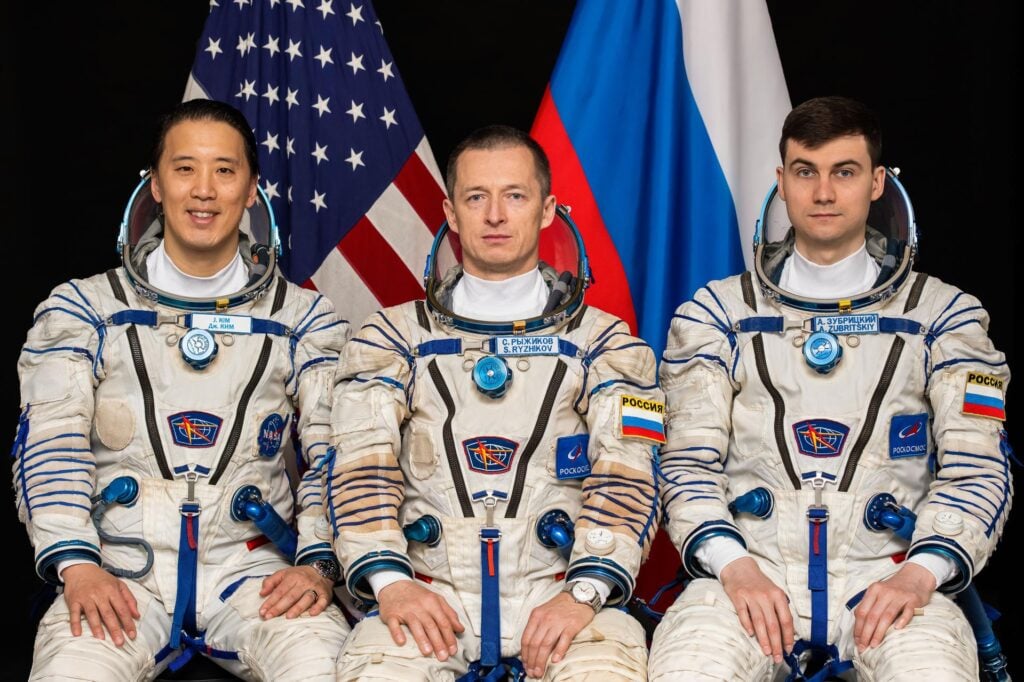
Soyuz MS-27 crew members (from left) NASA astronaut Jonny Kim and Roscosmos cosmonauts Sergey Ryzhikov and Alexey Zubritsky
pose for a pre-flight portrait at the Gagarin Cosmonaut Training Center in Russia. (Credit: GCTC)
Kim launched to the International Space Station on April 8, 2025, as a flight engineer on the Soyuz MS-27 spacecraft. He spent eight months aboard the station as an Expedition 72/73 flight engineer, conducting science experiments and maintaining the space station. During the science expedition, Kim orbited the Earth 3,920 times and traveling nearly 104 million miles. He saw the arrival of nine visiting spacecraft and the departure of six during his time in orbit.
This was Kim’s first spaceflight, where he served as flight engineer for Expedition 72 and 73. This also was Zubritsky’s first trip to the space station. Ryzhikov now has logged a total of 603 days in space during three trips to the orbital complex, ranking him 13th all time.
The three crew members were flown by helicopter to Karaganda, Kazakhstan, where recovery teams are based. After medical exams, Kim boarded a NASA aircraft and returned to Houston to spend Christmas with his wife and their three children.
Expedition 74 is now underway with veteran NASA astronaut Mike Fincke, KE5AIT, as commander leading six flight engineers including NASA astronauts Zena Cardman, KJ5CMN, and Chris Williams, KJ5GEW, JAXA (Japan Aerospace Exploration Agency) astronaut Kimiya Yui, KG5BPH, and Roscosmos cosmonauts Oleg Platonov, Sergey Kud-Sverchkov and Sergei Mikaev.
[ANS thanks NASA for the above information.]
AMSAT Remove Before Flight Key Tags Now Available
Yes, These are the Real Thing!
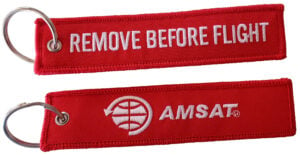
Your $20 Donation Goes to Help Fly a Fox-Plus Satellite
Includes First Class Postage (Sorry – U.S. Addresses Only)
Order Today at https://www.amsat.org/product/amsat-remove-before-flight-keychain
Satellites Experience “Orbital Summer” And “Orbital Winter”
Think satellites are immune to seasons? Think again!
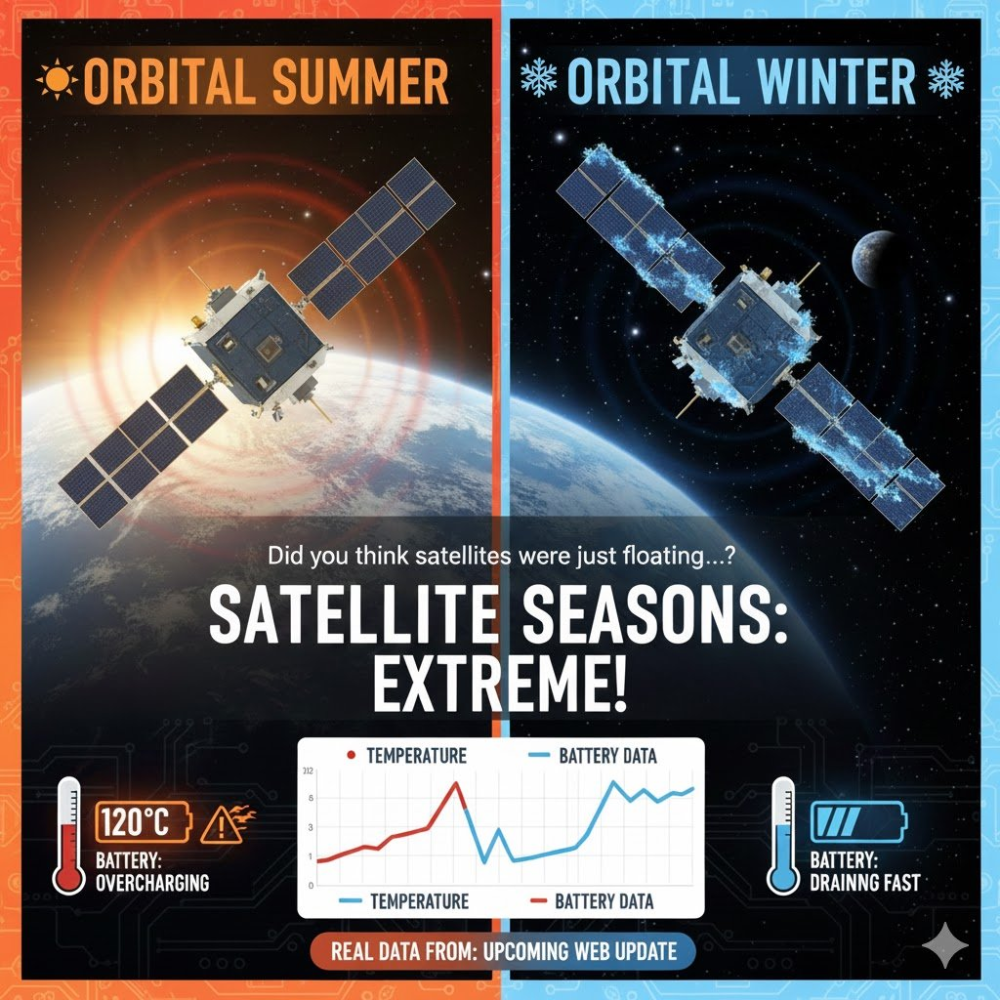
They experience “Orbital Summer” and “Orbital Winter” with extreme effects. Because of the position of the Earth, as well as the orbital path, satellites experience periods when they are entirely out of Earth’s shadow (“orbital summer”) and periods when they are in “eclipse” for most or all of their orbits (“orbital winter”).
What does this mean for their batteries and temperature?
(Credit: TinyGS)
When fully illuminated, solar panels are generating non-stop power and batteries are fully charged. But “Orbital Summer” isn’t just about light; it’s about heat. Without the shadow of an eclipse to cool down, the satellite heats up, putting stress on batteries and other components.
Conversely, when “Orbital Winter” happens, a satellite will experience maximum eclipse time. When in eclipse, batteries may not charge sufficiently. Satellites must survive long periods in the dark, relying heavily on batteries and internal heaters to keep from freezing.
“Orbital Summer” And “Orbital Winter” are primary contributors to satellite failure, and a major challenge to those who build and operate satellites of all types.
[ANS thanks TinyGS for the above information.]
Only 2 Weeks Left to Get Your 2025 Coin!
Celebrate the 40th Anniversary of Amateur Radio on Human Spaceflight
Help Support GOLF and FoxPlus.
Annual memberships start at only $120
Join the AMSAT President’s Club today and help
Keep Amateur Radio in Space!
https://www.amsat.org/join-the-amsat-presidents-club/
CCSDS Development Competition Open to European Hams
The European Space Agency (ESA) is presenting a pilot programme on behalf of The Consultative Committee for Space Data Systems (CCSDS) and is pleased to announce a new outreach initiative aimed at strengthening engagement with the European amateur satellite and academic communities. This initiative supports the wider objective of promoting the adoption and practical application of CCSDS space communication standards.
CCSDS invites European amateur satellite operators, students, educators, and academic researchers to participate and to help advance open, interoperable space communication technologies.
ESA, in partnership with Goonhilly Earth Station, CCSDS, AMSAT-UK, and AMSAT-DL, are launching a competition to develop high-quality reference implementations of selected CCSDS protocols.
This competition is sponsored by the European Space Agency (ESA).
About the Competition
This programme invites participants to:
Develop open, standards-compliant reference implementations of CCSDS protocols
Contribute to a shared technical resource for amateur satellite operators, universities, and research groups
Gain recognition within both the CCSDS community and the broader space communications field
An in-person hackathon at Goonhilly Earth Station will be available to interested participants, providing a unique environment for collaboration, expert guidance, and accelerated development.
Goonhilly Earth Station is coordinating the competition and will not assert any ownership over Hackathon/Competition outputs.
Prize
Winners of the competition will receive an invitation to attend a CCSDS conference in the United States, where they will present their results to the international CCSDS community.
Protocols Featured in the Competition
These are the outlines of the two CCSDS protocols selected for this competition:
LunaNet Signal-In-Space Recommended Standard – Augmented Forward Signal (LSIS – AFS)
The LSIS–AFS standard defines how lunar orbiters or surface systems broadcast a unified navigation and timing signal to support future missions on and around the Moon. It provides a framework for creating an enhanced, interoperable “forward signal” that spacecraft, rovers, and astronauts can use for more accurate positioning, timing, and situational awareness.
Space Communications Session Control (CCSDS 235.1)
The CCSDS 235.1 standard defines how space missions establish, manage, and conclude communication sessions between spacecraft and ground systems. It provides a common framework that ensures reliable coordination when exchanging data, sending commands, and transitioning between communication states.
Participants may choose either to develop a functional concept or prototype that demonstrates how the LSIS–AFS signal could be designed, transmitted, interpreted, or applied to support future lunar missions, or to create a practical, interoperable reference implementation of Space Communications Session Control aligned with the CCSDS 235.1 standard.
A Long-Term Vision: Toward a Cislunar Amateur Radio Payload
CCSDS is pleased to highlight a longer-term aspiration linked to this initiative. In close cooperation with its partners—particularly ESA, which is proposing a future cislunar amateur radio payload—CCSDS intends to support the preparation of the most successful protocol implementations for potential consideration for flight.
This offers an exceptional opportunity for community-developed CCSDS-compliant software to be demonstrated in a deep-space operational environment.
This prospective mission is subject to funding and programme approval.
Contact and Expressions of Interest
For enquiries or to express interest in participating, please contact: [email protected]
Additional details—including eligibility criteria, protocol specifications, submission requirements, evaluation processes, and timelines—will be released soon.
[ANS thanks the AMSAT-UK for the above information.]
VUCC Satellite Standing December 2025
————————————————————
VUCC Satellite Award/Endorsement Change Summary for
November 01, 2025 to November 30, 2025.
————————————————————
| Call | Nov | Dec |
|---|---|---|
| E70A | 840 | 901 |
| A65BR | 676 | 701 |
| F6GLJ | 609 | 701 |
| EA3TA | 607 | 681 |
| AD2DD | 604 | 650 |
| HP2VX | 527 | 543 |
| N6PAZ | 495 | 500 |
| PY2HZ | New | 427 |
| OH3DP | 300 | 352 |
| BI1QGX | 102 | 350 |
| W6IA | 278 | 302 |
| PY2YJ | 210 | 266 |
| DH0GSU | 170 | 204 |
| N9HF | New | 185 |
| KT8O | 153 | 175 |
| WB5TX | 151 | 156 |
| BI1NWO | New | 126 |
| DF3VG | New | 123 |
Congratulations to the new VUCC Satellite holders.
PY2HZ
N9HF
BI1NWO
DF3VG
N0HF is first VUCC Satellite holder from EL99
PY2HZ is first VUCC Satellite holder from GG48
[ANS thanks Jon Goering, N7AZ for the above information.]

DXCC Satellite Standings for December, 2025
————————————————————
DXCC Satellite Award/Endorsement Change Summary for
November 01, 2025 to December 01, 2025.
————————————————————
| Call | Nov | Dec |
|---|---|---|
| HB9RYZ | 166 | 169 |
| IK4CIE | 146 | 157 |
| G8BCG | 135 | 154 |
| PA7RA | 148 | 154 |
| DL9RAN | 125 | 150 |
| IU0LFQ | 121 | 150 |
| IK1GPG | 100 | 144 |
| DL8GAM | 125 | 136 |
| LA0FA | 128 | 133 |
| ON6AA | 114 | 131 |
| W2GDJ | 122 | 123 |
| LA7XK | 110 | 118 |
| JK2XXK | New | 106 |
| I1YDT | New | 100 |
| YB5QZ | New | 100 |
Congratulations to the new DXCC Satellite holders.
JK2XXK
I1YDT
YB5QZ
YB5QZ is first DXCC Satellite holder from Indonesia and OJ00
[ANS thanks Jon Goering, N7AZ, for the above information.]
A Dying Satellite May Photograph Asteroid Apophis in 2029
An Australian company wants to join efforts to study a rare space event, conducting its own flyby of the asteroid Apophis when it makes its close approach to Earth in 2029.
Sydney-based HEO Robotics, a provider of commercial satellite-to-satellite imagery, wants to add to the international missions already planning to get up close to the 1,115-foot-wide (340 meters) asteroid Apophis as it zooms by Earth in April 2029 by buying a satellite near the end of its life up in geostationary orbit and use its remaining fuel.

An illustration of the “God of Destruction” asteroid Apophis as it makes a close approach to Earth in April 2029
(Image credit: Jonathan Männel / with Eyes on the Solar System, NASA/JPL)
Satellites in the geostationary belt (GEO) orbit 22,236 miles (35,786 kilometers) above the equator. Spacecraft nearing the end of their lives use their remaining fuel to head into a so-called graveyard orbit above GEO to take themselves out of the way of the operational satellites. HEO aims to buy a satellite near the end of its mission lifetime and, using a little more fuel than needed for the graveyard trip, make a close approach to Apophis, which will pass within the GEO belt when it makes its close approach to Earth on Friday, April 13, 2029.
[ANS thanks Space.com for the above information. Read the full article at https://www.space.com/astronomy/asteroids/a-dying-satellite-could-use-its-final-moments-to-photograph-the-infamous-asteroid-apophis-in-2029]
Changes to AMSAT TLE Distribution for December 12, 2025
Two Line Elements or TLEs, often referred to as Keplerian elements or keps in the amateur community, are the inputs to the SGP4 standard mathematical model of spacecraft orbits used by most amateur tracking programs. Weekly updates are completely adequate for most amateur satellites. TLE bulletin files are updated daily in the first hour of the UTC day. New bulletin files will be posted immediately after reliable elements become available for new amateur satellites. More information may be found at https://www.amsat.org/keplerian-elements-resources/.
The following satellite has been removed from this week’s AMSAT TLE Distribution:
Duchifat 3 NORAD Cat ID 44854 Decayed from orbit on or about 08 Dec 2025
The following satellites have been added to this week’s AMSAT TLE Distribution:
SilverSat NORAD Cat ID 66909 Downlink frequency: 437.175 MHz
BEE-1000 NORAD Cat ID 66650 Downlink frequency: 436.5 MHz
SNUGLITE_III DURI NORAD Cat ID 66661 Downlink frequency 436.789 MHz
[ANS thanks Joe Fitzgerald, KM1P, AMSAT Orbital Elements Manager, for the above information.]
Boeing’s Next Starliner Flight Will Carry Cargo Only
NASA ended months of speculation about the next flight of Boeing’s Starliner spacecraft, confirming that the vehicle will carry only cargo to the International Space Station.
NASA and Boeing are now targeting no earlier than April 2026 to fly the uncrewed Starliner-1 mission, the space agency said. Launching by next April will require completion of rigorous test, certification, and mission readiness activities, NASA added in a statement.
Starliner’s first flight in December 2019, without crew, had to be truncated after software problems plagued the vehicle. It was nearly lost shortly after launch as well as before atmospheric reentry. It did not make a planned rendezvous with the space station.
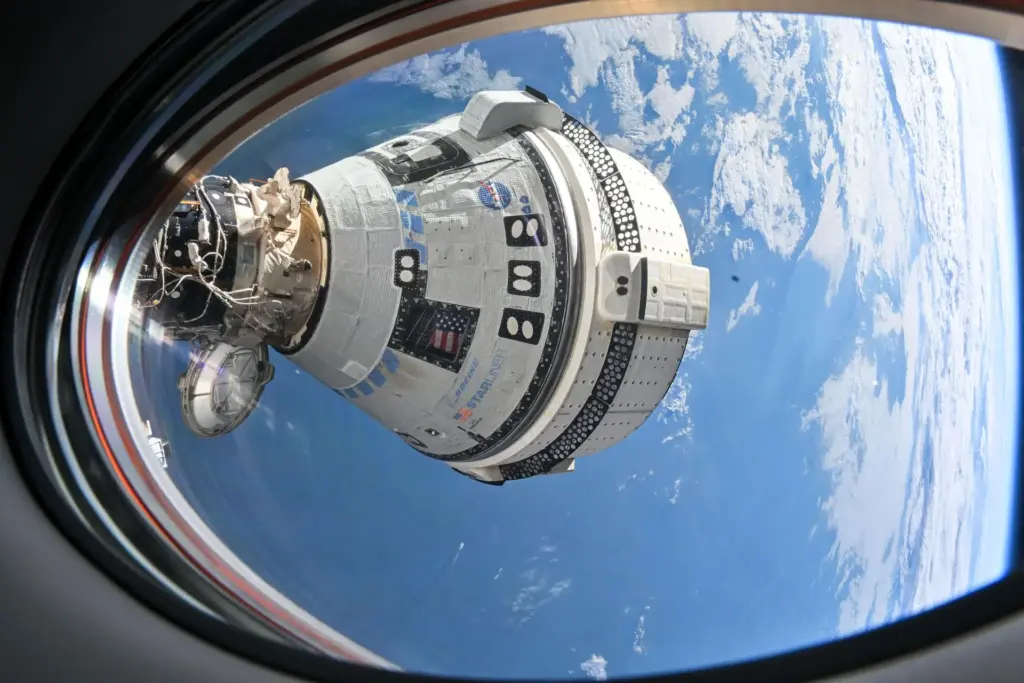
Boeing’s Starliner spacecraft is pictured docked to the Harmony module’s forward port at the International Space Station. Photo credit: NASA
The second mission, Orbital Flight Test 2, took place in May 2022. Because of problems on the previous mission, this spacecraft also flew uncrewed. This flight was more successful, reaching the space station despite some thruster issues.
NASA then spent more than two years testing Starliner on the ground before its first crewed flight in 2024, carrying NASA astronauts Butch Wilmore and Suni Williams, KD5PLB. During its approach to the space station, the Starliner spacecraft once again experienced serious thruster issues. (However, the life-and-death nature of this flight was not revealed until nearly a year later.) Starliner ultimately docked with the station, but after heated deliberations, NASA informed Boeing that the vehicle would return to Earth uncrewed.
As a result, a Dragon mission was launched later in 2024 carrying just two astronauts instead of a full complement of four. This allowed for the safe return of Wilmore and Williams in March 2025.
[ANS thanks Wired for the above information. Read the full article at https://www.wired.com/story/boeings-next-starliner-flight-will-only-be-allowed-to-carry-cargo/.]
ARISS News
Amateurs and others around the world may listen in on contacts between amateurs operating in schools and allowing students to interact with astronauts and cosmonauts aboard the International Space Station. The downlink frequency on which to listen is 145.800 MHz worldwide.
Scheduled Contacts
Due to the holidays, no contacts are scheduled until after the first of the year.
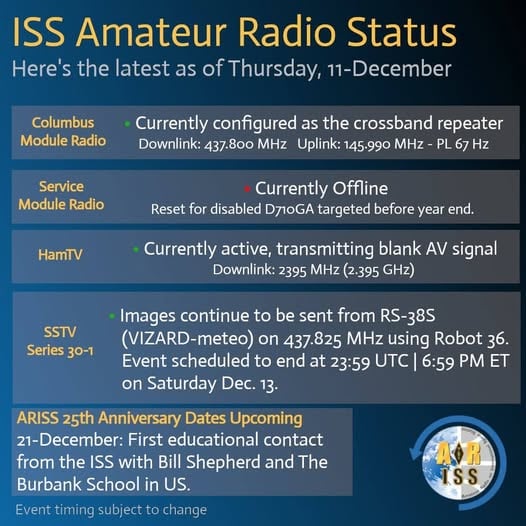
Note, all times are approximate. It is recommended that you do your own orbital prediction or start listening about 10 minutes before the listed time.
The latest information on the operation mode can be found at https://www.ariss.org/current-status-of-iss-stations.html
The latest list of frequencies in use can be found at https://www.ariss.org/contact-the-iss.html
[ANS thanks Charlie Sufana, AJ9N, one of the ARISS operation team mentors for the above information.]
Want to fly the colors on your own grid expedition?
Get an AMSAT car flag and other neat stuff from our Zazzle store!
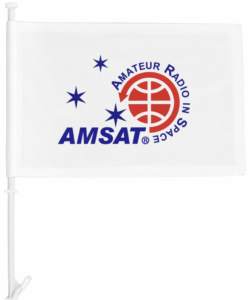
25% of the purchase price of each product goes towards Keeping Amateur Radio in Space
AMSAT Ambassador Activities
AMSAT Ambassadors provide presentations, demonstrate communicating through amateur satellites, and host information tables at club meetings, hamfests, conventions, maker faires, and other events.
None currently scheduled.
Interested in becoming an AMSAT Ambassador? AMSAT Ambassadors provide presentations, demonstrate communicating through amateur satellites, and host information tables at club meetings, hamfests, conventions, maker faires, and other events.
For more information go to: https://www.amsat.org/ambassador/
[ANS thanks Bo Lowrey, W4FCL, Director – AMSAT Ambassador Program, for the above information.]
Satellite Shorts from All Over
+ Earth observation satellite TUBIN of Technical University Berlin, Germany is about to re-enter Earth’s atmosphere in the upcoming days; 16th December +/-1 day. During the orbit decay it is transmitting a telemetry beacon every 10 seconds, including position, attitude, temperatures, etc. via amateur radio UHF band at 435.950 MHz. Researchers would appreciate support of additional radio amateurs listening in and forward the received telemetry data. Further information can be found at https://community.libre.space/t/tubin-tubsat-27-re-entry/13998. As the orbit is decaying quite fast, most recent TLE’s shall be used, which are frequently updated at https://db.satnogs.org/api/tle/?format=3le&norad_cat_id=48900. Any decoded frames, audio recordings or reception reports are very welcome and can be submitted following the instructions in https://community.libre.space/t/tubin-tubsat-27-re-entry/13998. The team at TU Berlin will collect all contributions and can provide specialized TUBIN re-entry QSL cards. Full project overview at https://www.tu.berlin/en/raumfahrttechnik/research/current-projects/tubin. (ANS thanks Steffen Reinert of Technische Universität Berlin for the above information.)
+ SkyRoof, a Windows application for Hams and satellite enthusiasts by Alex Shovkoplyas, VE3NEA, was recently featured on the website of AMSAT-SM, the Swedish amateur radio satellite organization. The article by Lars Thunberg, SMØTGU, may be found at https://www.amsat.se/2025/11/22/skyroof-sdr-satellite-software/. Lars also has an interesting article on setting up a LORA telemetry groundstation at https://www.amsat.se/category/operations/. (ANS thanks AMSAT-SM for the above information.)
+ Similarly, Peter Goodhall, MM9SQL, has developed Zenith, a web-based tracking application. Information at https://zenithtracker.org/. (ANS thanks Peter Goodhall, MM9SQL, for the above information.)
+ AMSAT’s CubeSat Simulator gets excellent reviews, but a budget version is available from the Ukraine for those with access to 3-D printing and a willingness to overcome some bugs and limitations. A YouTube video reviews the project at https://www.youtube.com/watch?v=pvtHcwemfco (ANS thanks @saveitforparts for the above information.)
+ At next year’s World Radiocommunications Conference (WRC-25), governments will face a choice that goes to the heart of how we monitor our warming planet. Some regulators are wondering whether to open part of the X-band — the 8.025–8.4 GHz range used by Earth observation satellites — to 5G and 6G mobile networks. Several major telecom operators have been pushing for this move, arguing that they could use this spectrum more efficiently and pay countries handsomely for the right to do so. Eleven satellite-focused companies have formed the Remote Sensing Collective to resist the change. They’ve done this because the satellites we depend on to understand the environment depend in turn on the X-band. (ANS thanks SpaceNews for the above information. Read the full article at http://bit.ly/44pC8wX.)
+ Last month, Chinese astronauts on board the country’s Tiangong space station discovered cracks in the window of their return vehicle, the Shenzhou-20, which officials suspected were the result of a space debris strike. The spacecraft was deemed not safe enough to return its crew, prompting an orbital game of musical chairs as the China Manned Space Agency (CMSA) launched an emergency uncrewed replacement spacecraft, Shenzhou-22, to the station. Two Shenzhou-21 astronauts embarked on the mission’s first spacewalk on December 9, inspecting and photographing a damaged spacecraft window which triggered an earlier emergency launch. CMSA did not publicize results. (ANS thanks Futurism.com for the above information. Read the full article at https://futurism.com/space/chinese-astronauts-spacewalk-station-damaged-spacecraft.)
+ NASA has lost contact with the Mars Atmosphere and Volatile Evolution, or MAVEN, a spacecraft that has circled the planet for more than a decade, collecting science data and serving as a key communications relay. (ANS thanks SpaceNews for the above information.)
Join AMSAT today at https://launch.amsat.org/
In addition to regular membership, AMSAT offers membership to:
- Societies (a recognized group, clubs or organization).
- Students are eligible for FREE membership up to age 25.
- Memberships are available for annual and lifetime terms.
Contact info [at] amsat.org for additional membership information.
73 and remember to help Keep Amateur Radio in Space!
This week’s ANS Editor,
Mark Johns, KØJM
mjohns [at] amsat.org
ANS is a service of AMSAT, the Radio Amateur Satellite Corporation, 712 H Street NE, Suite 1653, Washington, DC 20002
AMSAT is a registered trademark of the Radio Amateur Satellite Corporation.