March 10, 2016: Today the Amateur Radio on the International Space Station team (ARISS team) proudly celebrated its 1000th school radio contact!
The very first ARISS contact took place in 2000, and Astronaut Tim Kopra, amateur call sign KE5UDN, on the International Space Station (ISS) did the honors for today’s 1000th link-up to the University of North Dakota. Kopra spoke in real time to excited scholars in Grand Forks at the event organized by the North Dakota Space Grant Consortium (NDSGC). An additional program milestone—this was the first amateur radio contact with the ISS that has been hosted in North Dakota.
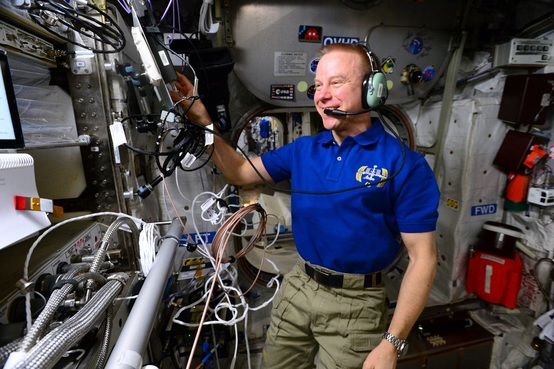
During the 10-minute ARISS contact Astronaut Kopra answered questions formulated by 20 different pupils in kindergarten all the way up to graduate school. A member of the winning 10th grade team from the Space Grant’s high altitude balloon competition last fall was awarded one of the slots to interview Kopra.
An ARISS event is more than the amateur radio contact, and in this case the NDSGC team that included college student volunteers made multiple visits to pupils in the second through fifth grades at Emerado Elementary (Emerado, ND); Highland Elementary (Crookston, MN); Century Elementary (Grafton, ND); Century Elementary (Grand Forks, ND); and Discover Elementary (Grand Forks, ND). The university teams led the young students in hands-on activities and learning about aerospace, priming the youth for the interview with Kopra. The students, many from smaller rural communities, built and launched rockets, crafted and tested parachutes similar to those on NASA’s Orion capsule, and designed and tested neutral buoyant objects.
Students in today’s audience for the 1000th contact numbered 500. TV and newspaper reporters captured the action; the university media team filmed it, and live-streaming was handled by John Spasojevich, amateur radio call sign AG9D.
One student asked Tim, “What advice would you give to students, such as myself, who wish to work for NASA one day?”
Tim advised: “Study very hard and work hard in school because if you do well in school you’ll learn a lot and it’s like money in the bank for you and your future career.” A UND staff member said, “Experiential learning has proven to be the most effective method of knowledge retention, so this [ARISS] experience would grant them [students] the skills necessary to be successful individuals in their future careers. The problem-solving, creativity, and perseverance required by radio communications are cross-disciplinary skills that students can utilize as they enter STEM fields and careers, enhancing the NASA-relevant workforce of North Dakota.”
Frank Bauer, International Chairman for ARISS congratulated the ARISS team on this noteworthy accomplishment: “With the outstanding support of NASA and the International Space Agencies participating in ISS, the ISS on-orbit crew members encompassing all 48 expeditions and the hundreds of ARISS volunteers world-wide, the ARISS team has reached a tremendous milestone: 1000 ARISS contacts between schools on the ground and the ISS crews on-orbit. Since our first contact in December 2000 to today’s contact in North Dakota, hundreds of thousands of students have participated in hands-on STEM learning that ARISS affords and many millions from the general public have witnessed Human Spaceflight in action through an ARISS contact. My congratulations to the ARISS international team and our ARISS stakeholders and sponsors on this phenomenal accomplishment!”
The NASA ISS Program Office produced several videos to celebrate the achievement of ARISS contact #1000, and the first two are online at:
ARISS telebridge station W6SRJ operators Tim Bosma, W6MU, and Don Dalby, KE6UAY, in Santa Rosa, California, skillfully supported the North Dakota ham radio linkup as the ISS passed overhead, relaying astronaut Tim Kopra’s radio signal to the students. Charlie Sufana, AJ9N, the ARISS Mentor from the Radio Amateur Satellite Corporation (AMSAT) and the lead operator for ARISS Contact #1, guided the UND Dakota Student Amateur Radio Association and the FORX Amateur Radio Club in all aspects of the ARISS contact.
Congratulations go to the entire ARISS team on its #1000 successful amateur radio contact with ISS astronauts and cosmonauts!
About ARISS
Amateur Radio on the International Space Station (ARISS) is a cooperative venture of international amateur radio societies and the space agencies that support the International Space Station (ISS). In the United States, sponsors are the Radio Amateur Satellite Corporation (AMSAT), the American Radio Relay League (ARRL), the Center for the Advancement of Science in Space (CASIS) and the National Aeronautics and Space Administration (NASA). The primary goal of ARISS is to promote exploration of science, technology, engineering, and mathematics (STEM) topics by organizing scheduled contacts via amateur radio between crew members aboard the ISS and students in classrooms or informal education venues. With the help of experienced amateur radiovolunteers, ISS crews speak directly with large audiences in a variety of public forums. Before and during these radio contacts, students, teachers, parents, and communities learn about space, space technologies, and amateur radio.
For more information, see the web pages of ARISS, AMSAT , and ARRL .
Join us on Facebook: Amateur Radio on the ISS (ARISS)
Follow us on Twitter: ARISS_status
Contact: David Jordan, AA4KN, ARISS PR – [email protected]